Best Male Anime Characters: My Honest Tier List
My first-person ranking of the best male anime characters, from Guts and Levi to Luffy and Light. See why every S-D pick earns its spot.
Tier Maker Pro 23.5 min read
If I had to name the male anime character I would follow through almost any story, my answer is Guts from Berserk. Not because he wins the most fights, gives the best speeches, or has the cleanest moral compass, but because every chapter of his journey costs him something. I care about what happens to him, and I care about the people he chooses to keep close.
That is the rule behind this ranking. These are some of the best male anime characters in my eyes, but this is not a power-level chart or an attempt to pretend that taste is objective. I am ranking how much I want to keep watching when a character is on screen: whether his scenes have pull, whether his choices feel like they belong to a real person, and whether he leaves me thinking after the episode ends.
Call it a male anime characters tier list built from affection, curiosity, and a few very strong biases. I ranked 22 characters from the 55 included in the Male Anime Characters template. You can disagree with every placement and still use the same template to build your own version.
Quick Answer: My S-Tier Male Anime Characters
My S tier is Guts, Levi Ackerman, Lelouch Lamperouge, Gintoki Sakata, and Shigeo "Mob" Kageyama.
They are not the five most famous names on the internet, and they do not share one personality type. What connects them is staying power. Each one gives me a reason to keep watching that goes beyond a cool design or a single great fight. They make me laugh, worry, wince, or rethink a scene after it is over.
If I could keep only one, I would keep Guts. If I wanted the character I would most trust with a complicated story, I would pick Lelouch. If I wanted the one whose quiet growth hits me hardest, I would pick Mob. That is the kind of tension I want in a ranking.
The Full Ranking: S to D
The short version is below. Each placement gets a proper explanation later in the article.
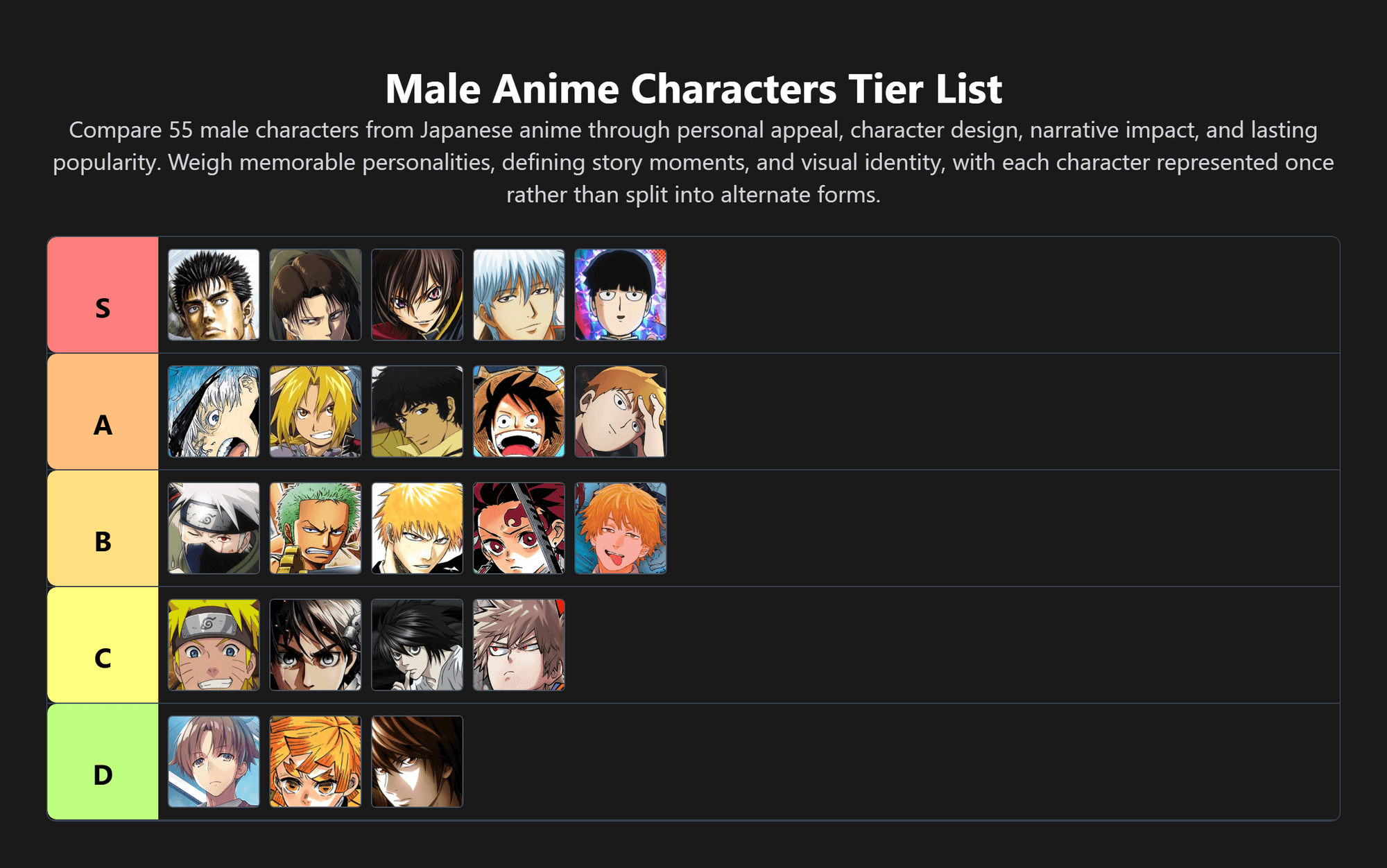
- S tier: Guts, Levi Ackerman, Lelouch Lamperouge, Gintoki Sakata, Shigeo Kageyama. I would follow these characters into almost any story, even when the story hurts.
- A tier: Satoru Gojo, Edward Elric, Spike Spiegel, Monkey D. Luffy, Reigen Arataka. Great company, sharp emotional hooks, and scenes I actively look forward to.
- B tier: Kakashi Hatake, Roronoa Zoro, Ichigo Kurosaki, Tanjiro Kamado, Denji. I like them a lot, but I am not always rushing back for their next arc.
- C tier: Naruto Uzumaki, Eren Yeager, L Lawliet, Katsuki Bakugo. Strong characters with real highs, but also stretches where my attention drifts.
- D tier: Kiyotaka Ayanokouji, Zenitsu Agatsuma, Light Yagami. My least eager rewatches. This is not a claim that they are badly written.
How I Ranked These Top Male Anime Characters
I used four questions, and I let them conflict with one another.
- Do I want to keep watching? A character can be important to the plot and still make me check the episode timer. I want the opposite effect: a scene starts and I forget to check.
- Does the character change how I experience the story? Some characters are fun in isolation but do not alter the emotional temperature of the series. The ones I rank highest make the whole story feel different when they are present.
- Are the choices believable? I do not need a character to be good, sane, or consistent in a simple way. I need his decisions to make sense as part of who he is, even when I hate the decision.
- Does he stay with me? This is the least scientific question and probably the most important. If I remember a line, a look, or a silence weeks later, that character has earned something.
A D tier here means "I am least likely to seek out this character's next scene," not "this character is worthless." A C tier is not a punishment. It usually means the character has a huge reputation and my personal response has not caught up with it.
S Tier: Characters I Would Follow Anywhere
Guts — Berserk
Guts is the character I think of when someone asks what makes a male anime character feel adult without simply making him grim. His anger matters because it grew from loss. His strength matters because it is always attached to a cost. The Black Swordsman design is iconic, but the reason I put him at the top is smaller than that: Guts keeps choosing to move forward even when moving forward is ugly.
The 1997 anime's Golden Age arc is the clearest example of why he works for me. He is not just a swordsman with a tragic backstory. He is a young man trying to work out what a dream means when he has spent his life surviving. The relationships around him complicate his ambition rather than decorate it. When the story turns, I am not watching a plot device suffer. I am watching someone I understand lose something he had only just learned to value.
Why S? Because I do not merely tolerate Guts's darkest scenes. I lean into them. He makes pain feel purposeful in a narrative sense, and that is a rare kind of trust between a character and a viewer.
Levi Ackerman — Attack on Titan
Levi is often reduced to "short, strong, clean." That is a fine joke and a terrible summary. His appeal is control: the way he reads a room, chooses the moment to move, and says the least painful version of the truth only when someone needs it. In a series where everyone is drowning in ideology, Levi is usually focused on the next person he can keep alive.
His relationship with Erwin Smith gives him a different kind of depth. Levi is not simply loyal to a commander or a cause. He is constantly weighing trust against the possibility that he is being used. That tension makes his composure feel active rather than stoic wallpaper. Even his obsession with cleanliness is a useful human detail: it gives his discipline somewhere to go when the world is at its worst.
Why S? Because I trust his scenes. When Levi enters a situation, I do not expect a guaranteed win. I expect a decision that reveals something about him.
Lelouch Lamperouge — Code Geass
Lelouch is the best argument for ranking a character on momentum rather than likability. He is theatrical, arrogant, manipulative, and often more concerned with being the smartest person in the room than with being a good one. I would not want to lend him my car, my secrets, or probably my lunch. I absolutely want to watch him try to out-think an empire.
What makes him more than a smug strategist is the personal wound underneath the performance. His devotion to Nunnally gives the political scheming a center. The series is at its best when his cleverness and his love for his sister pull him in different directions. That is when his grand gestures stop feeling like a magic trick and start feeling like a choice with a bill attached.
Why S? Because no other character on this list makes a conversation feel as dangerous. I can rewatch a scene I know and still enjoy watching him decide which truth to tell.
Gintoki Sakata — Gintama
Gintoki is my favorite reminder that a ranking like this should leave room for laughter. On the surface, he is a lazy odd-jobs owner who wants sweets, avoids work, and commits to a bit with total commitment. Then the serious episodes arrive, and you remember that this man was shaped by war. The comedy does not cancel out the grief. It becomes the shape he gives it.
That balance is hard to pull off without turning into two different characters stitched together. Gintoki works because the same person is visible in both modes. The stubbornness that makes him refuse an easy job is the same stubbornness that makes him defend someone who has nobody else. The ridiculous timing is not a mask over a completely separate hero; it is how he keeps moving through a world that has already asked too much of him.
Why S? Because few characters can make me laugh, then make a joke land with sudden tenderness, then make me sit quietly through a serious episode. When Gintoki is on screen, I never know which version of the show I am about to get, and I like that.
Shigeo "Mob" Kageyama — Mob Psycho 100
Mob is the quietest character in my S tier and the one whose growth sneaks up on me most. He has enormous psychic power, but the story is not really about proving that power deserves respect. It is about a boy who wants to become a better person, even though he is awkward, unsure, and surrounded by adults who are not always reliable role models.
That choice makes his big moments hit differently. When Mob finally expresses something, it does not feel like a power-up button. It feels like a person who has been holding too much inside finally finding a shape for it. His relationship with Reigen matters too, but not because Reigen gives him a perfect answer. It matters because Mob is allowed to grow while still being uncertain.
Why S? Because I would rather follow a character who is learning how to live than a character who is simply proving he can win. Mob makes restraint feel active.
A Tier: Great Company, Slightly Less Pull
Satoru Gojo — Jujutsu Kaisen
Gojo is the character who can walk into a scene and change its energy with a smile. He is funny, vain, and absurdly capable, but the part I keep returning to is his role as a teacher. Beneath the confidence is someone trying to protect a new generation from the failures of the old one. That gives the jokes a shadow.
He is A rather than S because his screen time often feels like an event rather than a continuous emotional journey. I love the event. I am just not always as invested in the quiet person underneath it, partly because the story uses mystery so aggressively. The potential is enormous, which is exactly why I want more of the human part.
Edward Elric — Fullmetal Alchemist
Edward has one of the best complete arcs on this list. His short temper is funny, his intelligence is satisfying to watch, and his devotion to Alphonse gives every risk a clear emotional reason. He is also allowed to be wrong, childish, and genuinely humbled. That range is why he feels alive rather than like a collection of cool alchemy poses.
He lands in A because I admire his arc more than I crave his company. That is a strange distinction, but it matters in a personal ranking. I love watching Edward grow. I rarely finish an episode thinking, "I need more Edward immediately." I more often think, "That was a good story."
Spike Spiegel — Cowboy Bebop
Spike is cool, but the reason he lasts is that the coolness is a little sad. The rumpled suit, the loose posture, and the dry jokes make him look like a man without a plan, while the story keeps revealing how much of his life is still controlled by the past. He is a wonderful mood character: sometimes I want a complicated plot, and sometimes I want to watch Spike drift through a strange job with people who are also avoiding something.
His A placement is partly a length advantage. Cowboy Bebop does not need to sustain him for hundreds of episodes, so every side of him gets room without becoming a formula. I like that economy. It makes me appreciate him, though it does not quite create the long-term attachment I feel toward my S tier.
Monkey D. Luffy — One Piece
Luffy is joy with a stubborn streak. He is not complicated in the way Lelouch or Mob are complicated, but he is not simple either. His refusal to abandon a friend is a real philosophy, and the story keeps testing it against systems that would rather he stay in his lane. When Luffy declares that someone is coming with him, it is funny because he is ridiculous and moving because he means it.
I put him in A because the length of One Piece changes the relationship. There are stretches where I love being in his world and stretches where I want to spend time with almost anyone else in the crew. That is not a knock on Luffy. It is the difference between loving a character and loving the rhythm of a very long journey.
Reigen Arataka — Mob Psycho 100
Reigen should not work. He is a con man, a terrible role model in several measurable ways, and completely powerless in a story full of psychics. Yet he is one of the most emotionally intelligent characters in the show. His best scenes are not about winning a fight. They are about recognizing what Mob needs and saying something that sounds irresponsible until you realize it is exactly the right thing.
He is A because Reigen is best in doses. He can steal a scene, but a whole series of Reigen would probably become exhausting. That is a compliment to his comic precision, not a complaint. He is the rare supporting character who makes the protagonist more interesting without taking the story away from him.
B Tier: I Like Them, I Do Not Always Rush Back
Kakashi Hatake — Naruto
Kakashi is the cool mentor archetype done with real care. He is sleepy, late, and apparently casual, then reveals a sharp understanding of teamwork and loss. His mask and Sharingan make him instantly recognizable, but his best contribution is the way he teaches by making his students confront the parts of themselves they avoid.
Why not higher? Because I often feel like I know what Kakashi is going to do emotionally before he does it. That consistency makes him dependable and a little less surprising over a long series. I still like him a great deal. I just do not feel the same pull to follow his private story as I do with the characters above him.
Roronoa Zoro — One Piece
Zoro is loyalty with a sword. His discipline gives the crew a spine, and his willingness to take on pain for Luffy is one of the clearest expressions of what the Straw Hats mean to each other. The three-sword style is visually distinctive, and the terrible sense of direction is a good comic counterweight to all the seriousness.
He sits in B because his appeal is dependable rather than surprising. I know what I am getting from a Zoro scene: resolve, a dry line, and probably a very impressive cut. That is a good thing. It is just not the same as the emotional unpredictability that pushes my favorite characters higher.
Ichigo Kurosaki — Bleach
Ichigo's best quality is that he does not want to be a chosen one. He wants to protect people. That bluntness gives him a strong initial hook, and his orange hair and oversized sword make him one of the most recognizable designs in anime. When the story leans into his anger as a form of care, he is excellent.
The B placement comes from inconsistency. Some Ichigo arcs make me want to binge; others feel like the story is moving around him while he waits for the next fight. I still think he is a strong lead. I just do not think every phase of his journey makes the most of what makes him interesting.
Tanjiro Kamado — Demon Slayer
Tanjiro is kindness under pressure. His empathy for demons does not make him naive; it makes his kills more painful and his determination more specific. He is trying to save his sister, and every other family he encounters reminds him why that promise cannot be casual. The result is a protagonist whose warmth feels like a stance rather than a default setting.
He is B because the formula can become visible. Tanjiro meets someone, feels their pain, finds the right breath style, and moves on. When the animation and emotional details are strong, it works beautifully. When they are not, I notice the repetition. I like Tanjiro enormously. I just do not think his character has as many unexpected corners as my favorites.
Denji — Chainsaw Man
Denji is messy in a way that feels intentional. His desires are ordinary, his circumstances are awful, and his humor often lands at the worst possible moment. That combination makes him unpredictable. He can be crude, then vulnerable, then genuinely frightening, and the story rarely gives him a clean way to process any of it.
He is B because the mess is both his strength and my limit. I appreciate what Chainsaw Man is doing with him, and I want to see where he goes. But when a character's emotional state is constantly being yanked around, I sometimes need a break from the intensity. Denji earns his place, but he does not make my must-watch list in every mood.
C Tier: Strong Characters With Personal Friction
Naruto Uzumaki — Naruto
Naruto is one of the most important characters in anime for a reason. His loneliness, stubborn optimism, and refusal to give up on people gave a generation a language for wanting to belong. His dream of becoming Hokage is not just a goal. It is a demand to be seen.
He is C because my personal relationship with the series is uneven. The highs are enormous, but the filler, repetition, and long stretches of escalation make it hard for me to stay emotionally close to him all the time. A C placement is not a claim that Naruto is less influential than the characters above him. It means that, today, I am more likely to watch a selected arc than to follow every step of the whole journey again.
Eren Yeager — Attack on Titan
Eren is a character I respect more than I enjoy. His early anger, desire for freedom, and terror of being trapped give the story a powerful engine. Later, his choices become the kind of thing I have to discuss rather than simply watch. That is a compliment to the writing and a challenge to my patience.
I put him in C because the experience of following Eren becomes heavier than the experience of following most characters here. The story earns that weight. I am not always in the mood to sit inside it. I find him fascinating, but fascination is not the same as comfort or eagerness.
L Lawliet — Death Note
L is a fantastic first-encounter character. The hunched posture, the sweets, the blunt questions, and the constant sense that he is testing everyone around him make him instantly memorable. His duel with Light is the reason Death Note's opening stretch is so gripping.
He is C because the pleasure of L is tied to a very specific kind of scene. I love the deduction, but after a while the constant mutual calculation starts to feel airless. L is brilliant in the way a locked room is brilliant: impressive, tense, and not somewhere I want to spend unlimited time.
Katsuki Bakugo — My Hero Academia
Bakugo is a character who grows on me in retrospect more than in the moment. His explosive confidence, tactical intelligence, and refusal to accept second place make him a great rival, and his insecurity gives all that volume something vulnerable underneath. When the story connects his ambition to his fear of being left behind, he becomes much more than the loud kid.
He is C because the loudness wears on me. I understand why he is abrasive, and I appreciate the development. I just do not always want to be in a scene with him. That is a personal tolerance issue, not a judgment on his quality.
D Tier: Not for Me, and That Is Okay
Kiyotaka Ayanokouji — Classroom of the Elite
Ayanokouji is built around deliberate blankness. He presents himself as ordinary, hides his abilities, and lets other people underestimate him. That can be a strong mystery engine, especially when the school's competitions force him to act. I understand why readers and viewers find him compelling.
For me, the blankness is the problem. I can appreciate a character who conceals his emotions, but I need some small doorway into why he is choosing to hide. Without that foothold, his intelligence feels like a remote-control trick rather than a human decision. I do not need him to become warm. I need him to become specific.
Zenitsu Agatsuma — Demon Slayer
Zenitsu has one of the most striking contrasts in modern shonen: a terrified, noisy young swordsman who becomes terrifyingly composed when he falls asleep. The idea is strong, and his Thunder Breathing attacks are genuinely beautiful. I also understand why his fear makes him relatable.
I put him in D because I struggle with the delivery. The screaming is meant to be funny, and for some viewers it is. For me, it swallows too much of his screen time and makes the quieter, more vulnerable parts harder to enjoy. When the story gives him a moment of sincerity, I like him. I just do not want to wait through the volume to get there.
Light Yagami — Death Note
Light is a great character to argue about and a difficult character to spend time with. His polished public life, private arrogance, and belief that he can decide who deserves to live make him a fascinating portrait of power curdling into certainty. The early cat-and-mouse story is still one of anime's best psychological thrillers.
He is D because "fascinating" is not the same as "enjoyable to follow." Once Light settles into his god complex, I find his inner monologue less revealing than L's strange questions. I want to see what happens. I do not necessarily want to hear him explain why he is right one more time. That is a strong reaction to a strong character, just not a flattering one in a ranking built on my viewing appetite.
My Most Controversial Choices
The choice I expect to cause the most disagreement is Light Yagami in D. He is iconic, central, and responsible for some of the most quoted moments in anime. I am not pretending otherwise. But this is not a historical importance list. When I imagine a rewatch, I am more excited to spend time with Reigen's terrible advice than with Light's certainty.
The second is Mob in S over Gojo. Gojo is the flashier pick and probably the easier crowd-pleaser. Mob is quieter, more awkward, and less immediately impressive. That is exactly why he stays with me. He makes the case that a character does not need to dominate every scene to dominate my memory.
The third is Naruto in C. I know how much he means to people. I grew up with the same kind of attachment to characters who were not technically the strongest or the coolest. My ranking is not trying to erase that history. It is simply saying that, right now, I am more interested in characters whose stories I can revisit without carrying the weight of a very long commitment.
If your list looks completely different, good. That is what a male anime characters ranked list should do: start an argument with a specific point of view.
Which Male Anime Character Should You Watch First?
It depends on what you want from anime, not on which character has the biggest fanbase.
- If you want the emotional and physical weight of a classic dark fantasy: Start with Guts and the 1997 Berserk adaptation. Check content warnings first; it is not a light watch.
- If you want a stylish, self-contained mood piece: Start with Spike Spiegel and Cowboy Bebop. It is a great entry point if you want something cool without a hundred-episode commitment.
- If you want to see why a quiet character can be the center of a loud world: Start with Mob and Mob Psycho 100. It is funny, warm, and surprisingly emotional.
- If you want a complete adventure with a clear emotional arc: Start with Edward Elric and Fullmetal Alchemist: Brotherhood. The character growth is easy to recommend even when the worldbuilding gets complicated.
- If you want a long journey with room for found family and absurd humor: Start with Luffy and One Piece. Go in knowing that the scale is part of the appeal, not a detour from it.
- If you want a psychological duel more than a traditional hero: Start with L and Death Note. The early episodes explain the appeal best.
If you are new to the anime tier list templates on Tier Maker Pro, I would begin with one show you already know. Ranking familiar characters makes it easier to notice what you actually value. You can also compare this list with the popular anime girls ranking and see whether your taste changes depending on the cast.
Frequently Asked Questions
Who is the best male anime character?
In my ranking, Guts from Berserk takes the top spot. His story combines physical struggle, emotional damage, and a stubborn will to keep moving. Levi, Lelouch, Gintoki, and Mob are also in my S tier because they give me a similar long-term pull for different reasons.
Is this an objective ranking of the top male anime characters?
No. This is a personal male anime characters tier list based on how much I want to keep watching each character and how strongly his scenes affect me. Popularity, power, and historical importance matter to the conversation, but they are not the only criteria.
Why did Light Yagami rank below Naruto and Bakugo?
Because this is not a quality ranking. Light is a brilliantly designed antagonist and one of anime's most recognizable figures. I simply find his later scenes less enjoyable to revisit than Naruto's emotional peaks or Bakugo's growth. A different viewer could put Light in S without being wrong.
Why are only 22 characters included in this article?
The Male Anime Characters template contains 55 options. I chose 22 who fit the article's argument and could each receive a meaningful explanation. The ranking image uses the same 22 characters and the same tiers as the article.
Can I make my own male anime characters tier list?
Yes. Open the template, drag the characters into your own S-to-D order, and export a PNG when you are happy with it. You can also start from a blank board on the tier list maker if your personal lineup does not match the existing template.
Final Thoughts: My Best Male Anime Characters
My favorite male anime characters are not the ones with the largest power scaling debates or the most merchandise. They are the ones who make me forget I am watching a ranking exercise and pull me back into the story. Guts makes me care about endurance. Levi makes me respect restraint. Lelouch makes me enjoy a terrible idea. Gintoki makes me laugh before he breaks my heart. Mob makes me believe that growing as a person can be the most interesting superpower of all.
That is my honest, slightly biased best male anime characters list. If you think I got it wrong, build your own list and defend it. The best part of a tier list is not reaching agreement. It is finding out what you actually care about when you have to put the names on the board.