2026–27 Champions League Club Power Rankings
Explore our 2026–27 Champions League club power rankings, comparing 36 teams by squad quality, recent form, tactical strength, and title-winning potential.
Tier Maker Pro 11 min read
All 36 Clubs Tiered by Squad, Coaching, Money and Pedigree (Updated October 29, 2026)
You are not asking "who played well last Tuesday." You are asking: "Who is actually going to win this thing, and who is just making up the numbers?"
That question has never been more interesting. PSG are chasing a third straight title after beating Arsenal on penalties in the 2026 final. Pep Guardiola is gone from Manchester City, and Enzo Maresca is in charge. José Mourinho is back at Real Madrid with Mbappé fresh off a World Cup Golden Boot. Liverpool have a new manager, Manchester United have made Michael Carrick permanent, and Arsenal are the reigning Premier League champions.
So I built a simple template and ranked all 36 clubs by six factors:
- Squad quality (stars and the strength of the starting eleven)
- Depth (can they survive injuries and an eight-game league phase?)
- Coaching and tactics (stability, identity, big-game record)
- Spending power (can they keep reinforcing?)
- Champions League pedigree (knockout experience)
- Domestic strength (how tough is their league week to week?)
If you disagree with a placement, good. That is exactly why I made this a template. Change the weights, try your own version, and tell me where I went wrong.
The Quick Version: Tier List at a Glance
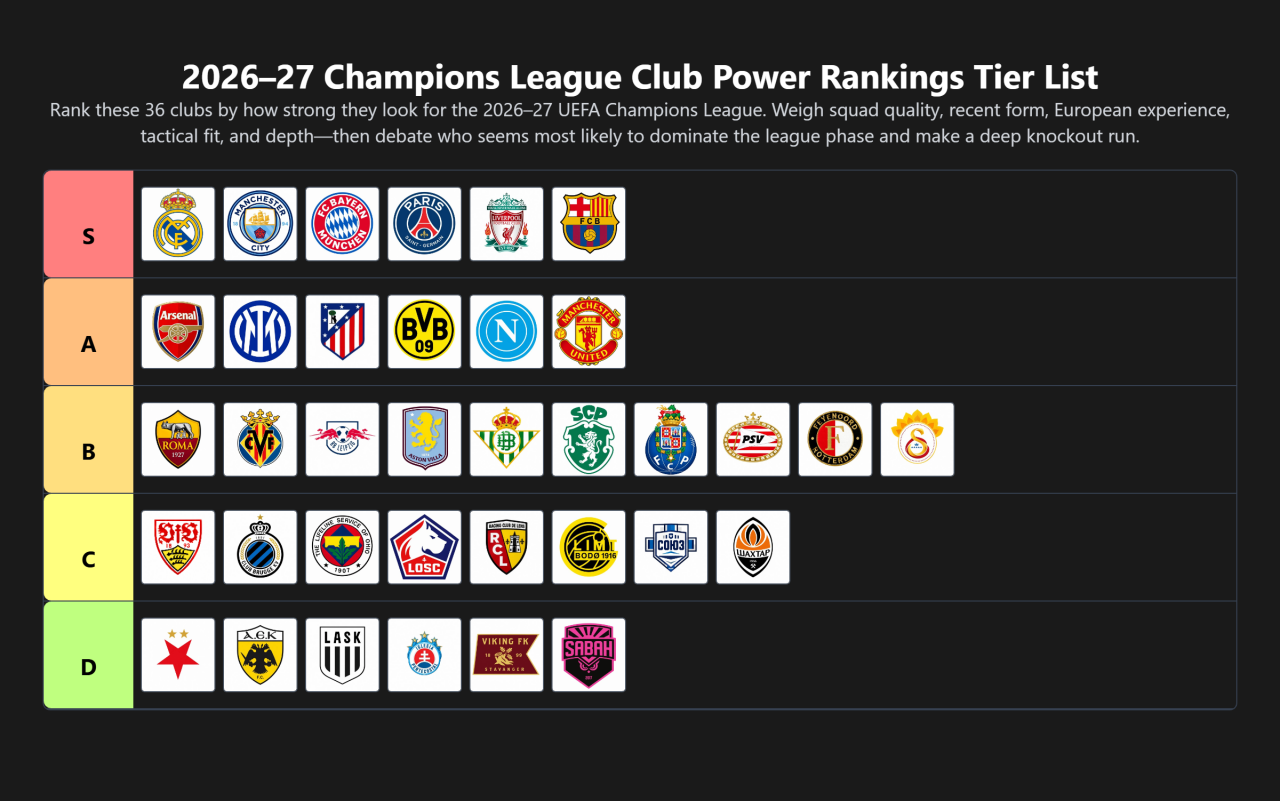
- S Tier · Title Favorites: Real Madrid, Manchester City, Bayern Munich, PSG, Liverpool, Barcelona |
- A Tier · Semi-Final Contenders: Arsenal, Inter Milan, Atlético Madrid, Borussia Dortmund, Napoli, Manchester United |
- B Tier · Safe Through the League Phase, Knockouts Are a Coin Flip: AS Roma, Villarreal, RB Leipzig, Aston Villa, Real Betis, Sporting CP, FC Porto, PSV Eindhoven, Feyenoord, Galatasaray |
- C Tier · Domestic Overachievers: VfB Stuttgart, Club Brugge, Fenerbahçe, Lille OSC, RC Lens, Bodø/Glimt, Como, Shakhtar Donetsk |
- D Tier · Likely Bottom-Half Finishers: Slavia Prague, AEK Athens, LASK, Slovan Bratislava, Viking FK, Sabah FK |
S Tier · Title Favorites
Europe's highest-investment squads and the clubs that live in the knockout rounds year after year.
1. Real Madrid
- Pedigree: The record-holder with 15 European Cups. No club handles the two-legged tie, the late goal and the big-night pressure better.
- Squad: Mbappé arrives after winning the World Cup Golden Boot, with Vinícius Júnior and Bellingham alongside him. The front line has the highest ceiling in the competition.
- Coaching: Mourinho's return is a big story. He has a history of getting results in two-legged ties, but the question is whether his structure can fit three star attackers.
2. Manchester City
- Squad and depth: Still one of the deepest squads in Europe. They can rotate through an eight-game league phase without a sharp drop in quality.
- Spending power: Few clubs can reinforce as freely, which protects them when injuries hit.
- Coaching: The big unknown. Maresca replaces Guardiola after a decade-long era, and a new tactical system takes time. That is the only real reason City are not ranked even higher.
3. Bayern Munich
- Domestic strength: Years of Bundesliga dominance give them a steady rhythm and confidence.
- Squad: A blend of elite attackers and a strong core. Bookmakers have them near the top of the market, and the club is widely seen as resurgent.
- Pedigree: Six European Cups and the experience to handle knockout nerves. The main risk is defensive stability against fast transitions.
4. Paris Saint-Germain
- Pedigree: The reigning champions and the team trying for a third straight title. They beat Inter 5–0 in the 2025 final and won the 2026 final on penalties against Arsenal.
- Coaching: Luis Enrique has built a pressing, collective system where the team is stronger than any individual. That is rare for a club with PSG's budget.
- Why not #1 here: Winning three in a row is historically brutal, and squad fatigue after back-to-back runs is real.
5. Liverpool
- Squad: A strong attacking line with the quality to beat anyone on a good night.
- Coaching: A new manager, Andoni Iraola, takes over after Arne Slot's exit. His high-energy style suits European football, but the first season of a new system is always a risk.
- Weakness: Defensive consistency. Good attacks win league-phase games, but knockout ties punish loose defending.
6. Barcelona
- Young core: Lamine Yamal leads one of the most exciting young groups in the competition. The ceiling is very high.
- Style: A high line and attacking football make them a threat to everyone, and a target for counters.
- Pedigree gap: Strong pedigree but limited recent knockout success. Bookmakers still rank them among the leading contenders.
A Tier · Semi-Final Contenders
Regular domestic title challengers with real depth. They can beat an S Tier side on a good night.
7. Arsenal
- Form: Reigning Premier League champions and 2026 Champions League finalists, so the team has proven it can go deep.
- Why A, not S: They lost the final on penalties, and the squad has less depth and knockout history than the very top clubs.
- Domestic pressure: A tough defence of the league title may stretch the squad over the winter.
8. Inter Milan
- Pedigree: Finalists in 2023 and 2025, so they know how to build a deep run.
- Tactics: A well-organised, experienced side that is hard to break down.
- Concern: The 5–0 final loss in 2025 showed a gap against the very best, and an older squad can struggle with the workload.
9. Atlético Madrid
- Identity: A defence-first, disciplined team that is uncomfortable to play against in two legs.
- Domestic strength: La Liga's top three keep them sharp every week.
- Limit: They do not usually have the attacking depth of the S Tier.
10. Borussia Dortmund
- Recruitment: One of Europe's best clubs at finding and developing young talent.
- Pedigree: Finalists in 2024, and capable of beating anyone at home.
- Limit: Consistency. They can be brilliant one night and uneven the next.
11. Napoli
- Domestic strength: A top Serie A side with a strong, physical and organised style.
- Squad: Quality in the first eleven, but the bench is thinner than the clubs above.
- Risk: Managing a double workload of league and Europe.
12. Manchester United
- Spending power: The financial muscle and star attackers to match anyone on paper.
- Coaching: Michael Carrick, a club legend, is now the permanent manager, so the project is still young.
- Why A, not higher: Inconsistency is the issue, and the market treats them as a long shot rather than a favorite.
B Tier · Safe Through the League Phase, Knockouts Are a Coin Flip
Strong national contenders with quality players, but without the depth of the top clubs.
13. AS Roma
Passionate home support and strong individual quality, but limited financial room compared with the Premier League clubs.
14. Villarreal
A technical, well-coached side with plenty of European experience. They are dangerous in a single game, but the squad is shallow.
15. RB Leipzig
Athletic, aggressive and well-drilled, with a reliable recruitment model. Without a true superstar, they can hit a ceiling.
16. Aston Villa
One of the most improved clubs in Europe thanks to strong coaching, smart recruitment and Premier League investment. Their step up in class is the question.
17. Real Betis
A technical, attacking team and one of La Liga's most entertaining sides. Depth is limited, so injuries hit hard.
18. Sporting CP
Excellent at developing players and playing positive football. The squad is often rebuilt when stars are sold.
19. FC Porto
A famous European name with a history of upsets. The club's finances limit how much it can keep or buy.
20. PSV Eindhoven
A very good domestic side that plays attacking football. The Dutch league is weaker, so the step up to Europe is big.
21. Feyenoord
Passionate and energetic, with a strong youth system. Depth is the main weakness.
22. Galatasaray
A strong domestic budget and a huge home atmosphere in Istanbul. Away form and tactical discipline often decide their results.
C Tier · Domestic Overachievers
Capable of a surprise at home, but usually outclassed at this level.
23. VfB Stuttgart
Smart coaching and a young, fast side from a strong Bundesliga. The squad is not built for a long European run.
24. Club Brugge
A reliable Belgian champion with a good scouting model. Limited by league strength.
25. Fenerbahçe
A big club with big support and real Turkish-league investment. Consistency is the main issue.
26. Lille OSC
A well-run club that sells players to stay sustainable. Rebuilds make it difficult to progress.
27. RC Lens
Loud support and good organisation, but they lack the budget to compete with Europe's elite.
28. Bodø/Glimt
A fascinating side with a strong team identity and an artificial pitch in a cold climate. They have a record of upsetting bigger names, but the depth is limited.
29. Como
An ambitious, heavily invested project with a possession-based identity. The most interesting rising club on this list. The ranking reflects experience, not potential.
30. Shakhtar Donetsk
Technical players and a strong tradition, but operating under difficult circumstances limits the squad's stability.
D Tier · Likely Bottom-Half Finishers
Newcomers and clubs from smaller leagues. Taking part is the achievement.
- 31. Slavia Prague: A well-organised Czech champion, but a big gap in squad quality and depth.
- 32. AEK Athens: Passionate home crowd and decent Greek-league investment, though the squad is not built for this level.
- 33. LASK: An aggressive, pressing side from the Austrian league that can cause problems for slower teams.
- 34. Slovan Bratislava: A domestic champion with the smallest budget in the competition's weaker group.
- 35. Viking FK: Ambitious and brave, but a small-market club in its first big European campaign.
- 36. Sabah FK: The least experienced side in the field. Every point here is a bonus.
Two Questions You Are Probably Asking
Q1. Can PSG really win a third straight Champions League?
A. Yes, they are the team most likely to, but it is historically very hard.
PSG have the strongest recent record, a coach with a clear system, and a squad that works as a unit. Bookmakers also make them the market favorite. But repeating three times is brutal: fatigue, injuries and rivals who have studied them all add up. That is why I put them 4th in the S Tier, not 1st. The experience of Real Madrid and the depth of Manchester City carry more weight in a long knockout run.
Q2. Is Manchester City still S Tier after losing Guardiola?
A. For now, yes, but it is the most fragile S Tier spot.
The squad, depth and spending power are still elite. What is different is the tactical identity. Maresca is an excellent coach, but changing a system that worked for ten years takes time. If the team clicks early, City are title favorites. If it doesn't, they could slide. That is why this is the biggest swing placement in the whole ranking.
FAQ
Who is the favorite to win the 2026–27 Champions League?
PSG head most betting markets as the holders, with Arsenal, Bayern Munich, Barcelona, Manchester City and Real Madrid close behind. In my ranking, the S Tier clubs are the main contenders.
Why does your ranking differ from the betting odds?
Betting markets price in value and public opinion. This ranking focuses on squad depth, coaching, spending power and knockout history. Both are useful, and the gaps between them are where the interesting debates are.
How does the league phase work?
All 36 teams play eight matches. The top 8 go straight to the round of 16, teams in 9th–24th play in the knockout playoffs, and everyone else is out.
When is the final?
The final is on June 5, 2027. The quarter-finals are in April 2027 and the semi-finals follow at the end of April and the start of May.
Who is the favorite for the top scorer?
Kylian Mbappé is widely favored after his World Cup Golden Boot, though Real Madrid's new setup under Mourinho could change how goals are shared.
Will this ranking be updated?
Yes. I will update it after major results, injuries and managerial changes, so bookmark this page.
Final Takeaways
- Real Madrid and PSG are the two clubs I would least want to face in a knockout tie.
- Arsenal, Inter and Atlético are the A Tier teams most likely to take down an S Tier side.
- Manchester City's new era is the biggest unknown of the season.
Do you agree with the tiers? Tell me which club you would move up or down, and try the template with your own criteria. I will update this list as the season develops.
Information based on UEFA competition details and pre-season and early-season reports as of October 29, 2026.