F1 Drivers Ranked 2026: Post-Vegas Tier List
After Las Vegas, Kimi Antonelli is champion and Mercedes have the constructors' crown. See my 15-driver 2026 tier list and the P2 fights still live.
Serena 9 min read
Updated November 26, 2026 after the Las Vegas Grand Prix.
The 2026 Formula 1 drivers' championship is no longer a live mathematical fight. Kimi Antonelli leaves Las Vegas with 402 points, 98 clear of Max Verstappen with only 50 points left on the table. Mercedes have also wrapped up the constructors' title with 666 points, 149 ahead of Ferrari.
That changes the job of this ranking.
My original August tier list was built around who could win the title. This version asks a cleaner question: how should the 2026 field be judged now that the championship outcome is settled? I am weighing race results, pace, execution, consistency across the season and how each driver performed relative to the car underneath them.
This is not the official championship order, and it is not a ranking of raw talent alone. It is my post-Vegas verdict on the 15 drivers who defined the season most clearly.
Quick answer: the 2026 F1 picture after Las Vegas
- Drivers' champion: Kimi Antonelli, 402 points
- Closest challenger: Max Verstappen, 304 points
- Third in the standings: Lewis Hamilton, 267 points
- Drivers P4 on the road to Qatar: George Russell and Lando Norris, both on 264
- Constructors' champion: Mercedes, 666 points
- Next race: Qatar Grand Prix, Lusail International Circuit, November 29 local time
The Las Vegas result was a Max Verstappen statement. He won from Lando Norris by 0.639 seconds, with Oscar Piastri third, Antonelli fourth and Pierre Gasly fifth. It was the kind of controlled, low-margin victory that has defined Verstappen's peak years, even if the championship math had already moved beyond him.
Antonelli did not need to win in Nevada. He needed to avoid disaster, score consistently and keep a season-long advantage intact. Fourth place did exactly that. The title is the reward for the complete body of work, not for one spectacular weekend.
The post-Vegas F1 tier list
Here is the selected 15-driver ranking used in this article:
- S-tier: Kimi Antonelli, Max Verstappen
- A-tier: Lando Norris, Lewis Hamilton, George Russell, Charles Leclerc
- B-tier: Oscar Piastri, Isack Hadjar, Liam Lawson, Pierre Gasly
- C-tier: Fernando Alonso, Carlos Sainz, Alex Albon, Gabriel Bortoleto
- D-tier: Lance Stroll
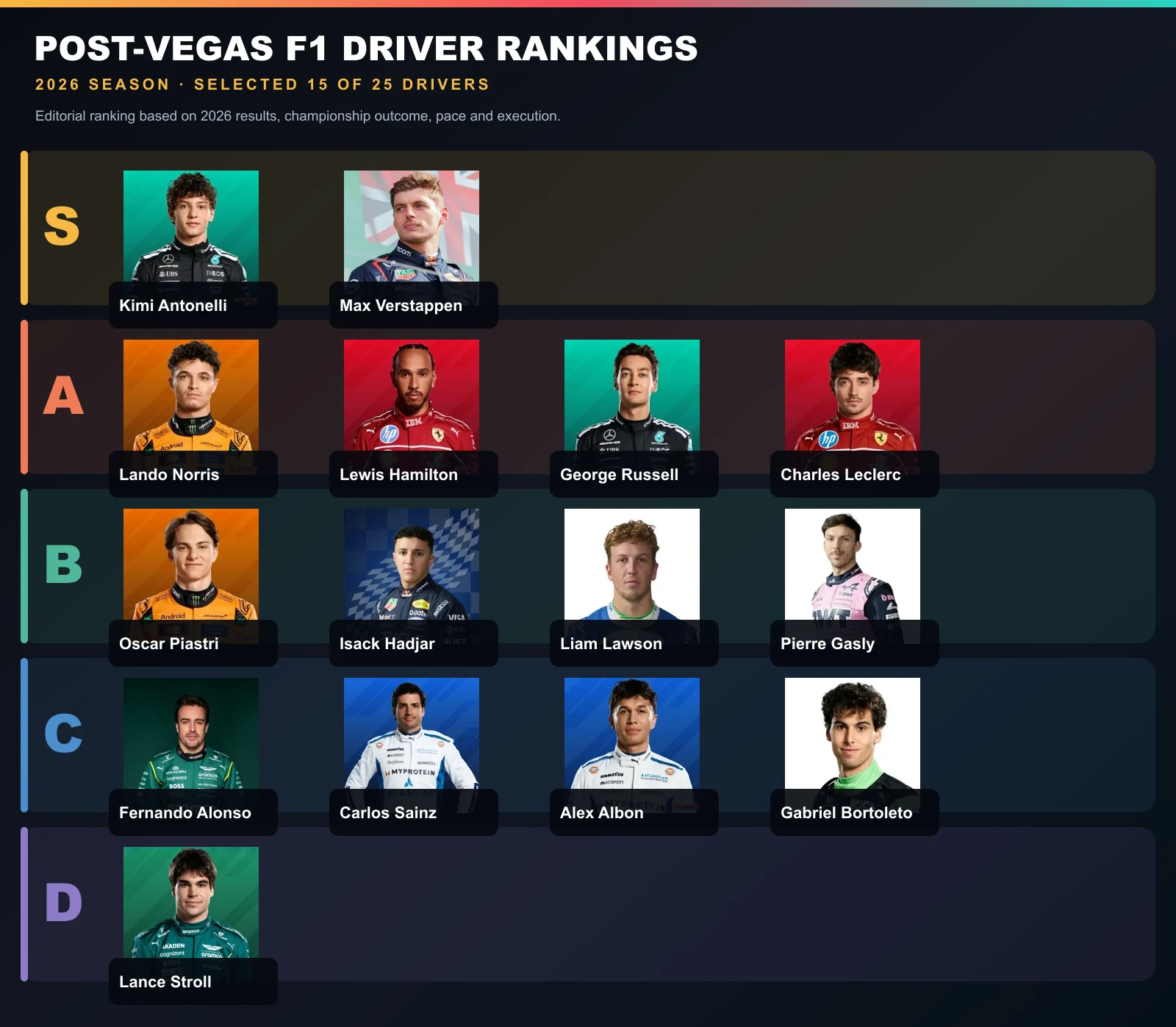
The template now contains 25 official 2026 season participants, including substitute drivers. This graphic deliberately uses a smaller 15-driver sample so the ranking remains readable and focused on the stories that mattered most.
S-tier: the champion and the season's benchmark
Kimi Antonelli belongs at the top because he turned exceptional pace into a championship season. His speed was never the question. The decisive improvement was his ability to bank points when the car was not perfect, avoid unnecessary losses and keep the title race under control across the second half of the year.
Max Verstappen stays alongside him despite finishing second. His Las Vegas win was a reminder that, race by race, he can still be the most complete driver on the grid. The gap in the standings reflects the season as a whole, not a lack of top-end performance. When the car gave him a window, he punished everyone.
The distinction matters: Antonelli owns the 2026 title, while Verstappen remains the driver most rivals would still pick for one race in equal machinery.
A-tier: elite seasons with one missing piece
Lando Norris was part of the title conversation for much of the year and ended Las Vegas on the podium. He has the one-lap speed and racecraft to beat anyone, but the championship requires that level almost every weekend. His 264 points leave him level with Russell and only three behind Hamilton, which says more about how crowded the top six became than about a lack of quality.
Lewis Hamilton produced the most important personal response of the season. After a difficult first Ferrari year, he became a consistent front-running threat again. Hamilton's 267 points put him third and make the final two races relevant: he is defending a narrow advantage in the drivers' standings rather than merely playing out the calendar.
George Russell had the speed to make the title conversation uncomfortable at times. His qualifying ceiling is among the highest on the grid, and 264 points puts him level with Norris. The remaining question is not whether he can produce a brilliant weekend, but whether he can stack 20 of them without the occasional scoreless detour.
Charles Leclerc remains one of the cleanest single-lap performers in F1. His best races combined aggression with precision, and 250 points keeps him close enough to the top group to make every Ferrari weekend meaningful. The gap to the leaders is less about raw pace than about converting every promising Friday into a complete Sunday.
B-tier: strong seasons and clear momentum
Oscar Piastri is the hardest driver to place. Third in 2025 and a proven race winner, he entered 2026 with title expectations. His 167 points tell the story of a season that never quite caught fire, even if the underlying speed remained obvious. B-tier is not a verdict on his ceiling; it is a verdict on the 2026 results.
Isack Hadjar was one of the season's most useful measuring sticks. A second-year driver sharing a garage with Verstappen has nowhere to hide, and 122 points is a serious return. His qualifying speed and willingness to attack have made him more than a promising name.
Liam Lawson delivered the kind of midfield season that teams value. There were points finishes, a standout Monaco result and enough adaptability to suggest he belongs in F1 on merit rather than reputation. His 89 points are a fair reflection of a driver getting more from a difficult package than the final table always shows.
Pierre Gasly continues to be the reliable leader Alpine needs. A Las Vegas top-five finish was the highlight of a campaign that also brought 52 points. Gasly is not a title contender in this car, but he is exactly the sort of driver who keeps a midfield team moving forward.
C-tier: useful seasons without enough top-end evidence
Fernando Alonso remains a driver opponents respect, but the 2026 Aston Martin package rarely gave him the platform to show it for long. Seven points is a thin return for a driver of his quality. His racecraft is still visible; the results are not.
Carlos Sainz brought structure and technical feedback to Williams, and his 11 points reflect a team still searching for consistency. There were weekends where his experience maximised the package, but not enough of them to move him into the next tier.
Alex Albon remains a dependable benchmark in difficult cars. Five points understates some of his defensive work and qualifying performances, yet this ranking is based on the season's visible output. Williams needed more from the car around him.
Gabriel Bortoleto has shown the speed and aggression expected from a highly rated young driver. Fourteen points is a useful first step, but this season was about learning how to turn flashes into repeatable results. The next step is cleaner weekends rather than another spectacular highlight.
D-tier: a season that did not come together
Lance Stroll ends the selected ranking in D-tier because the year produced zero points and too few competitive weekends. Aston Martin's overall form is part of the explanation, but a teammate comparison still matters. The season needs a reset, not a new narrative pretending the results were better than they were.
What is still worth following
The two championships are gone, but the remaining races are not empty.
First, the fight for second in the drivers' standings is real. Verstappen has 304 points, Hamilton has 267, and Russell and Norris are tied on 264. A poor weekend from any one of them can change the final top four. Leclerc is also close enough at 250 to make the last two rounds uncomfortable.
Second, the constructors' order behind Mercedes still matters. Ferrari have 517 points, Red Bull 440 and McLaren 431. The gap between Red Bull and McLaren is only nine points, so the final two rounds can decide who finishes third. For teams, that position changes prize money, winter momentum and how the season is remembered internally.
Third, Qatar will create a different kind of test. Lusail's long, flowing corners and the mandatory tyre-lap limit make this less of a straightforward pace contest. Strategy, track position and clean execution will matter.
Build your own 2026 driver ranking
The F1 Drivers 2026 tier list includes the full 25-driver season list, including the substitute drivers who appeared during the year. You can rank all of them or focus on a smaller group.
For a quicker debate, I set up a 10-driver challenge built around the same post-Vegas question: who has the strongest 2026 case? The editor's order is already loaded, but you can reset it and make your own.
Play the 2026 F1 driver ranking challenge
For the next race specifically, read the full Qatar Grand Prix 2026 track guide and winner tier list.
FAQ
Did Kimi Antonelli win the 2026 F1 title? Yes. After Las Vegas, Antonelli had 402 points and a 98-point lead with only two conventional race weekends remaining. The championship was therefore mathematically decided.
Did Mercedes win the 2026 constructors' championship? Yes. Mercedes had 666 points to Ferrari's 517, with a maximum of 86 points still available for a two-car team across Qatar and Abu Dhabi.
Why does this ranking include only 15 drivers? The full 2026 template includes 25 official season participants, but this graphic highlights the 15 drivers most relevant to the title fight, the top-team picture and the biggest season stories. Keeping the image to 15 makes the tier comparison easier to read.
Why are there 25 drivers if F1 has 22 full-time seats? The 2026 template is a season-participant ranking, not just a full-time grid list. It includes drivers who made official race appearances as substitutes during the year.
Is this the same as the official championship standings? No. The points are official, but the tier list is editorial. It weighs performance, execution and context rather than simply copying the points table into different colours.
What should readers watch in Qatar? The drivers' P2 fight, the constructors' battle between Red Bull and McLaren, and how teams manage Lusail's mandatory two-stop tyre rules. Those are the most meaningful live stories left in the season.