Netflix Original Series Tier List: 16 Shows Ranked
Dark or Stranger Things? Compare 16 Netflix original series across S–D tiers, with clear reasons for each pick and a template to rank your favorites.
Tier Maker Pro 12.5 min read
Dark earns the top spot in this Netflix Original Series tier list because its puzzles serve a painful family story. Arcane, The Queen's Gambit, and The Haunting of Hill House join it in S tier: four very different shows that make their distinctive styles matter to their characters.
The harder decisions come below them. Stranger Things has extraordinary ensemble chemistry, while MINDHUNTER can make an interview more unsettling than an action sequence. Both have a strong claim to the top row. This ranking gives greater weight to sustained storytelling and emotional payoff than to a show's biggest scene.
These are 16 selections from the 38-show Netflix Original Series template, with reasons for each placement. They are editorial judgments, rather than viewing statistics or an official Netflix ranking. Premises are discussed below; major twists and endings are left unrevealed.
Quick Answer: The Netflix Original Series Tier List
- S — Exceptional storytelling: Dark, Arcane, The Queen's Gambit, The Haunting of Hill House.
- A — Strong recommendations with reservations: MINDHUNTER, BEEF, Squid Game, Stranger Things.
- B — Worth watching, with more uneven stretches: The Crown, Ozark, Sex Education, Money Heist.
- C — Distinctive strengths, less consistent storytelling: Wednesday, Bridgerton, The Witcher.
- D — The weakest overall payoff in this selection: The Umbrella Academy.
Order within a tier reflects a slight preference, not a measurable difference. D is relative to these 16 selections, and an omitted show has not been assigned a low score.
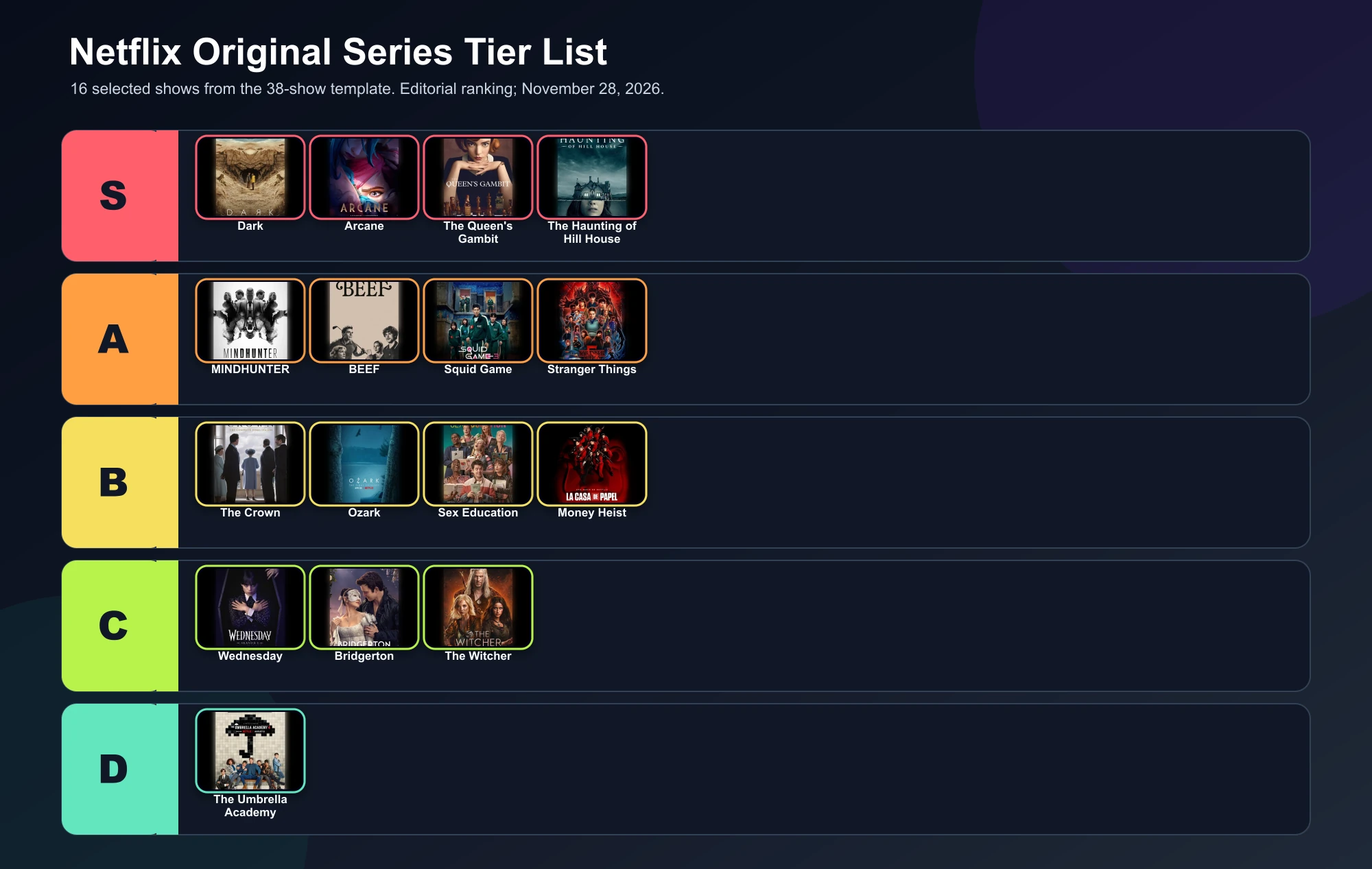
Editorial ranking of 16 selected shows from the 38-show template. Image assembled locally using template assets.
What Counts, and How the Shows Are Judged
This article follows the template's Netflix-branded selection, which includes live-action series, animation, limited series, and acquired shows continued by Netflix. It is not a catalogue of everything available on the service. Money Heist needs that distinction: Antena 3's original premiere announcement documents its Spanish television debut before its later Netflix run. Calling every entry a Netflix production from its first episode would be misleading.
The editorial scope is material released by November 28, 2026. Future seasons receive no credit or penalty. Series are considered across their released runs, rather than quietly substituting a favorite opening season; BEEF is treated as an anthology, not as a single continuing feud.
Four questions guide the placements:
- Do character decisions drive the story? A reversal matters more when it grows from someone's loyalties or weaknesses.
- Does the structure reward attention? Complexity should deepen the story, rather than merely delay an explanation.
- Do the major arcs earn their payoff? A powerful beginning carries less weight if later developments weaken its consequences.
- Does the show deliver its own kind of pleasure? Romance, comedy, animation, and horror deserve to be judged on what they attempt.
No fixed numerical formula can settle those questions. The useful part is applying them consistently enough to explain why one show sits above another.
S Tier: Four Different Ways to Earn the Top Row
1. Dark
Dark turns a disappearance in the German town of Winden into a story about time, inheritance, and the damage families pass on. Its strongest quality is the connection between its machinery and its emotions: understanding how events fit together changes what a relationship means.
That puts it first here. Its complexity gives earlier scenes new weight, rewarding attention beyond the satisfaction of solving a puzzle. The reservation is accessibility. Names, generations, and relationships demand concentration. If effortless viewing is your priority, Dark may belong below a more immediate favorite; on structural ambition and payoff, it leads this selection.
2. Arcane
Arcane builds its conflict around sisters Vi and Jinx and the unequal cities of Piltover and Zaun. Its animation communicates tension through posture, expressions, color, and the physical distance between characters. The spectacle often carries information that another show would deliver through explanation.
The later escalation can feel crowded, especially when intimate conflicts share space with larger struggles over power. Even so, its visual identity remains tied to emotional stakes. That is the reason for S tier. Familiarity with League of Legends can add context, but the sisters' competing needs provide a clear human point of entry.
3. The Queen's Gambit
Beth Harmon's chess career gives The Queen's Gambit a clean outward trajectory, while ambition, dependence, and isolation complicate her progress. The tournament scenes work because winning and losing mean something beyond a change in standing.
The limited-series format is an advantage it uses well. Supporting encounters feed Beth's development, and the narrative stays focused on what success can and cannot repair. Compared with the sprawling worlds around it, the show offers a more contained commitment. It earns its place by making a specialized pursuit legible as a character story, without requiring the audience to understand every move on the board.
4. The Haunting of Hill House
Hill House follows the Crain family across childhood and adulthood, letting conflicting memories turn a haunted house into a source of continuing family tension. Its horror has force because the siblings carry different versions of the same history.
The shifting perspectives are especially valuable: another character's account can change the meaning of an earlier scene. The emotional explanations sometimes become more explicit than the quietest scares require, which keeps it fourth here. Nevertheless, the relationship between form and subject is unusually strong. It belongs beside the other S-tier entries because its frightening images help tell the family story, rather than interrupting it.
A Tier: Excellent Reasons to Start, Clear Reasons to Debate
5. MINDHUNTER
MINDHUNTER follows FBI investigators developing criminal profiling through interviews with murderers. Conversations become contests over language, control, and what the investigators believe they can understand. Holden Ford, Bill Tench, and Wendy Carr give those encounters different professional and personal stakes.
Its restraint makes it a strong alternative to crime shows built around pursuit. The reservation is closure: its two-season run leaves continuing threads without the comprehensive resolution offered by the strongest completed stories above it. Viewers who value scene-by-scene tension over a finished larger arc could reasonably move it into S. This ranking keeps that distinction visible.
6. BEEF
BEEF finds drama in people turning private dissatisfaction into conflict. Its opening road-rage story follows Danny and Amy; its second season moves to a new cast and a country-club blackmail conflict. Across the anthology, resentment becomes a way for characters to avoid confronting their own insecurity.
That engine earns A tier. Small decisions can accumulate into disproportionate consequences while uncomfortable humor keeps the characters from becoming simple moral examples. The reservation is the strain of escalation: as retaliation expands, plausibility can matter less than intensity. For a viewer who prefers sympathetic company, its deliberately abrasive personalities may also make it a difficult recommendation.
7. Squid Game
Squid Game makes familiar children's games terrifying by placing indebted contestants inside a lethal competition. Its most important tension lies in the alliances: survival and compassion can demand incompatible choices, giving simple rules a personal cost.
It ranks below BEEF here because the broader machinery of the competition can draw attention away from the intimate relationships that make it compelling. That is a trade-off, rather than a denial of its suspense. Its strongest case for S is the clarity with which a game exposes someone's priorities. Its A placement reflects a preference for stories that sustain that character focus more consistently across their run.
8. Stranger Things
Stranger Things gives supernatural danger an emotional base in friendship, family, and the small town of Hawkins. Its ensemble makes the adventure inviting: disagreements and loyalties supply reasons to care before the threat becomes enormous.
The same expansion that creates memorable combinations of characters also divides attention among more storylines. On a whole-series ranking, scale and momentum do not automatically outweigh the tighter focus of an earlier mystery. A tier recognizes the show's character chemistry while giving the more concentrated storytelling above it the edge. If attachment to an ensemble is your main criterion, this is an easy candidate to promote.
B Tier: Strong Hooks, More Uneven Returns
9. The Crown
The Crown dramatizes the tension between royal duty and private desire across Queen Elizabeth II's reign. Its changing casts make the passage of time visible, and scenes of protocol can turn a restrained exchange into a struggle over authority.
B tier reflects the uneven dramatic opportunities of such a broad historical span. Some conflicts make the institution feel painfully personal; others create more distance from the people inside it. It is a richer choice for viewers drawn to performance and political ritual than for those wanting a tightly connected plot. Its historical setting should also be read as dramatization, not documentary evidence.
10. Ozark
Ozark's money-laundering premise forces the Byrde family to treat immediate danger as a practical problem. Marty and Wendy's different responses keep the domestic conflict connected to their criminal arrangements, giving negotiations weight beyond the transaction itself.
Its pressure is effective, but relentless danger can make a new crisis feel like another turn of the same mechanism. That repetition limits its place here. Compared with MINDHUNTER's quieter uncertainty, Ozark pushes harder for momentum. Choose it when you want compromised people making urgent decisions; move it higher if sustained tension matters more to you than variation in the story's rhythm.
11. Sex Education
Sex Education starts with Otis using knowledge absorbed from his therapist mother to advise fellow students. The central irony is productive: being able to explain a relationship problem does not mean being equipped to handle your own.
Its warmth comes from allowing embarrassment, friendship, and vulnerability to coexist. The challenge is the expanding ensemble, which gives more experiences attention while making the overall focus less steady. B tier rewards its character empathy and comic premise while acknowledging that unevenness. For viewers who prize recognizable emotional mistakes over elaborate plotting, it could comfortably sit above several A-tier dramas.
12. Money Heist
Money Heist pits the Professor's plans against the unpredictability of his crew, hostages, and police negotiators. Its appeal lies in the collision between a carefully designed scheme and people who cannot behave like pieces on a board.
That creates propulsive reversals, but repeated surprises can make the plan seem protected by the storytelling. The question becomes whether a twist reveals convincing preparation or simply rescues the situation. B tier captures both sides. It is an engaging choice for ensemble melodrama and cliffhangers, with a lower placement for viewers who need each tactical development to survive close scrutiny.
C Tier: Appealing Identities, Less Persuasive Overall Arcs
13. Wednesday
Jenna Ortega's deadpan performance gives Wednesday an immediate center. Nevermore Academy supplies a setting where her refusal to accommodate other people produces both comedy and friction.
The distinction is between a compelling central presence and an equally compelling mystery. The surrounding investigations do not always give relationships the same specificity as Wednesday's manner and reactions. C tier reflects that gap. If gothic atmosphere and a distinctive lead are your priorities, it is likely to outperform this placement on your own board.
14. Bridgerton
Bridgerton builds romantic tension through courtship, gossip, family obligations, and the risk of public embarrassment. Its costumes and social occasions help make desire visible within a setting full of rules.
Its placement comes from how often delayed communication prolongs an emotional obstacle. Anticipation can be pleasurable, but it can also hold characters in place after the conflict is clear. That reservation concerns the execution of romantic tension, rather than the value of romance as a genre. Viewers who enjoy the prolonged courtship itself have a sound reason to place it much higher.
15. The Witcher
The Witcher is strongest when Geralt's work brings a concrete moral problem into view: dealing with a creature becomes inseparable from understanding the people around it. Yennefer and Ciri broaden the stakes beyond those encounters.
As political and magical storylines expand, the relationships can lose momentum to the work of connecting the world. That balance keeps it in C here. The monster-hunting premise remains distinctive, but a satisfying larger fantasy story needs its characters' choices to organize the lore. Viewers primarily seeking combat, creatures, and an expansive setting may weigh those strengths differently.
D Tier: The Sharpest Drop Between Premise and Payoff
16. The Umbrella Academy
The Umbrella Academy has a strong foundation in the Hargreeves siblings: unusual powers sit alongside resentment, affection, and the consequences of a damaging upbringing. Their inability to cooperate gives even a world-threatening problem a family dimension.
The reservation is cumulative. Repeated timeline disruptions and renewed catastrophes can weaken the sense that an earlier choice will continue to matter. For this ranking's emphasis on lasting consequences, the overall payoff does less to justify that repetition than the shows above it. D still leaves room to enjoy its personalities and absurdity; it records the largest gap between an appealing setup and a satisfying whole.
Three Placements Worth Arguing About
MINDHUNTER below S depends on how much closure should matter. Someone ranking the quality of individual scenes could move it above several completed series without contradicting the reasoning here.
Stranger Things below Dark separates attachment from construction. Hawkins offers more immediately inviting company; Winden demands more work and gets greater credit here for what its structure accomplishes.
Bridgerton in C is the clearest test of personal weighting. If romantic anticipation is the experience you came for, the delay criticized above may be part of the reward. A useful tier list makes that difference discussable.
For a comparison built around another television catalogue, the HBO Original Series tier list provides a related debate about memorable peaks and complete runs.
Make a Ranking That Reflects What You Value
Start with the shows you know well enough to explain. Leave unfamiliar titles unranked, or give them a separate “Not watched” row. Low placement should mean disappointment with something you have assessed, rather than lack of familiarity.
Then choose a consistent scope: entire released runs, or only the seasons you have watched. Label that choice before sharing. A first-season favorite and a whole-series judgment can produce different boards, and both can be useful when their boundaries are clear.
Finally, compare the two shows on either side of each tier boundary. Name the specific reason one belongs higher. If your reason changes from “better character development” to “I like the costume design” halfway through, decide whether that reflects your priorities or an inconsistent standard.
Keep this article's placements, reverse them, or build a custom tier list around your own criteria. The strongest result is a board whose choices you can explain, with enough room for someone else to disagree.