Pixar Movies Ranked: All 31 Films in a SABCD Tier List
We ranked all 31 Pixar movies from Toy Story to Toy Story 5 in S-to-D tiers. See which films made S-tier, which fell to D, and tell us where we got it wrong.
Tier Maker Pro 18 min read
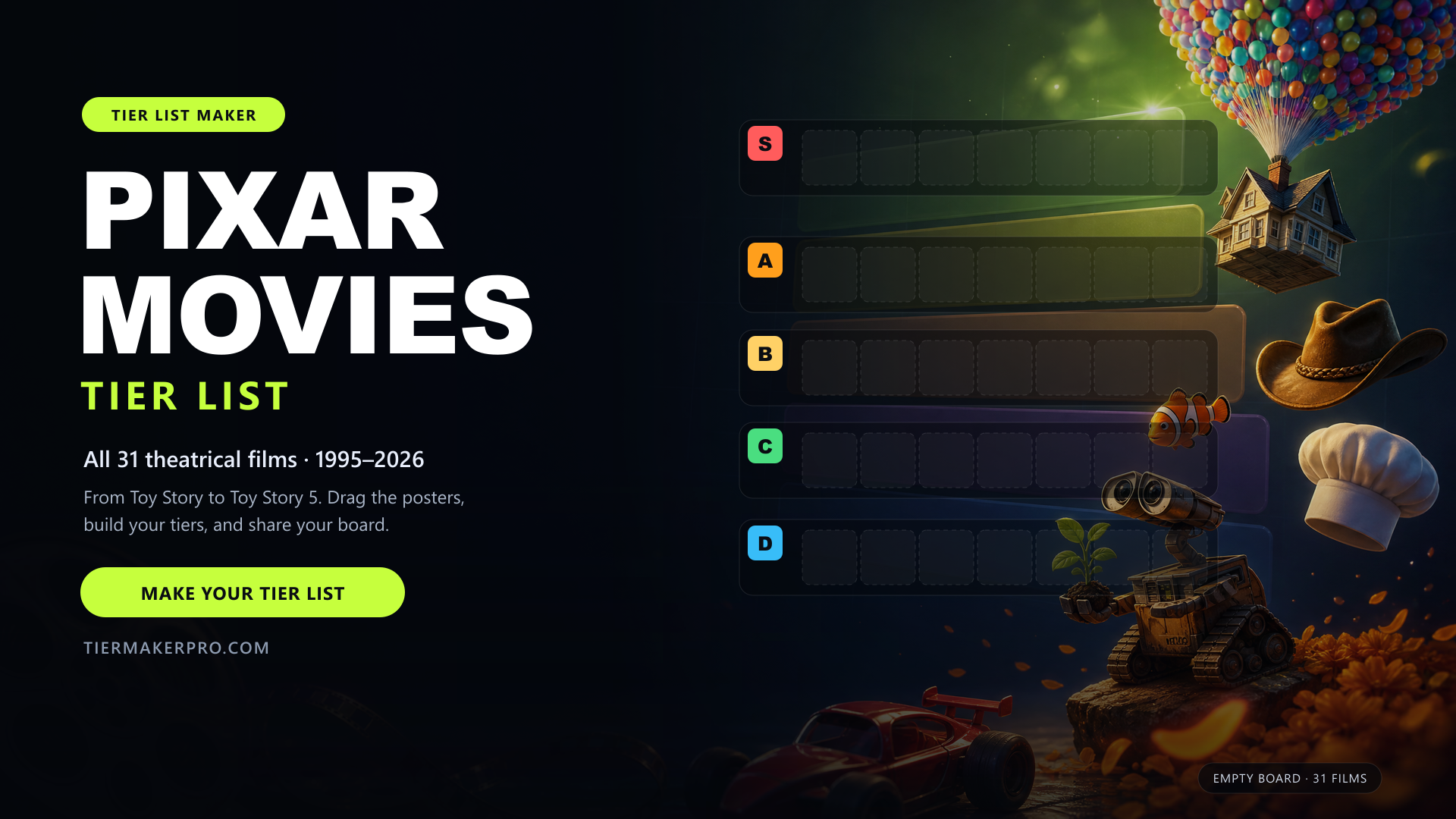
Be honest: when Toy Story 5 opened with a franchise-record $312 million worldwide, did you also start arguing with your friends about which Pixar movie is actually the best? I did. Then I tried to settle it, and ended up ranking every Pixar movie ever made, from Toy Story (1995) to Toy Story 5 (2026).
It has been a loud year for Pixar. Hoppers opened to $88 million globally, the best start for a Pixar original since Coco. Toy Story 5 then became the studio's biggest event since Inside Out 2. Meanwhile, Elio is still the film people point to when they ask whether Pixar lost its touch, and the July layoff news made everyone wonder what comes next.
So here is my Pixar movies ranked list, made with a tier list template I put together myself. It is my list, and some placements will annoy you. Good. That is the point. Scroll to the end, build your own, and tell me where I got it wrong.
The Quick Version: Pixar Tier List at a Glance
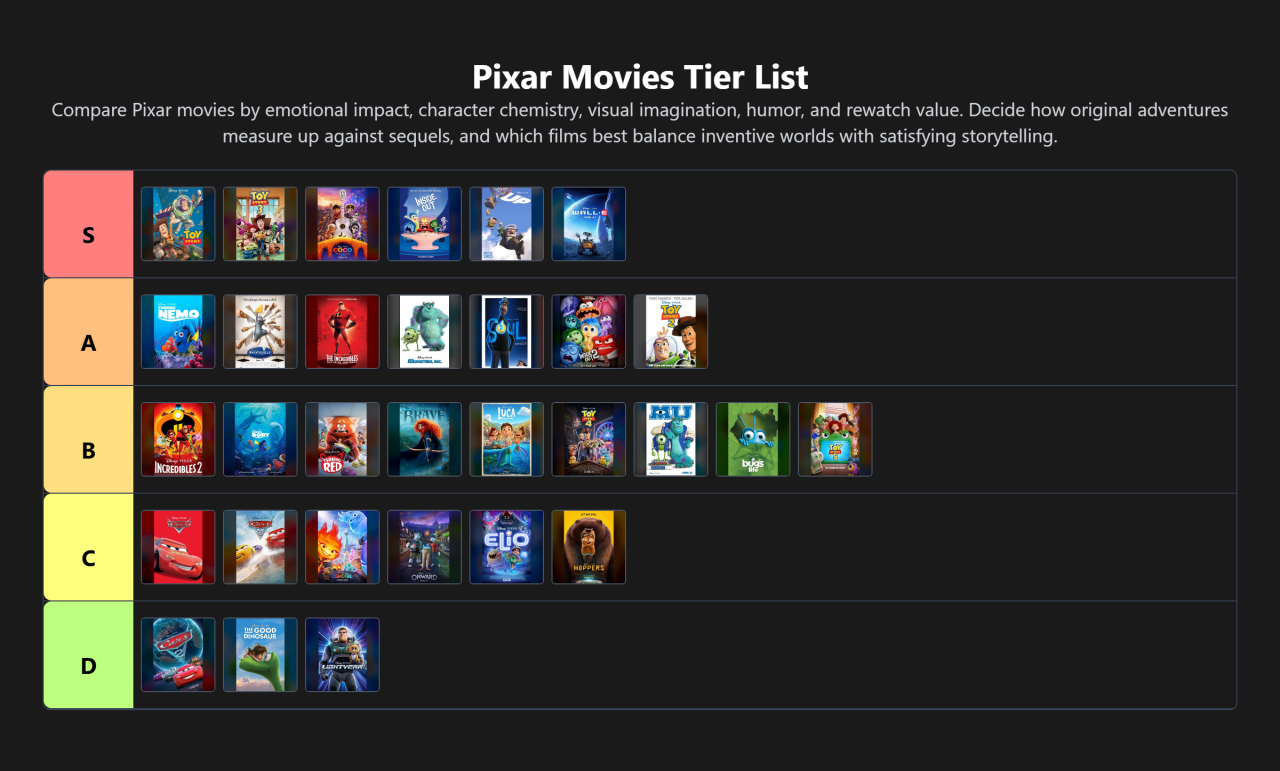
- S Tier (Masterpieces): Toy Story, Toy Story 3, Coco, Inside Out, Up, WALL-E
- A Tier (Strong Picks): Finding Nemo, Ratatouille, The Incredibles, Monsters, Inc., Soul, Inside Out 2, Toy Story 2
- B Tier (Good, With Flaws): Incredibles 2, Finding Dory, Turning Red, Brave, Luca, Toy Story 4, Monsters University, A Bug's Life, Toy Story 5
- C Tier (Easy to Forget): Cars, Cars 3, Elemental, Onward, Elio, Hoppers
- D Tier (Pixar's Low Points): Cars 2, The Good Dinosaur, Lightyear
How I Ranked Them (The Three Tests)
Before the reasons, here is the yardstick. Every film got the same three questions, and the tier comes from how it answered all three, not just one.
- The story test: Does the plot hold together, and does the film have something to say beyond "here is a fun adventure"? Pixar at its best makes a simple idea carry real weight.
- The heart test: Did it actually get to me? Pretty animation is easy now. A scene that makes a whole room go quiet is rare.
- The rewatch test: Would I put it on again, and would I still be talking about it a year later? This is the test that separates S from A, and A from B.
What decides the tier in practice: S films pass all three with room to spare. A films pass all three but have one visible soft spot. B films pass two. C films pass one, usually just the craft. D films struggle with the story test itself. Box office and awards were not part of the math.
S Tier: The Pixar Masterpieces
What these six share is that none of them has a weak act, and each one has a scene people can describe from memory years later.
S Tier Movies and Why They Made It
Toy Story (1995) The first fully computer-animated feature film, and the surprise is that the technology is not the reason it still works. The story is a jealousy plot between Woody and Buzz that grows into real friendship, and it is built on one clean idea: a toy's whole purpose is to be loved by a kid. That gives every joke and every chase an emotional reason to exist. It passes the rewatch test easily, because the script is so tight that nothing feels like filler even decades later.
Toy Story 3 (2010) The incinerator scene is the famous moment, but what makes it work is the hour of setup before it. The toys face their worst fear, being outgrown, and the film lets them face it honestly. Then the ending hands Andy's toys to Bonnie in a way that feels like a real goodbye to childhood, for the characters and for the people who grew up with them. It closes a trilogy without cheating, which is very hard to do.
Coco (2017) Coco takes a cultural tradition, Día de los Muertos, and treats it with care rather than using it as decoration. The music matters to the plot, not just to the soundtrack: "Remember Me" means something different each time it returns, and the last time is the one that breaks people. The film is really about memory and family, and that theme pays off in a way few animated films manage. It won the Oscars for Best Animated Feature and Best Original Song, but the better evidence is how many viewers talk about the ending first.
Inside Out (2015) This one turned an abstract idea, that sadness has a purpose, into a story a child can follow. The best moment is Bing Bong's sacrifice, because it makes the film's argument without explaining it. The clever part is that kids enjoy the adventure while adults get the emotional lesson underneath. It also changed how families talk about feelings, which is a bigger legacy than most films ever have.
Up (2009) The opening montage tells a whole marriage in a few minutes with almost no dialogue, set to Michael Giacchino's score, which won an Oscar. Everything that follows, the balloons and the talking dogs, is funnier and lighter because we already know what Carl lost. The adventure then turns out to be about letting go of a promise that had become a burden. Plenty of people argue the first ten minutes are better than the rest, and that is a fair criticism, but the rest is still strong.
WALL-E (2008) The first half is a nearly silent love story between two robots, led by Ben Burtt's sound design rather than words. That is a huge risk for a family film, and it pays off because the characters feel alive through movement alone. The second half carries a sharper message about consumption and the planet without turning into a lecture. It is the most confident Pixar film in how little it explains.
A Tier: Great Films, Just Short of Perfect
Each of these is a film I would happily rewatch. The difference from S is one visible soft spot: a slow stretch, a weaker half, or an idea that is bigger than its execution.
A Tier Movies and Why They Made It
Finding Nemo (2003) It opens with one of Pixar's darkest first scenes, and that loss gives Marlin's overprotectiveness a real reason. The underwater world is vivid, and Dory is one of the best sidekicks the studio ever wrote. The reason it is not S is the middle, which works as a series of episodes and loses a little drive. Still, the theme, that a parent has to learn to let go, hits everyone who has raised a kid.
Ratatouille (2007) A rat who wants to cook sounds like a bad pitch and plays like a great film. Brad Bird gives it a clear message, "anyone can cook," and then complicates it honestly through Anton Ego's review near the end, which is one of the best pieces of writing in any Pixar film. It also makes food look so good that it is hard to watch hungry. The only soft spot is the human romance, which is thinner than the rat story.
The Incredibles (2004) Brad Bird's superhero movie works as a family comedy first. The idea that a hero has to hide his gifts in a world that rewards mediocrity gives the film both laughs and a point of view. Edna Mode is one of the great side characters in animation. It sits in A because the final act leans on a standard villain plot, but the first two thirds are sharp.
Monsters, Inc. (2001) The world is original, a city powered by children's screams that turns out to run better on laughter, and that reversal is the clever centre of the story. Sulley and Mike are a great pair, and Boo gives the film its heart. It gets a lot of emotional mileage from a toddler who barely speaks. It is not S because it plays a little smaller than the very best.
Soul (2020) Pete Docter's film asks what makes a life meaningful, and the answer, that a spark is not a purpose, is a genuinely interesting idea. The jazz music, led by Jon Batiste, and the score by Trent Reznor and Atticus Ross won the Oscar and give the film a distinct sound. The visuals of the "Great Before" are some of Pixar's most inventive. I keep it in A because its philosophy can feel heavy for younger viewers, and the body-swap section is less moving than the ideas around it. This is one I expect to be argued with on.
Inside Out 2 (2024) Adding Anxiety was the right call, because it gave the sequel something new to say about growing up. The film was a huge hit, and it connected with many viewers who felt anxious themselves. It is not S because the structure follows the first film closely, so some of the surprise is gone. Even so, it is a rare sequel that adds to the original rather than repeating it.
Toy Story 2 (1999) This film was reportedly planned as a direct-to-video project before it became a theatrical sequel, and it ended up better than almost any sequel of its time. Jessie's backstory, with Sarah McLachlan's song, is one of Pixar's most affecting sequences. It also deepens the series' main question, whether a toy is better loved by a kid for a few years or kept forever on a shelf. The A rating comes from a middle that is more of a caper than the first film's tight story.
B Tier: Good Movies With Real Flaws
B-tier films pass two of the three tests. Most have one big idea that works and one that does not, which is why they are fun to watch once and harder to rewatch.
B Tier Movies and Why They Landed Here
Incredibles 2 (2018) Putting Elastigirl in the lead was a smart choice, and Jack-Jack's scenes are some of the funniest in the studio's catalogue. The action is slicker than the first film. The problem is the main villain plot, which is easy to guess and thinner than the family drama that made the original special.
Finding Dory (2016) Dory's memory loss gives the film real emotional weight, especially when her parents come back into the story. Hank the octopus is a fun addition. The film follows Nemo's structure closely, though: a lost fish, a journey, a reunion. It feels like a very good echo rather than a new idea.
Turning Red (2022) This is one of Pixar's most specific and personal films, set in Toronto in 2002 and built around Mei's puberty-as-red-panda metaphor. It is funny, brave, and has a style that is different from anything else in the catalogue. The first half is very sharp. The second half becomes more conventional, and the resolution is less surprising than the setup deserved.
Brave (2012) A mother-daughter story with a clear emotional centre, and beautiful Scottish landscapes. The production had a well-known director change midway through, and the story sometimes feels like it was reshaped. The curse plot is more a device than a theme, so the film hits the heart test but only partly the story test.
Luca (2021) A warm, sunny summer film set on the Italian Riviera with a lovely friendship between two sea monster boys. It has very few real stakes, which makes it relaxing, but also easy to forget. It is a comfort movie rather than a classic, and I mean that kindly.
Toy Story 4 (2019) The animation is beautiful, Forky is a brilliant idea, and Bo Peep's return gives the film a strong new angle. Where it loses me is the ending, which changes what Toy Story 3 had finished. If you love the trilogy as a complete story, this film feels like an addition that reopens a closed door. Plenty of people love it, and I do understand why. More on this below.
Monsters University (2013) A charming campus comedy with a fun theme, that you can try your hardest and still not be the best. The trouble is that it is a prequel, and we already know how Mike and Sulley end up. That takes away tension, so it never quite justifies its existence beyond being pleasant.
A Bug's Life (1998) A smart early Pixar film with a strong premise: a colony of ants stands up to the grasshoppers who bully them. It has good comic characters and a classic underdog structure. It is overshadowed by what came next, and its characters are less memorable than the studio's later leads.
Toy Story 5 (2026) Critics were generous, with a 94% Rotten Tomatoes score at launch, and the franchise-record opening shows how much people wanted to go back to these characters. I put it in B for now for a simple reason: a new release always feels better in the moment than it does after a few rewatches. The rewatch test is the one it has not yet taken. This is the film most likely to move up on my list.
C Tier: Easy to Forget
C-tier films usually pass only the craft test. The animation is good, but I would struggle to retell the story or name a scene that stayed with me.
C Tier Movies and Why They Fell Short
Cars (2006) The look of Radiator Springs is lovely, and Paul Newman's performance as Doc Hudson gives the film a quiet emotional note. The main story, a hotshot racer learning humility, is familiar, and the film is slow in the middle. It is a fan favourite and a merchandising giant, but that is not the same as being a great story.
Cars 3 (2017) A real improvement on the second film, with a more thoughtful story about Lightning McQueen getting older and a good new character in Cruz Ramirez. It earns a solid C because it returns to what made the first film work. It is still a sports comeback story that does not reach the emotional level of Pixar's best.
Elemental (2023) The world of Element City is gorgeous, and the immigrant-family theme feels sincere. The romance between Ember and Wade is sweet. But the rules of the world, how fire, water, and the rest actually live together, have holes that distract from the story. The visuals are S-tier, but the writing is not.
Onward (2020) The idea of a fantasy world that forgot its magic is clever, and the brothers' relationship rings true. The ending, where the film is really about Barley rather than the dad they came to find, is its best moment. The middle of the quest, though, feels uneven and the world-building is underused.
Elio (2025) An interesting premise about a lonely kid who ends up representing Earth to the stars, with real emotional ideas about belonging. It never found its audience, and it became a big part of the conversation about whether Pixar was losing its touch. I think it deserves more credit than its box office suggests, but it did not leave me with a scene I would bring up later.
Hoppers (2026) Critics loved it, and it passed $370 million worldwide, which makes it a real success for a Pixar original. I put it in C on a first impression, mainly because I have not given it a rewatch yet. The rewatch test is exactly where a new film has the least evidence, so I am ready to be talked out of this one.
D Tier: Pixar's Low Points
D-tier films fail the story test itself. The craft is still Pixar-level, but the film does not know what it is trying to say.
D Tier Movies and Why They Landed at the Bottom
Cars 2 (2011) This is the film that pushed Mater from sidekick to lead and turned a gentle small-town story into a spy comedy. Mater works in small doses, but carrying a whole movie exposes the joke. For years it was the weakest-reviewed Pixar film, and the tone clash between slapstick and spy violence is a big reason.
The Good Dinosaur (2015) The landscapes look almost photographic, and that is the best thing about it. The story, a boy and his human pet, is simple to the point of being thin, and the production was known to have gone through a director change. It came out the same year as Inside Out, which makes it feel even slighter by comparison.
Lightyear (2022) The setup is clever: this is supposed to be the movie Andy saw as a kid. But Buzz in this film is a different character from the toy we love, and the gap between the title and what you expect is what hurt it. It is a well-made sci-fi film that does not give Toy Story fans what the name promised.
Two Questions You Will Probably Ask
Q1: Why is Toy Story 4 only in B tier?
Answer: It comes down to the ending. Toy Story 3 finished the story: Andy grew up, the toys went to Bonnie, and it felt complete. Toy Story 4 is well made and funny, with a great new character in Forky, but it changes the meaning of that goodbye by sending Woody somewhere new. That is a bold choice, and I respect it, yet it makes the trilogy feel less final.
Here is the test I used: if I rewatched the series in order, would I want to stop at three? I would. That does not make the fourth film bad, it makes it a very good film that did not need to exist. Plenty of people love it, and a tier list is about taste, so this is the placement I most expect to hear about.
Q2: Hoppers has a 96% score. Why is it in C tier?
Answer: A critics' score tells you how many reviewers liked a film around release. A tier list is about how it holds up afterwards. Those are different questions, and the second one needs time.
Coco and Up earned their place because years later I can still describe individual scenes. Hoppers is new, and I have not seen it enough to know whether it will stay with me in the same way. I would rather put a new film low and move it up than the other way around. If you think that is wrong, that is exactly what the template is for.
Make Your Own Pixar Tier List
I built this using a simple template, so you can drag the same 31 films into your own tiers and see how different they look. I am curious about three things: where you put Toy Story 5, whether Cars really belongs in C, and whether Soul should have been S. Share yours in the comments.
Pixar Movies Ranked: FAQ
How many Pixar movies are there?
This list covers 31 Pixar feature films, starting with Toy Story in 1995 and ending with Toy Story 5 in 2026.
What is the best Pixar movie?
On my list, the S tier has six films: Toy Story, Toy Story 3, Coco, Inside Out, Up and WALL-E. If I have to pick one, it is Toy Story 3, because it passes the story, heart and rewatch tests with the most room to spare, but the other five are close.
What is the worst Pixar movie?
My D tier has three: Cars 2, The Good Dinosaur and Lightyear. Cars 2 is the one I would skip first, because its tone does not match what made the first Cars work.
Is Toy Story 5 worth watching?
Yes. Critics have been positive, with a 94% Rotten Tomatoes score at launch, and it set a franchise record at the box office. I rank it B for now because it has not yet passed the rewatch test, which is still a good movie.
Is Hoppers worth watching?
Yes. Hoppers had very strong reviews and gave Pixar the best opening for an original film since Coco. I put it in C, but I am open to moving it after a rewatch.
Why did Elio struggle?
I think the idea was interesting but did not give audiences a clear reason to go. Hoppers did better because the premise was easier to explain in one line.
How is a tier list different from a normal ranking?
A numbered ranking forces you to say film 14 is better than film 15, which is rarely true. A tier list groups films that feel about the same, which is more honest and also easier to argue about.
Can I make my own Pixar tier list?
Yes. Use the same 31 films and the same five tiers, then compare. Different lists are what make this fun.
Disagree with a placement? Good. Put your own S, A, B, C and D tiers in the comments.