Worlds 2026 Player Tier List: Ranking All 10 Finalists
After BLG beat Gen.G 3-1 at Worlds 2026, I reranked all ten finalists using Tier Maker Pro’s LoL template. Knight and Xun lead S tier; Viper and Bin headline A.
Tier Maker Pro Fan Desk 8.5 min read
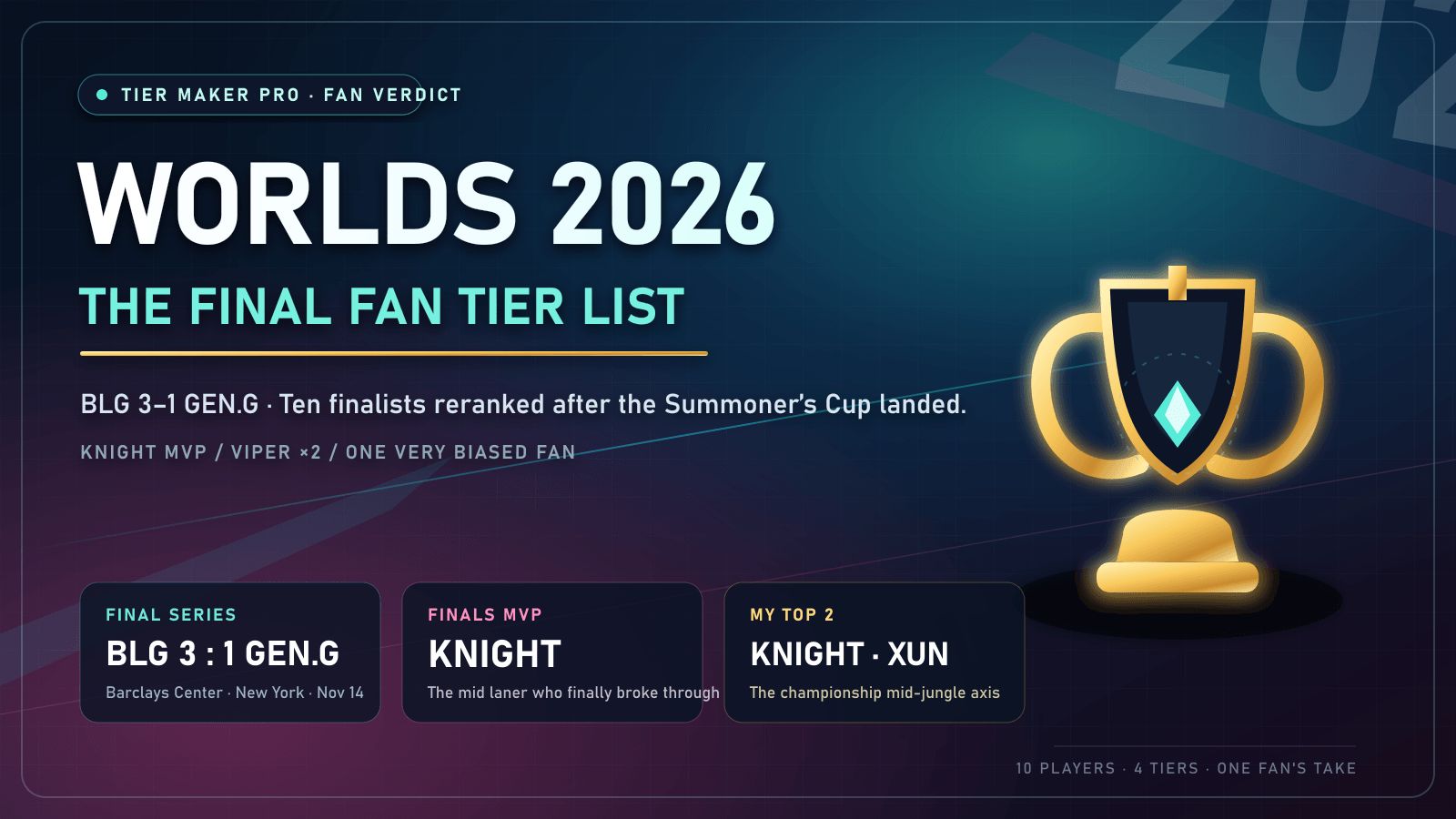
The final score is almost too simple: BLG 3-1 Gen.G. The story is not.
BLG dropped the opening game, then won three straight to claim the organization’s first World Championship and give the LPL its first title since 2021. Knight took Finals MVP. Viper lifted the Summoner’s Cup for the second time. And by the end of the run, BLG had eliminated all four LCK representatives, from the final Swiss rounds through the grand final in Brooklyn.
That is not a title built on a lucky bracket. It is a title built on a team that kept getting better while the pressure increased.
So I did the most fan-brained thing possible: I opened Tier Maker Pro’s 2026 LoL Best Player template, picked only the ten starters from the final, and ranked them again through the lens of Worlds 2026.
This is not an official ranking. It is a fan ranking with a short memory for narratives and a very long memory for what actually happened in the series.
My full finalist tier list
- S tier — Knight, Xun: The two players who set the terms of the championship run.
- A tier — Bin, Viper, ON, Ruler: Elite performances with one or two arguments against a perfect grade.
- B tier — Chovy, Canyon, Kiin: Great players whose best was not quite enough in the final.
- C tier — Duro: A harsh grade for a young player who had to learn on the biggest stage.
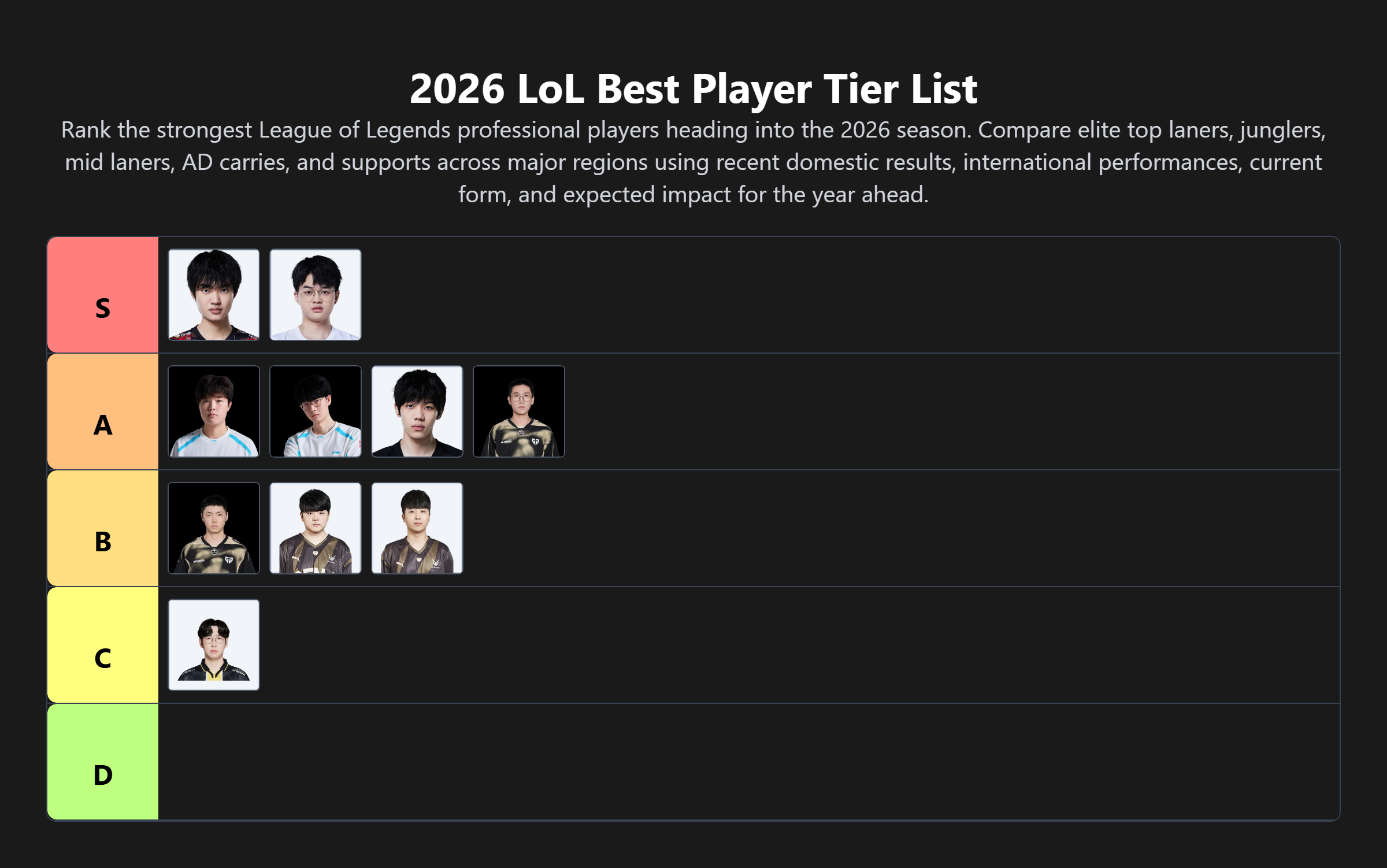
I built this with the site’s 2026 LoL Best Player tier-list template. You can open it, rerank the same ten players, and tell me which placement annoyed you the most.
S tier: The two players who made BLG’s win inevitable
Knight — This time, “almost” was not the ending
For years, the Knight conversation followed the same script: incredible in domestic play, dominant in lane, but always one Worlds series short of the final proof.
This time, he wrote a better ending.
What stood out was not simply that Knight dealt the most damage or won the most lanes. It was that he stopped waiting for the game to come to him. He moved first. He forced the map to rotate around mid. When BLG were behind the curve in the opening game, Knight was still looking for the next play instead of protecting a stat line.
Then he won Finals MVP, becoming the first Chinese mid laner to lift the World Championship. The “world-class but not world champion” asterisk is gone.
Xun — The other half of the championship engine
If Knight was the blade, Xun was the hand deciding when to swing it.
His value was not just clearing speed or a flashy Baron steal. It was sequencing: knowing when Bin needed cover, when Viper needed space, and when Gen.G could be squeezed into a bad river fight. Across the last three games, BLG’s map became cleaner and more aggressive at the same time. That is usually the fingerprint of a jungler who has the whole team on the same page.
Xun made the post-event first All-Pro team. More importantly, he made Knight’s pressure count.
A tier: Stars who delivered, but did not quite own the series
Bin — Three finals, finally a trophy
Bin became the first Chinese player to reach three World Championship finals, and this time he left with the cup.
Game 1 was rough for BLG’s top side. After that, Bin settled into the series beautifully. He kept the lane stable when BLG needed to absorb pressure, then found the right teamfight angles once Xun and Knight were dictating the tempo. He is still loud, still confident, still willing to make the brave play. The difference is that the brave play now has a world title behind it.
Why not S? Because this final was not a wire-to-wire Bin carry. But the championship version of Bin showed up when the series turned.
Viper — One game that belonged in a highlight reel
Game 2 lasted 53 minutes and 16 seconds. Viper finished with 1,776 damage per minute, one of the highest marks ever recorded in an international game.
That stat line is absurd, but the eye test was even better. Even when BLG looked close to losing the map, Viper kept finding ways to stay relevant. He was the late-game insurance policy, the player who turned “we are still alive” into “we can actually win this.”
He also became a two-time world champion. I still have him in A because the series’ directional force came from mid and jungle. Knight and Xun changed the shape of the game; Viper made sure BLG could finish the job. Both matter. I just value the ones who turn the wheel first.
ON — Support is hardest when nobody notices you
Support is the most unforgiving role in a ranking like this. A good engage becomes someone else’s highlight. A bad engage becomes your entire reputation.
What I liked about ON’s tournament was the lack of panic. He did not need to force a miracle every time the camera found him. He held the first-contact role, kept the vision structure intact, and trusted his carries to do the damage. BLG’s post-event first All-Pro support nod was deserved, and so was his first world title.
The margin was thin. He made the pressure moments look simpler than they were.
Ruler — He lost the final; he did not lose the plot
Gen.G lost 1-3. Ruler was still the only Gen.G player on the post-event first All-Pro team.
That says a lot about the series. BLG could attack Gen.G’s top side, manipulate the mid wave, and force the jungle into uncomfortable paths. What they could not do was make Ruler disappear. He remained the team’s cleanest late-game output source and the player most capable of dragging a messy fight back into range.
An ADC cannot patch every hole in the map. A tier is not a consolation prize here. It is respect for the best individual performer on the losing side.
B tier: Great players, one final-sized “but”
Chovy — He finally reached the final. He still could not close it.
This was Chovy’s first Worlds final. For a player whose career has been defined by the gap between domestic dominance and international completion, reaching the last series mattered.
But finals are cruel. You can be the best mid laner in the world for most of the year and still be remembered for the game that slipped away. Gen.G looked excellent in Game 1. From Game 2 onward, BLG’s mid-jungle pressure slowly took away Chovy’s room to operate.
He did not collapse. He just could not create the same kind of emergency exit that Knight found when the series tilted.
Canyon — The veteran champion ran into a faster map
Canyon is still one of the most elegant jungle pathfinders in the game. Gen.G do not reach the final without him.
But BLG’s last three games were ruthless in how they attacked his decision space. Xun and Knight kept pushing the mid wave, changing the timing of river fights, and making Canyon react instead of dictate. This was not a case of a veteran suddenly forgetting how to play. It was a case of one team solving the other’s rhythm.
In a final between this many stars, that small loss of initiative is enough to drop a legend a tier.
Kiin — Stability has value, but it does not always decide a final
Kiin was a central part of Gen.G’s 6-0 knockout run into the final. He is the kind of top laner every star-heavy roster wants: low-resource, reliable, flexible, and difficult to punish.
The problem is that the last three games became a mid-jungle scramble. BLG dragged the series into a state where immediate reactions mattered more than clean weak-side structure. Kiin’s steady play was still useful. It just did not produce the one sequence that could swing the trophy.
B tier is not an insult. It is what happens when a very good finalist runs into a champion whose best players take over the exact moments that decide the series.
C tier: Expensive lessons can still be valuable
Duro — The biggest stage can be the harshest teacher
Duro had to learn the final in real time. Reaching this stage in a season this stacked is an achievement, and there is no reason to treat one series as a career verdict.
But from a fan’s eye test, BLG were very precise about making his first-contact decisions expensive. Some engages did not get the follow-up they needed. Some river setups were answered before Gen.G could turn them into vision control. When a support’s job is to open the door, every missed hinge becomes obvious.
C tier here means “the final exposed the next step,” not “the player is bad.” The next version of Duro can make this placement look extremely silly.
Why Knight is above Viper
If the ranking were only about single-game ceiling, Viper would be S. Give me Game 2 Viper and I will argue with anyone.
But I am ranking the player who did the most to make BLG look like the champion before the final score existed. That was Knight, with Xun as the amplifier. Knight changed the geometry of the map. Xun kept changing the timing. Viper turned the result into damage, then into a trophy.
All three were essential. The tiebreaker is simple: the players who create the winning shape come first in my fan ranking.
Now it is your turn
I already know some of these placements will be unpopular. Knight in S will be called recency bias. Viper in A will be called disrespect. Duro in C will sound too harsh.
Good. A fan tier list should have a point of view. The only truly boring result is putting everyone in the same tier and pretending the final did not happen.
Open the 2026 LoL Best Player template, rebuild the top ten, and tell me who belongs in S.