Best My Hero Academia Characters: My Honest S-D Tier List
I ranked 12 My Hero Academia characters by emotional pull, story impact, and rewatch value, from All Might in S tier to Mineta in D.
Tier Maker Pro 13.5 min read
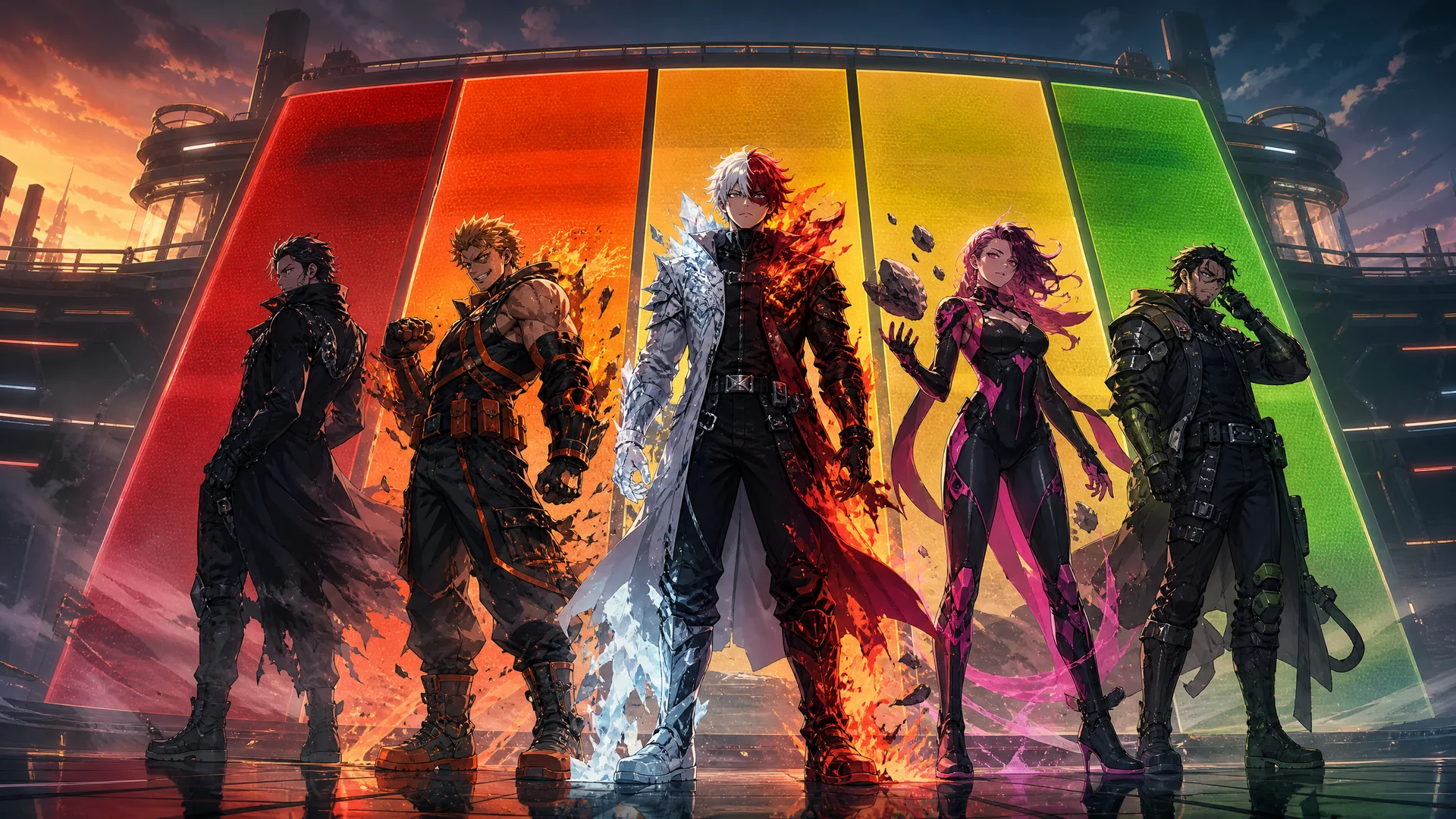
All Might is the character I hear first when I think about My Hero Academia. Not because he is the strongest hero in every fight, but because the idea of him survives longer than his power does. He tells people that they can become something better, then spends the rest of the story proving how heavy that promise can be.
That is the lens I used for this ranking. I am not sorting these characters by raw combat power, screen time, or how useful their Quirks would be in a tournament. I am ranking how much pull they have when they are on screen: whether their choices change the scene, whether their flaws make them more interesting, and whether I want to return to their episodes after the story has moved on.
This is my personal My Hero Academia characters tier list, built with the My Hero Academia Characters template. The template contains 36 students, heroes, teachers, and villains. I selected 12 who could each carry a real explanation rather than rushing through the entire roster.
Quick Answer: My S-Tier MHA Characters
My S tier is All Might, Izuku Midoriya, and Shota Aizawa.
All Might represents the promise of heroism, Midoriya is the person who has to live inside that promise, and Aizawa is the teacher who understands that ideals mean nothing without preparation. They pull the story in different directions, but each one makes the world feel more serious and more human.
The Full Ranking: S to D
- S: All Might, Izuku Midoriya, Shota Aizawa
- A: Katsuki Bakugo, Shoto Todoroki, Tomura Shigaraki
- B: Ochaco Uraraka, Hawks, Eijiro Kirishima
- C: Endeavor, Himiko Toga
- D: Minoru Mineta
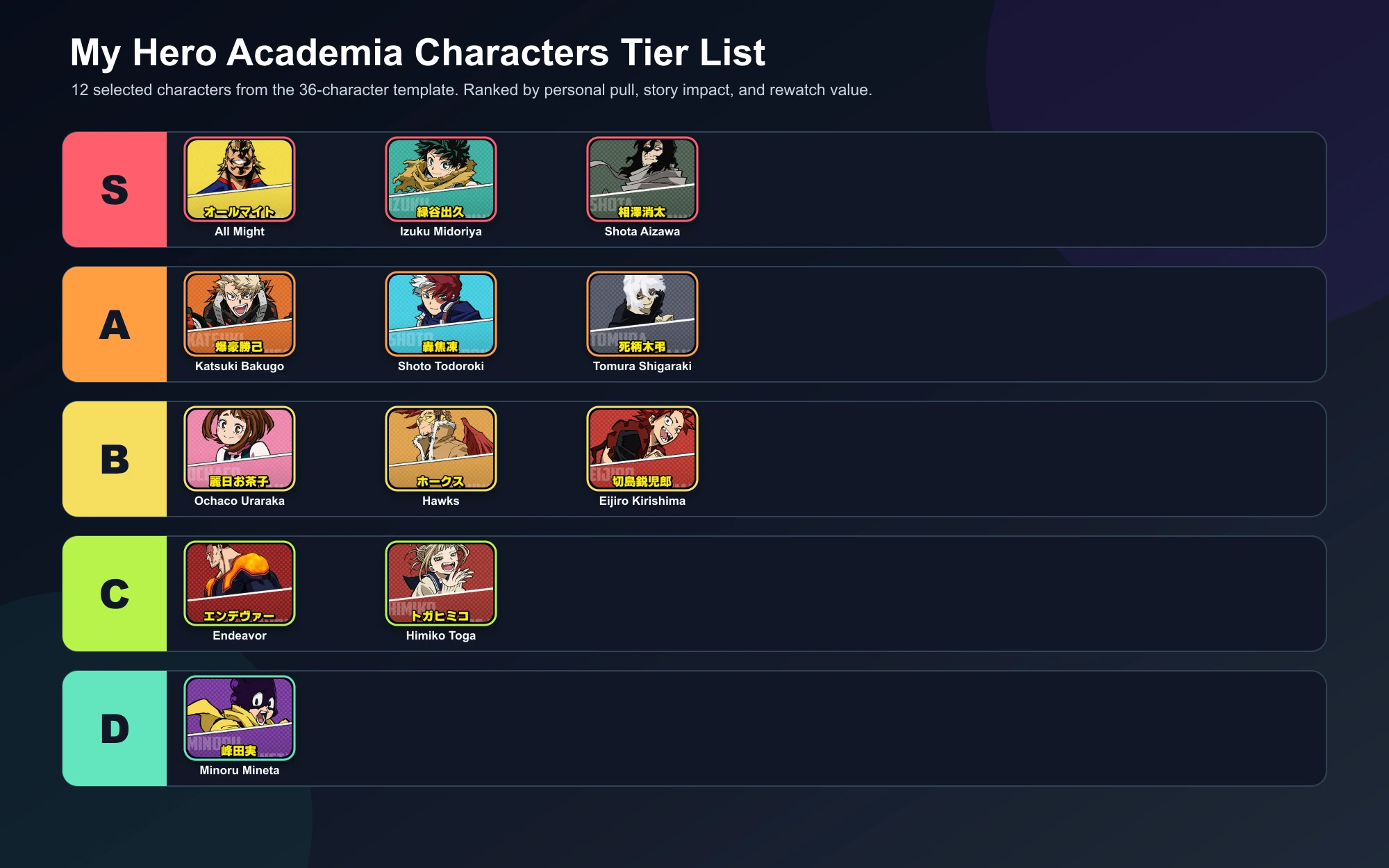
I can already hear the objections. Bakugo belongs higher. Todoroki belongs higher. Endeavor is too complicated for C. That is fine. A personal ranking should reveal a point of view, not pretend there is one mathematically correct answer.
How I Ranked These My Hero Academia Characters
I used four questions:
- Do I lean forward when they appear? A character can be important to the plot and still feel like homework.
- Does their arc change the way I understand someone else? The best MHA characters do not exist in isolation. They force the story to reconsider heroism, responsibility, or failure.
- Do their flaws create drama or just noise? A difficult character is not automatically a good character.
- Would I revisit their best scenes? This is the least objective question and probably the most honest one.
The ranking is not a power-level chart. All Might at his peak would beat almost everyone here, but that is not why he is in S. Mineta is not in D because his Quirk is weak. He is in D because the way the story uses him rarely gives me a reason to care beyond the joke.
S Tier: Characters Who Define the Story
All Might
All Might is the emotional foundation of My Hero Academia. His entrance changes the scale of the world, but his real importance comes from what happens after the symbol starts to crack. The story asks a powerful question through him: what does a society do when its perfect hero becomes a person with limits?
What keeps All Might in S is the contrast between the legend and the man. His confidence is genuine, but so is his fear that he has left the next generation with a burden instead of a future. He is at his best when he is not winning a fight, but trying to decide what kind of example he should leave behind.
Izuku Midoriya
Midoriya could have been a generic chosen-one protagonist. Instead, his best scenes are usually about the cost of being chosen. He does not simply inherit power; he has to negotiate what that power means, who it belongs to, and whether he can carry it without losing himself.
I like that Midoriya's kindness is not always treated as a simple virtue. Sometimes it is his greatest strength. Sometimes it is a warning sign. He keeps reaching for people who are difficult to save, and the story is smart enough to ask whether that instinct comes from empathy, guilt, or both.
He ranks just below All Might because his story is still most compelling when it is responding to the legacy around him. Still, he is the character who makes the central idea of MHA feel personal rather than abstract.
Shota Aizawa
Aizawa is the character who keeps the hero school from feeling like a fantasy summer camp. He is tired, practical, and almost aggressively unromantic about heroism. That makes him the perfect counterweight to All Might's inspirational language.
What makes Aizawa more than a stern teacher is the way he protects students without turning them into fragile children. He is willing to let them struggle, but he does not treat struggle as a substitute for care. His belief in preparation is a different kind of faith in the next generation.
Aizawa also benefits from being consistently written. He rarely does something that feels out of character just to create a dramatic beat. In a series full of huge emotional swings, that steadiness matters.
A Tier: Great Characters With One Small Step Missing
Katsuki Bakugo
Bakugo has one of the strongest arcs in the series because the story refuses to make him immediately likable. His pride is loud, his insults are exhausting, and his early behavior is genuinely hard to defend. The interesting part is that the story does not ask us to forget any of that.
His growth is not a polite personality transplant. It is a slow, awkward process of learning that being the best is not the same as being worthy of respect. Bakugo at his best becomes someone who understands the gap between ambition and responsibility. He ranks in A rather than S because I still find some of his loudest scenes more repetitive than revealing.
Shoto Todoroki
Todoroki has one of the cleanest introductions in the series. His half-cold, half-hot design is memorable, but his real appeal is the tension between inherited power and personal identity. He starts as a character defined by what he refuses to use, then has to decide what he actually wants to become.
His story works because it connects a superhero ability to a family wound without turning the ability into a metaphor with only one meaning. Todoroki is not just learning to use his fire. He is learning that reclaiming part of himself does not mean forgiving everything that happened around it.
He is in A because his middle stretch can feel quieter than his strongest material. When Todoroki is central, he is excellent. When he is not, he can drift into the background a little too easily.
Tomura Shigaraki
Shigaraki is the best argument that My Hero Academia understands how to build an antagonist. He starts as an immature threat, becomes a genuine source of dread, and eventually forces the heroes to confront the systems that created him.
His power is frightening, but his character is more frightening because of what it says about neglect. He is not interesting simply because he wants to destroy things. He is interesting because the story gives him a history that makes destruction feel like the only language he was taught.
Shigaraki could be S for readers who care most about villain arcs. For me, he is A because some of his later transformations begin to overwhelm the more fragile, personal version of the character I find most compelling.
B Tier: Characters I Enjoy, But Do Not Always Revisit
Ochaco Uraraka
Uraraka could easily have been written as the cheerful love interest and nothing more. To the series' credit, she becomes a more interesting character when her motivations start to separate from Midoriya's. Her desire to help her family is practical, and her growth as a hero is tied to questions about identity and money that most superhero stories avoid.
She is in B because the story does not always give her enough room to carry an arc on her own. When Uraraka gets a meaningful emotional beat, she is great. When she is used mostly as a supporting presence, the energy drops.
Hawks
Hawks is one of the most efficient additions to the cast. He looks like a relaxed celebrity hero, then becomes a much more difficult figure once the story starts asking what he has sacrificed to keep the system running.
His appeal is not just the cool design or the speed. It is the tension between his friendly public persona and the compromises underneath it. He is the kind of character who makes the hero society feel less stable simply by explaining how it works.
I keep him in B because his strongest material arrives late and depends heavily on the larger plot. He is excellent when the story gives him moral weight, but he does not have the same standalone pull as the characters above him.
Eijiro Kirishima
Kirishima is the character I would recommend to someone who wants a reminder that masculinity in MHA does not have to mean emotional distance. His idea of being a man is tied to courage, loyalty, and the willingness to admit fear rather than hide it.
That makes him one of the healthier emotional presences in the show. His scenes with Bakugo are especially useful because they reveal a version of Bakugo that is not only competition and anger. Kirishima is not one of my favorite characters, but he is one of the characters I trust the most.
He stays in B because he is more valuable as part of an ensemble than as the center of a story. That is not a small role, but it is a different kind of role.
C Tier: Strong Ideas, More Personal Friction
Endeavor
Endeavor is one of the most complicated characters in the series and one of the hardest to rank. You can acknowledge his growth without pretending his past is easy to move past. That tension is exactly what makes him compelling.
His presence forces the story to ask whether a hero can be useful without being good, and whether a family can heal when the person who hurt it also wants to change. Those are better questions than a simple redemption arc would allow.
I put him in C because I respect the complexity more than I enjoy spending time with him. His best scenes are uncomfortable in a way that is intentional, but they are not scenes I often want to revisit.
Himiko Toga
Toga is a fun character to watch because she can shift a scene from comedy to horror without warning. Her Quirk is visually interesting, and her obsession with identity makes her more than a simple serial-killer archetype.
The problem is that the story sometimes leans on her unpredictability instead of giving her a deeper internal conflict. Her best moments connect her to Uraraka and the question of who gets accepted by society. When she is treated as pure chaos, she becomes less memorable.
She is C for me: a great presence in small doses, but not a character I want to center in every conversation about MHA.
D Tier: Not for Me, and That Is Okay
Minoru Mineta
Mineta is the one choice here that comes closest to a personal penalty box. He can have useful comic timing, and his Quirk creates some creative battle possibilities. The series occasionally gives him a moment that suggests he could be more than a running joke.
Most of the time, though, his behavior is repetitive and distracting. The joke is rarely developed beyond the same pattern, and it often pulls attention away from characters and conflicts with more emotional weight. I do not need every character to be serious, but I do want the humor to reveal something.
D does not mean he ruins the show. It means that in a personal ranking about which characters I want to spend time with, he is the one I would cut first.
My Most Controversial Choices
The first controversial choice is putting Shigaraki in A instead of S. He is absolutely one of the best villains in modern anime, but I value the quieter, more vulnerable version of Shigaraki more than the later version that becomes a walking apocalypse. That is a preference, not a denial of his importance.
The second is putting Endeavor in C. A lot of readers might place him much higher because he is central to some of the series' strongest family drama. I agree with the importance. I just do not confuse importance with favorite.
The third is putting Bakugo in A rather than S. His arc is excellent, and I understand why he is the favorite of many fans. For me, the loudest version of Bakugo still wears out some scenes before the later growth fully lands.
Which My Hero Academia Character Should You Watch First?
If you want the emotional core of the series, start with All Might. His story explains what heroism is supposed to mean in this world.
If you want the experience of a flawed hero learning what responsibility costs, start with Midoriya. His journey is the main road through the story.
If you want to know whether the supporting cast can carry the show, start with Aizawa. He is the clearest proof that MHA is not only about the person throwing the biggest punch.
If you enjoy villains more than heroes, start with Shigaraki. He is the clearest window into the damage that the hero system leaves behind.
Frequently Asked Questions
Who is the best My Hero Academia character?
In my ranking, All Might is the best because his legacy shapes almost every other major character. Midoriya is the stronger protagonist in terms of growth, but All Might gives the series its central promise and its central contradiction.
Is this an objective My Hero Academia characters tier list?
No. This is a personal My Hero Academia characters tier list based on emotional pull, story impact, and rewatch value. A reader who puts Bakugo, Todoroki, or Shigaraki in S is not wrong. They are ranking a different set of priorities.
Why are only 12 characters included?
The template contains 36 options, but this article only uses 12. I chose characters who could each receive a meaningful explanation, including students, professional heroes, teachers, and villains. A smaller group makes the ranking easier to compare than a list that tries to cover everyone at once.
Can I compare MHA characters with other anime rankings?
Yes. If you want a broader comparison, I also wrote a male anime characters tier list that includes Bakugo, Todoroki, and other leads from outside MHA.
Can I make my own My Hero Academia tier list?
Yes. Open the My Hero Academia Characters template, choose the characters you want, drag them into your own tiers, and export an image when the order feels right. If you want a completely original lineup, you can also start from the tier list maker.
Final Thoughts: My Best My Hero Academia Characters
My favorite thing about this cast is that the series rarely lets heroism stay simple. All Might makes it look like a promise. Midoriya makes it look like a debt. Aizawa makes it look like work. Bakugo, Todoroki, Uraraka, and the rest each find a different way to ask what a hero is supposed to be when the uniform comes off.
That is why my ranking puts character before power. The strongest Quirk does not automatically make the strongest scene. The characters who stay with me are the ones who make the world feel more complicated after they leave it.
If your list looks completely different, good. The best version of this ranking is the one you make yourself.