IMDb's Top 20, Ranked as Shawshank Finally Hits China (2026)
Shawshank is finally getting a China theatrical release, 32 years late — perfect excuse to re-rank the IMDb Top 20 my way, tier by tier.
Oliver 14.5 min read
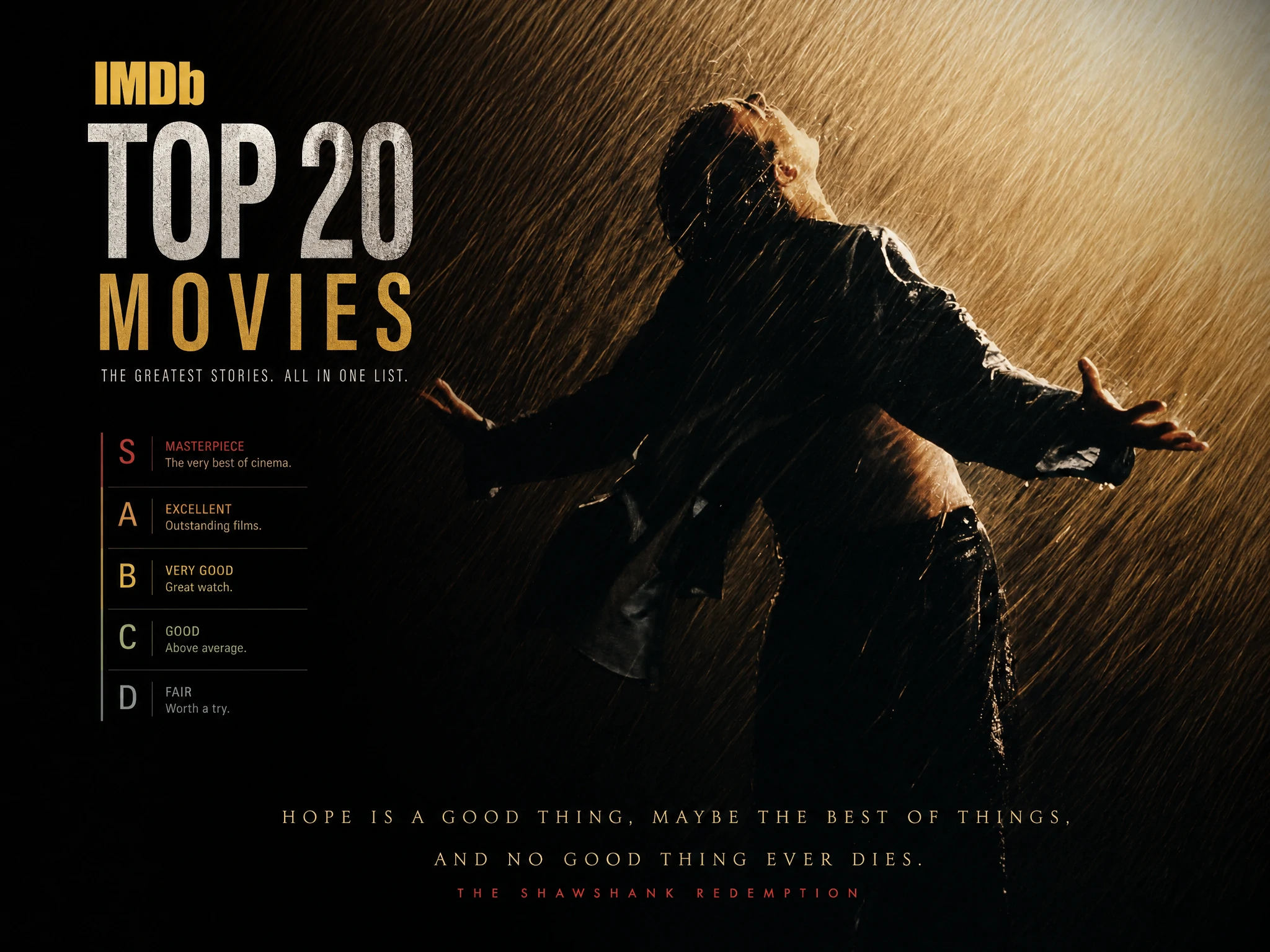
Shawshank Is Finally Getting Its China Premiere, 32 Years Late
That kind of "better late than never" story is exactly what pulled me back into one of my favorite pointless internet pastimes: re-litigating the IMDb top 20 movies of all time. Everyone agrees the list is mostly right. Almost nobody agrees on the order. So I sat down over a weekend, rewatched clips of everything I hadn't seen recently, and actually thought through where each one lands for me and why — not just vibes, but the specific scenes and moments that put them where they are. This is not a scientific ranking, it's one movie-obsessed person's honest opinion, backed by way too many hours of rewatching. A few of these placements will probably surprise you.
My Personal Tier List of the IMDb Top 20
Here's the full breakdown at a glance before I get into the "why" behind each one:
- S Tier: The Godfather (1972), The Godfather Part II (1974), The Shawshank Redemption (1994), 12 Angry Men (1957), Schindler's List (1993)
- A Tier: The Dark Knight (2008), The Lord of the Rings: The Fellowship of the Ring (2001), The Lord of the Rings: The Return of the King (2003), Pulp Fiction (1994), GoodFellas (1990)
- B Tier: Se7en (1995), Fight Club (1999), The Lord of the Rings: The Two Towers (2002), Star Wars: Episode V – The Empire Strikes Back (1980), One Flew Over the Cuckoo's Nest (1975)
- C Tier: Inception (2010), The Matrix (1999), Interstellar (2014)
- D Tier: Forrest Gump (1994), The Good, the Bad and the Ugly (1966)
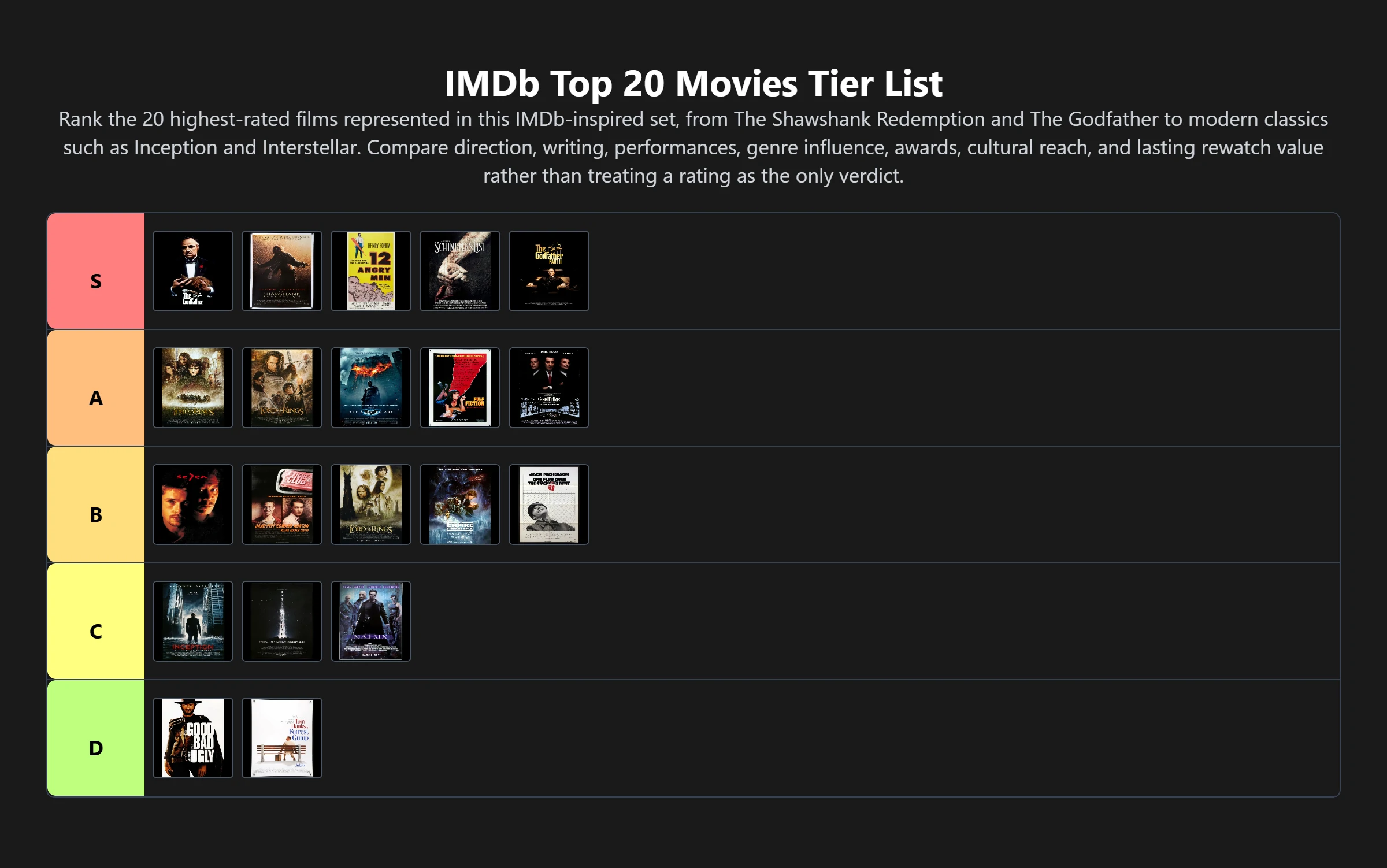
Now, the actual reasoning — and the specific viewing memories — behind each placement:
S Tier — No Notes
These are the ones I think genuinely earned their spot at the top, full stop — no asterisks, no "great but."
The Godfather (1972) and The Godfather Part II (1974) I'm putting these together because separating them feels wrong, and honestly I don't think I've ever watched one without immediately wanting the other queued up. I first saw both back to back on a rainy weekend in college, on a laptop with genuinely terrible speakers, and even through tinny audio the baptism sequence in Part II — murders intercut with a christening — left me sitting in silence for a solid minute after the credits rolled. I've rewatched them probably eight or nine times since, and the thing that keeps pulling me back isn't the violence, it's how quiet most of the movie actually is. Coppola basically invented the modern crime epic twice in a row, and somehow the sequel is the rare one that argues with the original instead of just repeating it.
The Shawshank Redemption (1994) The most quietly devastating "feel good" movie ever made. I didn't see this one in a theater either — like most people my age, I caught it on cable, half by accident, on a night I was supposed to be doing something else. I remember specifically not being able to change the channel once Andy started tunneling, and by the time the rooftop beer scene hit I'd fully abandoned whatever plans I had. What gets me on every rewatch isn't the escape, it's Red's parole board scenes — watching the same speech evolve from a performance into something genuinely earned is one of the best slow-burn character arcs in anything on this list. Wild that an entire country is only now getting to see it on the big screen for the first time.
12 Angry Men (1957) This was a "watch it for class" assignment in college that I fully expected to hate — black and white, one room, no action, sounds like homework. Instead I ended up staying after class arguing with a classmate about which juror we'd have been. One room, twelve guys, zero action scenes, and it's still more tense than half of this year's thrillers. I've rewatched it a few times since just to track how the film uses heat and blocking — characters physically drifting toward or away from Fonda's character as their votes shift — and it holds up every single time.
Schindler's List (1993) I've only watched this one twice, on purpose, years apart, because it's not a movie I think you're supposed to have on in the background. The first time was in a film history class; the second was alone, much later, and it hit even harder the second time in ways I wasn't expecting. The girl in the red coat is the moment everyone talks about, and it deserves it, but what stays with me longer is the quieter stuff — Ben Kingsley's face in the accounting scenes. It belongs at the top and I won't pretend otherwise, even though it's the one film on this list I'm least likely to casually rewatch.
A Tier — Still Elite
The Dark Knight (2008) I saw this one at a midnight release in high school, packed theater, and I still remember the audience actually gasping at the pencil trick. Heath Ledger's Joker gets all the credit, and it's deserved, but on rewatch it's actually Christian Bale and Aaron Eckhart quietly carrying the moral half of the movie that makes it hold up. The interrogation scene between Batman and the Joker is the one I've rewound the most out of anything on this entire list — the way Ledger keeps shifting his energy mid-scene still gets me.
The Lord of the Rings: The Fellowship of the Ring (2001) and The Return of the King (2003) I did the full extended-edition marathon with friends once — all three movies, one day, snacks planned like a military operation — and Fellowship is the one that still makes me want to go outside and go hiking by the time the credits roll. Return of the King I have genuine complaints about pacing-wise (yes, I know about the multiple endings, everyone knows about the multiple endings), but Pippin's song over the Osgiliath montage is such a gut-punch that I forgive it every time. The trilogy that made "three-hour movie" sound like a compliment instead of a warning.
Pulp Fiction (1994) Still the most quotable script on this entire list. I had a college roommate who could recite the entire "Royale with Cheese" exchange from memory, unprompted, and would just do it at random moments for years. That's the kind of movie this is — dialogue you absorb without meaning to. On rewatch what actually impresses me now isn't the nonlinear structure everyone talks about, it's how much genuine tenderness is buried in Jules and Vincent's scenes between the violence.
GoodFellas (1990) I'll die on the hill that this is Scorsese's most rewatchable movie, even above his more "important" work — it's the one I put on when I want a great movie but don't want to think too hard, and it never once feels like a compromise. The narration alone is doing more heavy lifting than most entire scripts; Henry Hill's voice pulling you through decades of escalating chaos makes even the mundane scenes feel urgent. The long tracking shot into the Copacabana is the one I show people who claim they "don't get" why critics care about camera work.
B Tier — Great, Just Not My Top Picks
Se7en (1995) I watched this completely blind at a friend's house in high school, no idea what was coming, and that ending genuinely wrecked the room — total silence, then everyone just kind of looking at each other. It still gets me every single time on rewatch. But once you already know what's in the box, the middle third — all the detective-procedural legwork — drags a little more than I remembered it dragging the first time, which is the main thing keeping it out of my top tier.
Fight Club (1999) I rewatched this three times in one month back in college, which in hindsight was probably too many times too close together, because by the third viewing the twist had completely stopped landing and I started noticing how much the middle stretches once you already know where it's going. It's a genuinely great movie that I think benefits from not rewatching too often — this is the rare film on the list where distance actually helps it.
The Lord of the Rings: The Two Towers (2002) Unfairly treated as the "middle chapter" filler when it has some of the best battle sequences in the trilogy — I still think the Helm's Deep sequence is more tense on a tenth watch than most modern action movies are on a first. I remember specifically rewatching just this one entry during a rainy week and being surprised by how much it holds up as a standalone experience, not just a bridge between the other two.
Star Wars: Episode V – The Empire Strikes Back (1980) This was a VHS tape at my grandparents' house growing up, worn out from rewinding, and I genuinely didn't know the reveal was coming the first time I saw it because nobody had spoiled it for me yet — a near-impossible experience to have with this movie today. A near-perfect sequel structurally, I just personally rank a few sci-fi entries above it emotionally.
One Flew Over the Cuckoo's Nest (1975) Jack Nicholson is incredible here — the scene where he tries to rally the ward around the imaginary World Series broadcast is one of my favorite pieces of acting on this entire list. The ending genuinely upset me the first time I watched it, in a way I wasn't prepared for going in. This one's just a notch below the S tier for me emotionally, mostly because I find myself needing real distance before I can rewatch it.
C Tier — My Slightly Controversial Takes
Inception (2010) I love this movie, but I think the internet has ranked it a little higher than it deserves purely because of the ending debate. I remember the theater I saw it in literally breaking into an argument in the lobby afterward about whether the top falls, and honestly, that lobby conversation might be more culturally significant than the actual ending shot. Take away the "was it a dream" discourse and it's a very good, tightly constructed, not-top-20-of-all-time heist movie with an incredible score doing a lot of the emotional lifting.
The Matrix (1999) I first watched this on a dorm room projector years after it came out, already knowing "there is no spoon" as a meme before I'd seen the actual scene, which tells you something about how deep this movie got into the culture. Genuinely groundbreaking for its time — the bullet-time stuff still looks better than it has any right to — but I think it's aged in a way some of the others on this list haven't, and the sequels didn't do it any favors reputation-wise either.
Interstellar (2014) This is the one I get the most pushback on. I saw it in IMAX on opening weekend and the docking sequence alone was worth the ticket price — genuinely one of the best pieces of pure tension I've seen in a theater. But I love the first half so much more than the back half; the tesseract sequence loses me a little every time, and by the third act the runtime starts to show in a way it doesn't in Nolan's tighter films.
D Tier — My Personal Least Favorites (Still Great Movies!)
Forrest Gump (1994) This is a movie I've probably seen more times than anything else on this list, purely because it was a family rewatch staple growing up, on in the background during holidays more times than I can count. It's a classic for a reason and I understand exactly why it's here — I just genuinely never choose it on a rewatch night when I have the option, which feels like the most honest way to explain a D-tier ranking.
The Good, the Bad and the Ugly (1966) I watched this specifically to prep for a Sergio Leone deep dive with a friend who's a much bigger Western fan than I am, and I came away respecting the craft — that final three-way standoff is a masterclass in editing tension purely through cutting between faces — more than I actually enjoyed the nearly three-hour runtime. I think that's a totally normal reaction to a lot of classic Westerns, honestly.
This is obviously just my own gut ranking, shaped by whatever mood I was in the first time I saw each of these — if your S tier looks completely different, that's the fun part. That's kind of the whole appeal of a top-20 list like this: everyone's version looks a little different because everyone's version is tangled up with when and how they first watched it.
Why "Better Late Than Never" Is Basically Shawshank's Whole Story
The China premiere isn't a random footnote, it's on-brand for this movie. Shawshank was a genuine box-office disappointment in 1994 — that roughly $73 million worldwide gross didn't come close to covering the cost of a theatrical run at the time — and it only clawed its way to classic status years later through VHS rentals, cable reruns, and word of mouth. Getting an official Chinese theatrical release, and specifically becoming the film chosen for the format's first-ever IMAX presentation, thirty-two years after it first premiered is just the latest chapter in a movie that has always found its audience the slow way.
It's also not happening in a vacuum. Shawshank is part of a small but noticeable wave of "delayed premiere" classics finally reaching mainland Chinese screens in 2026: Kubrick's The Shining got its first-ever mainland release back in January, Jaws and Memento both landed on Chinese commercial screens for the first time in May, and Triangle (2009) opened in July. It's sparked a fun bit of chatter online, too — fans joking about which other beloved-but-never-officially-released classics might be next in line for the same treatment. It's a good reminder that a "best movie ever" ranking isn't really fixed — access, re-releases, and even one country finally getting to see a film for the first time can shift how a whole new wave of viewers experiences the IMDb Top 20.
It's also worth noting how unusual this list actually is in general: three Lord of the Rings entries, two Godfather films, and a black-and-white courtroom drama from 1957 all sitting in the same top 20 as a 2010 sci-fi blockbuster. Not many "best of all time" lists age that gracefully across genres and decades.
I Turned My Ranking Into an Actual Graphic
After going back and forth on this for way too long, I ended up dragging everything into a film tier list template I found online so I could actually visualize my S-to-D breakdown instead of just listing it out in a doc. It's got all 20 movies pre-loaded, and you can drag them around or swap in your own posters if you want to build your version. If you'd rather start from a blank tier list template and rank a completely different set of movies, that works too — took me maybe ten minutes total to make mine. There's even a Shawshank-specific character tier list if you'd rather rank Andy, Red, and the rest of the cast instead of the whole IMDb list.
So, Where Would You Put Shawshank?
That's my ranking, controversial takes and all. I'd genuinely love to know where you'd move things around — does Interstellar deserve better than C tier? Is Forrest Gump getting slandered by me putting it in D? And if you're in China and finally getting to see Shawshank on a big screen for the first time this August, I'm a little jealous. Drop your own tier breakdown in the comments, I read all of them.