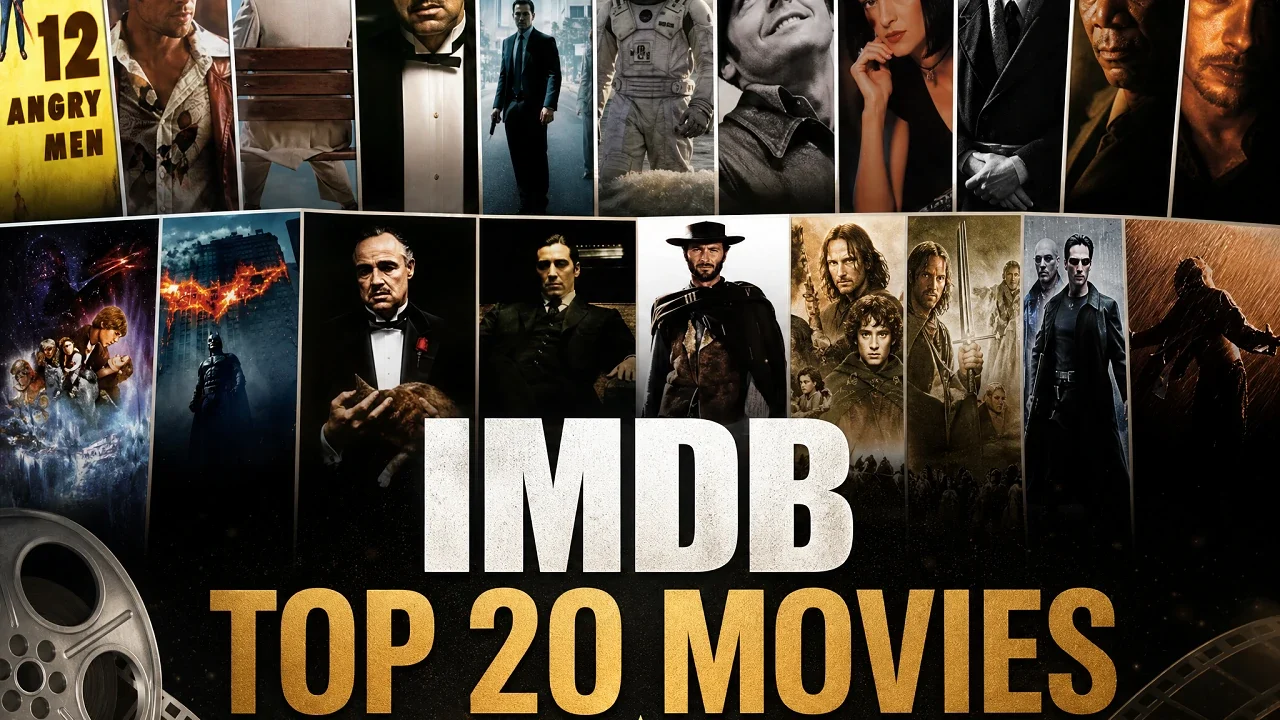
This IMDb Top 20 set brings together prison drama, gangster cinema, war history, fantasy adventure, science fiction, animation, and intimate character studies. Compare the films by direction, writing, performances, visual invention, historical or genre influence, awards, emotional payoff, and whether repeated viewing reveals more than the first impression.
-
1
The Shawshank Redemption
Frank Darabont's 1994 prison drama follows banker Andy Dufresne through institutional cruelty, quiet planning, and an unlikely friendship with Red. Its patient structure turns hope into something earned, while the final release gives the story a durable emotional payoff.
Official source
-
2
The Godfather
Francis Ford Coppola's 1972 crime epic traces Michael Corleone's transformation from reluctant outsider to strategist at the center of his family's power. Marlon Brando's restraint, Al Pacino's gradual hardening, and ritualized images make loyalty and moral compromise inseparable.
Official source
-
3
The Dark Knight
Christopher Nolan's 2008 Batman film turns Bruce Wayne and the Joker into a test of public ethics, civic order, and personal limits. Heath Ledger's performance anchors its legacy, while grounded action and moral pressure give this blockbuster unusual dramatic weight.
Official source
-
4
The Godfather Part II
The 1974 sequel follows young Vito Corleone's rise beside Michael's increasingly isolated rule, making inheritance and corruption visible across two generations. Robert De Niro and Al Pacino portray power gained and power defended as contrasting tragedies.
Official source
-
5
12 Angry Men
Sidney Lumet's 1957 courtroom drama confines twelve jurors to one room and builds suspense from discussion. Juror Eight's reasonable doubt exposes prejudice, fatigue, and group pressure; precise blocking and escalating debate make changing one's mind feel dramatic.
Official source
-
6
Schindler's List
Steven Spielberg's 1993 historical drama follows Oskar Schindler as profit, Nazi connections, and witnessing persecution push him toward saving Jewish workers. Black-and-white photography, the red coat motif, and Liam Neeson's controlled performance balance historical horror with personal moral awakening.
Official source
-
7
The Lord of the Rings: The Return of the King
Peter Jackson's 2003 finale closes the journey with Minas Tirith, the Black Gate, and Frodo's passage through Mordor. Its eleven Oscars reflect scale and craft, while its strongest ranking case is the emotional closure and ensemble payoff accumulated across the trilogy.
Official source
-
8
Pulp Fiction
Quentin Tarantino's 1994 crime film rearranges intersecting Los Angeles stories about hitmen, boxers, and uneasy mercy. Conversational violence, pop-cultural digressions, and nonlinear editing make style part of the subject; compare dialogue rhythm, structure, chemistry, and independent-cinema influence.
Official source
-
9
The Lord of the Rings: The Fellowship of the Ring
The 2001 Fellowship introduces Middle-earth through the Shire, Rivendell, Moria, and a fragile traveling company. Jackson balances exposition with momentum before the journey fractures, while practical atmosphere and Howard Shore's score establish a world larger than its opening chapter.
Official source
-
10
The Good, the Bad and the Ugly
Sergio Leone's 1966 western places Blondie, Tuco, and Angel Eyes in a hunt for Confederate gold during the Civil War. Morricone's score, extreme close-ups, dry humor, and the cemetery standoff turn western ritual into operatic spectacle.
Official source
-
11
Forrest Gump
Robert Zemeckis's 1994 drama filters decades of American history through Forrest's limited but sincere understanding. Tom Hanks gives his kindness and literal-mindedness both comedy and melancholy, while digital composites place him inside famous events; compare sentiment and historical framing.
Official source
-
12
The Lord of the Rings: The Two Towers
The 2002 middle chapter splits the fellowship across Rohan, Isengard, and the road to Mordor before Helm's Deep. Gollum adds a morally unstable guide, while the battle tests digital creatures, crowd staging, and emotional rhythm; rank its escalation and standalone tension.
Official source
-
13
Fight Club
David Fincher's 1999 adaptation follows an unnamed office worker whose insomnia, consumer frustration, and friendship with Tyler Durden become a violent ideology. Norton, Pitt, and the unreliable viewpoint keep identity unstable; compare visual design, social provocation, and seductive danger.
Official source
-
14
Inception
Christopher Nolan's 2010 science-fiction heist sends a team through nested dreams to plant an idea. The rotating hallway, practical stunts, layered exposition, and unresolved final image make its mechanics part of the pleasure; weigh puzzle design against emotional motivation.
Official source
-
15
Star Wars: Episode V - The Empire Strikes Back
Irvin Kershner's 1980 sequel darkens the space opera through Hoth, Luke's training with Yoda, and the revelation linking him to Darth Vader. It ends without conventional victory yet deepens the heroes and mythology, giving sequel discipline and tonal confidence unusual importance.
Official source
-
16
The Matrix
The Wachowskis' 1999 science-fiction action film turns hacker Thomas Anderson's discovery of simulated reality into a story about agency and awakening. Bullet time, wire work, cyberpunk design, and philosophical references were widely imitated, but Neo's choice keeps the spectacle human.
Official source
-
17
GoodFellas
Martin Scorsese's 1990 crime film follows Henry Hill from teenage fascination with the New York mob to paranoia, betrayal, and witness protection. Rapid cutting, voice-over, dark humor, and the Copacabana tracking shot make crime intoxicating before moral collapse; compare energy and consequence.
Official source
-
18
One Flew Over the Cuckoo's Nest
Milos Forman's 1975 drama places rebellious gambler Randle McMurphy inside an institution ruled by Nurse Ratched. Jack Nicholson's charisma makes resistance infectious, while the patients' fragile community exposes forced conformity; five major Oscars recognize its ensemble acting and humane institutional critique.
Official source
-
19
Interstellar
Christopher Nolan's 2014 space epic follows Cooper from a failing Earth through wormholes and relativistic time in search of a habitable future. Scientific ideas and IMAX spectacle are matched by a parent-child story, Hans Zimmer's organ score, and an emotional climax.
Official source
-
20
Se7en
David Fincher's 1995 thriller pairs retiring detective Somerset with newcomer Mills as they investigate murders staged around the seven deadly sins. Rain, cramped interiors, graphic evidence, and a punishing final act create a world where procedure cannot contain evil; atmosphere and ending are its sharpest signatures.
Official source