"Plants vs. Zombies Tier List: All 49 Plants Ranked (2026)"
"Rank all 49 original Plants vs. Zombies plants in this 2026 tier list, from S to D, based on damage, defense, and overall usefulness."
Tier Maker Pro 19.5 min read
Introduction: Which Plants Are Actually the Best in Plants vs. Zombies?
If you have ever played Plants vs. Zombies, you probably remember the feeling of watching a huge wave of zombies approach your lawn while desperately trying to find enough sunlight to build a strong defense. Sometimes one powerful plant can save an entire level. Other times, even an expensive lineup can collapse because you picked the wrong combination.
That brings us to one of the biggest questions for PvZ players: Which plants are actually the best, and which ones are not worth using?
With the continued interest in classic tower defense games, Plants vs. Zombies remains a recognizable title for players who enjoy comparing strategies, revisiting familiar characters, and debating which plants deserve a place in the strongest lineup. Nostalgia is part of the appeal, but the gameplay itself is what makes these discussions interesting. A plant that looks ordinary can be incredibly useful, while a visually impressive plant might have serious limitations in actual combat.
For this ranking, I decided to compare all 49 plants from the original Plants vs. Zombies and place them into five tiers: S, A, B, C, and D.
This is not simply a damage ranking. I considered attack power, defensive ability, sunlight efficiency, versatility, and overall usefulness across different game environments.
I also made a [Plants vs. Zombies Plant Tier List Template – INSERT INTERNAL LINK HERE] so everyone can create a personal ranking. If you disagree with my choices, try the template and build your own tier list. I am especially interested in seeing which plants other players think deserve S Tier!
How I Ranked the 49 Plants
Before looking at the results, it is important to explain what makes a plant strong.
A high damage number does not automatically make a plant one of the best choices. Some plants are valuable because they generate sunlight, protect important attackers, slow down zombies, or provide a special ability that can completely change a difficult situation.
I used five main criteria:
- Attack Power: Damage output, attack speed, area damage, and effectiveness against different zombies.
- Defense: How well a plant protects other plants and prevents zombies from reaching the house.
- Sunlight Efficiency: Whether its performance justifies its sunlight cost.
- Versatility: How useful it is across different levels, environments, and enemy types.
- Strategic Value: Whether its abilities create useful combinations or solve difficult combat situations.
The ranking focuses on the original Plants vs. Zombies experience, including daytime, nighttime, pool, roof, and survival gameplay. Some plants are naturally designed for specific situations, so their positions reflect their overall usefulness rather than their performance in only one level.
Complete Plants vs. Zombies Tier List: All 49 Plants
Here is the complete ranking overview before getting into the individual explanations.
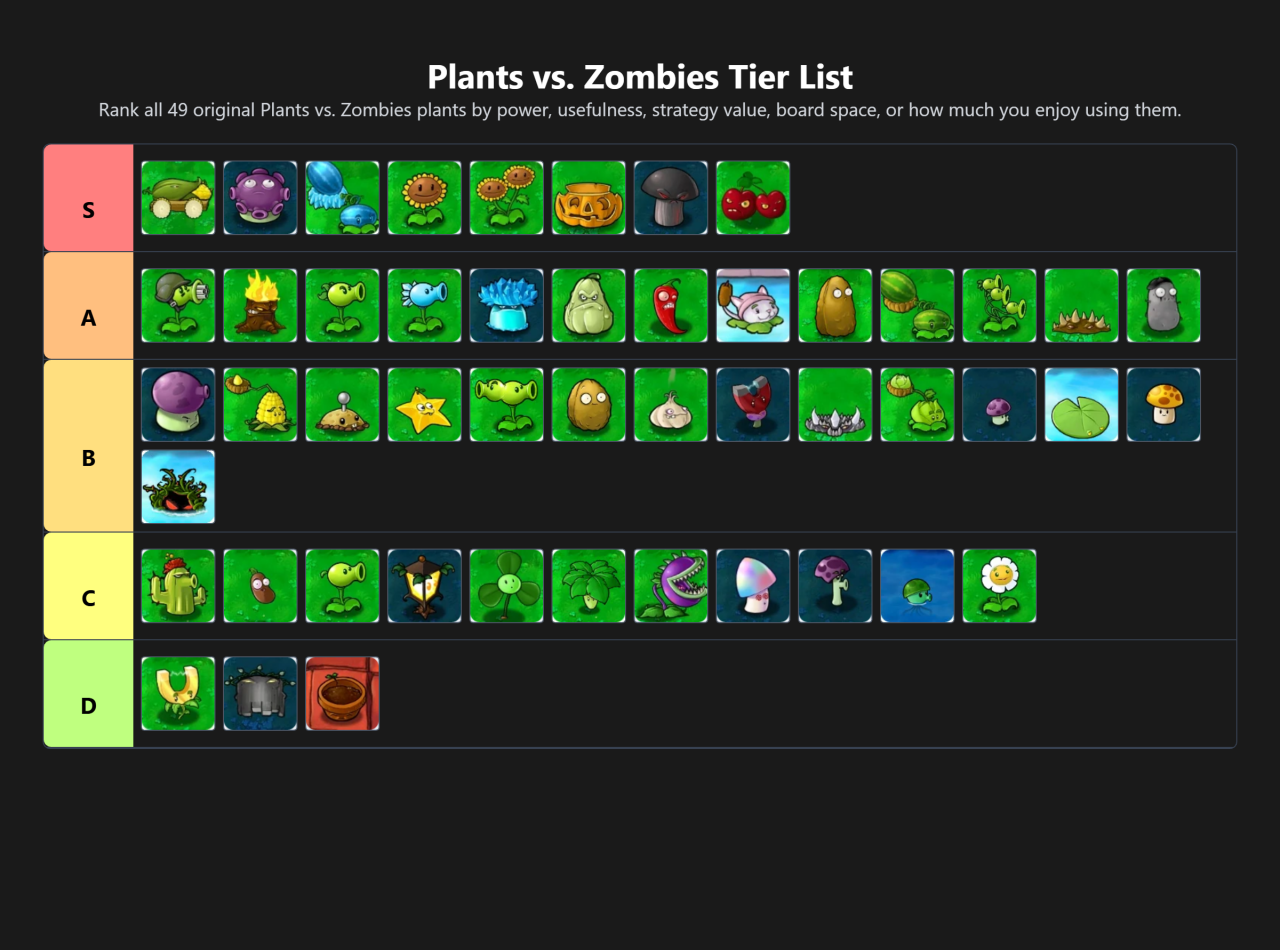
- S Tier: Cob Cannon, Gloom-shroom, Winter Melon, Sunflower, Twin Sunflower, Pumpkin, Doom-shroom, Cherry Bomb.
- A Tier: Gatling Pea, Torchwood, Repeater, Snow Pea, Ice-shroom, Jalapeno, Squash, Cattail, Tall-nut, Melon-pult, Threepeater, Spikeweed, Imitater.
- B Tier: Fume-shroom, Kernel-pult, Potato Mine, Starfruit, Split Pea, Wall-nut, Garlic, Magnet-shroom, Spikerock, Cabbage-pult, Puff-shroom, Sun-shroom, Lily Pad, Tangle Kelp, Peashooter.
- C Tier: Cactus, Coffee Bean, Plantern, Blover, Umbrella Leaf, Chomper, Hypno-shroom, Scaredy-shroom, Sea-shroom, Marigold.
- D Tier: Gold Magnet, Grave Buster, Flower Pot.
S Tier – The Best Plants in Plants vs. Zombies
S Tier is reserved for plants that provide exceptional value in actual gameplay. These plants can become the foundation of a powerful strategy because of their damage, defense, resource generation, or unique abilities.
1. Cob Cannon
Cob Cannon is one of the strongest offensive plants in the original game. Its explosive attacks can eliminate large groups of zombies across a wide area, making it especially valuable during difficult survival waves.
It requires two Kernel-pults and a considerable sunlight investment, but its enormous damage potential makes that investment worthwhile. When dealing with large groups of dangerous enemies, few plants can match its ability to clear an entire area.
2. Gloom-shroom
Gloom-shroom delivers powerful close-range damage in every direction. Its ability to attack multiple nearby zombies makes it extremely effective when enemies approach your defensive line.
When combined with Pumpkin and other defensive plants, it becomes an important part of a strong formation. Its short range is a limitation, but its damage potential is excellent when properly positioned.
3. Winter Melon
Winter Melon combines powerful splash damage with a slowing effect. This combination makes it much more than an ordinary attacking plant.
It damages multiple zombies while reducing their movement speed, giving other plants additional time to attack. Although it requires a high sunlight investment, its performance against large waves makes it one of the best offensive choices.
4. Sunflower
Sunflower is arguably the most important economic plant in the game. It does not attack zombies, but it produces the sunlight needed to build almost every successful strategy.
Without sufficient sunlight, even the strongest offensive lineup becomes difficult to maintain. Its low cost and consistent production make it essential in a wide variety of levels.
5. Twin Sunflower
Twin Sunflower improves sunlight production by generating more sunlight than a regular Sunflower.
It requires an additional investment, but the increased production becomes extremely valuable in longer levels. If your strategy depends on expensive plants such as Melon-pult, Winter Melon, or Cob Cannon, Twin Sunflower can help support your entire formation.
6. Pumpkin
Pumpkin provides an additional defensive layer around other plants. It is particularly useful for protecting valuable attackers and keeping important parts of your formation alive.
A well-protected Gloom-shroom or other key plant can remain active much longer. Pumpkin does not deal damage, but its defensive contribution can make an enormous difference.
7. Doom-shroom
Doom-shroom has one of the most destructive attacks in Plants vs. Zombies. Its explosion can eliminate many zombies within a large area, making it an excellent emergency option.
Its crater after use and its nighttime planting requirement prevent it from being universally useful. However, when you need to eliminate a dangerous group quickly, its explosive power is difficult to ignore.
8. Cherry Bomb
Cherry Bomb is one of the most reliable emergency plants. It immediately explodes and damages zombies in a surrounding area.
Its ability to clear a dangerous situation without requiring a complicated setup makes it useful in many different levels. When zombies are getting too close to your house, Cherry Bomb can be the difference between winning and losing.
A Tier – Excellent Plants with Strong Combat Value
A-tier plants are highly effective and can fit into many successful strategies. They might not have the same overall impact as S-tier plants, but their offensive power, defensive abilities, or special functions make them excellent choices.
9. Gatling Pea
Gatling Pea fires multiple peas in rapid succession, providing excellent offensive pressure. Its damage becomes even more impressive when combined with Torchwood.
It requires a Repeater to upgrade, so it is not the cheapest option. However, its high attack output makes it a strong late-game attacker.
10. Torchwood
Torchwood transforms regular peas passing through it into fire peas, increasing their damage.
Its biggest strength is its ability to improve an entire offensive formation rather than relying on its own attacks. When paired with Repeater or Gatling Pea, it can significantly increase overall damage.
11. Repeater
Repeater fires two peas at a time, providing reliable damage for a reasonable sunlight investment.
It is a straightforward offensive plant that works well in many situations. It also serves as the foundation for Gatling Pea, giving it additional strategic value.
12. Snow Pea
Snow Pea slows zombies while dealing damage. This additional control makes it useful even when its raw damage is not particularly impressive.
Slower zombies remain in your attackers' range for longer, allowing your defensive formation to deal more damage before enemies reach your Wall-nuts or other barriers.
13. Ice-shroom
Ice-shroom can freeze zombies across the lawn, making it one of the most useful crowd-control plants.
Its ability to temporarily stop enemy movement is especially valuable during dangerous waves. It can give you time to reorganize your defense or eliminate enemies before they become a serious threat.
14. Jalapeno
Jalapeno destroys zombies across an entire row.
Its lane-wide damage makes it an excellent emergency offensive option, especially when a large group of zombies is approaching from one direction. It is simple, powerful, and easy to use.
15. Squash
Squash delivers powerful damage to nearby zombies with a relatively low sunlight cost.
It is particularly useful for eliminating dangerous individual enemies. Its limited attack range and single-use nature prevent it from reaching S Tier, but its efficiency makes it a very good tactical choice.
16. Cattail
Cattail is one of the most flexible attacking plants in pool levels.
Its homing attacks can target zombies across different lanes, including airborne enemies. This flexibility makes it especially useful when ordinary attackers cannot cover every position.
17. Tall-nut
Tall-nut provides strong defensive protection and can stop several dangerous zombies that would otherwise break through ordinary Wall-nuts.
It is an excellent choice when building a durable defensive line. Its lack of offensive damage is its main limitation, but its defensive value is undeniable.
18. Melon-pult
Melon-pult deals splash damage, allowing it to damage multiple zombies with a single attack.
Its powerful projectiles make it an effective mid-to-late-game offensive plant. It is particularly useful against groups of enemies moving together.
19. Threepeater
Threepeater attacks zombies in three different lanes.
This gives it excellent coverage, especially when enemies approach from multiple directions. Its relatively high sunlight cost means that it needs careful placement, but it can provide strong offensive support.
20. Spikeweed
Spikeweed continuously damages zombies walking over it and can destroy certain vehicles.
It is especially useful against Zombonis and other ground-based threats. However, it cannot stop zombies by itself, which limits its defensive usefulness compared with stronger barriers.
21. Imitater
Imitater allows players to copy another plant, making it one of the most flexible strategic choices.
It can duplicate important plants and help reduce waiting time between placements. For example, copying a powerful explosive or defensive plant can give players more options during difficult waves.
Its main disadvantage is that it requires an additional seed slot. Nevertheless, the extra flexibility makes it a valuable addition to many strategies.
B Tier – Useful Plants with Some Limitations
B-tier plants can be very effective in the right circumstances. However, their damage, defensive strength, or versatility is generally less impressive than the higher-ranked options.
22. Fume-shroom
Fume-shroom attacks multiple zombies in front of it and can penetrate certain defenses, including screen doors.
It is a useful nighttime attacker, particularly when dealing with groups of enemies. Its limited range prevents it from being as flexible as some higher-tier offensive plants.
23. Kernel-pult
Kernel-pult throws kernels and occasionally launches butter that temporarily stops zombies.
Its ability to interrupt enemies gives it useful crowd-control potential. However, its damage output is relatively inconsistent, making it less dependable than stronger attackers.
24. Potato Mine
Potato Mine is inexpensive and can eliminate a zombie with a powerful explosion.
It is particularly useful during the early game when sunlight is limited. Its main weakness is the time required to arm itself, which makes it less reliable against zombies that are already close.
25. Starfruit
Starfruit fires projectiles in multiple directions, giving it unusual attack coverage.
It can be effective in certain formations and offers an interesting alternative to conventional attackers. However, its unusual attack pattern makes it less consistent than more straightforward offensive plants.
26. Split Pea
Split Pea can attack zombies both in front of and behind it.
This makes it useful against Digger Zombies and other enemies that approach from unexpected directions. However, its specialized role limits its overall usefulness compared with plants that perform well in more situations.
27. Wall-nut
Wall-nut is a basic defensive plant with high durability and a relatively low cost.
It can buy valuable time for attacking plants, making it an important part of many beginner strategies. However, it does not deal damage and can eventually be overwhelmed by stronger zombies.
28. Garlic
Garlic changes the lane that zombies move through after biting it.
This allows players to redirect enemies toward stronger defensive positions. Its strategic value can be useful, but it requires a carefully planned formation to achieve the best results.
29. Magnet-shroom
Magnet-shroom removes certain metal equipment from zombies, weakening some dangerous enemies.
Its special ability can be extremely useful in the right levels, particularly when facing metal-equipped zombies. However, it does not provide consistent direct damage, so its overall value is situational.
30. Spikerock
Spikerock is an upgraded version of Spikeweed with greater durability and damage.
It is particularly useful against vehicles and tough ground-based enemies. Its higher sunlight cost limits its efficiency in some situations, but it provides strong defensive support.
31. Cabbage-pult
Cabbage-pult provides reliable projectile damage and works well on rooftops, where ordinary straight-line attacks may not be suitable.
It is a useful early and mid-game attacker, but stronger offensive plants eventually outperform it in terms of damage and overall combat value.
32. Puff-shroom
Puff-shroom costs no sunlight and can provide early defensive support during nighttime levels.
Its zero-cost advantage makes it excellent for saving resources and building an early formation. Unfortunately, its short attack range limits its effectiveness later in the game.
33. Sun-shroom
Sun-shroom is a nighttime sunlight producer that gradually becomes more productive.
It is useful for building an economy without relying entirely on expensive Sunflowers. However, its slower development can be a disadvantage when you need sunlight quickly.
34. Lily Pad
Lily Pad allows players to place plants on water.
It does not deal damage or directly stop zombies, but it is essential for creating a proper pool defense. Its importance comes from enabling other plants to function in aquatic environments.
35. Tangle Kelp
Tangle Kelp can pull an underwater zombie beneath the water, eliminating it.
It is a useful defensive tool in pool levels, particularly when a dangerous zombie gets too close. Its one-time use and limited target range make it less versatile than higher-tier plants.
36. Peashooter
Peashooter is one of the first offensive plants players unlock.
It provides consistent, straightforward damage at a low sunlight cost. It is easy to understand and useful for beginners, but once stronger attackers become available, Peashooter loses much of its value.
C Tier – Situational and Specialized Plants
C-tier plants are not necessarily bad. Many have useful abilities, but their effectiveness depends heavily on the level, enemy type, or strategy being used.
37. Cactus
Cactus can attack both ground and airborne enemies, making it useful against Balloon Zombies.
However, its overall damage and versatility are not strong enough to compete with the best offensive plants. It is more of a specialized defensive choice.
38. Coffee Bean
Coffee Bean wakes up sleeping mushrooms during daytime levels.
Its function is important when using nighttime plants in the daytime, but it cannot provide any direct offensive or defensive value by itself. Its usefulness depends entirely on the other plants in your formation.
39. Plantern
Plantern illuminates the area around it during nighttime levels, helping players see through fog.
This can be valuable in specific environments, but it does not directly damage or stop zombies. Its limited combat contribution keeps it in C Tier.
40. Blover
Blover can remove Balloon Zombies and clear certain airborne threats.
Its ability can be extremely useful when facing enemies that ordinary ground-based attackers cannot reach. However, its specialized function makes it less valuable across the entire game.
41. Umbrella Leaf
Umbrella Leaf protects nearby plants from certain airborne attacks, including attacks from Bungee Zombies.
Its defensive function can prevent valuable plants from being stolen, but it does not directly contribute to attacking or stopping ordinary zombies.
42. Chomper
Chomper can swallow zombies, including some dangerous enemies, making it look like a powerful offensive plant.
Unfortunately, its long digestion time leaves it unable to attack for a while. This creates a major weakness during large waves, where continuous damage is important.
43. Hypno-shroom
Hypno-shroom can turn a zombie into an ally after being eaten.
This ability can create interesting situations because an enemy may begin attacking other zombies. However, its effectiveness depends on which zombie consumes it, making it less predictable than conventional attackers.
44. Scaredy-shroom
Scaredy-shroom offers inexpensive ranged attacks and can deal damage from a distance.
Its major weakness is that it hides when zombies approach too closely. This makes it unreliable when enemies break through the defensive line.
45. Sea-shroom
Sea-shroom is a free aquatic attacking plant that provides early offensive support in pool levels.
Its zero sunlight cost is useful, but its short range and relatively limited damage make it less effective as the game progresses.
46. Marigold
Marigold produces coins instead of attacking zombies.
It can be useful for collecting additional in-game currency, especially for players interested in earning coins for other purposes. However, its lack of direct combat contribution makes it a weaker choice for difficult defensive levels.
D Tier – Plants with Limited Overall Combat Value
D Tier does not mean these plants are completely useless. It means their overall contribution to defeating zombies is relatively limited compared with the other available choices.
47. Gold Magnet
Gold Magnet collects coins and other valuable objects automatically.
It can be convenient for players who want to collect resources without manually picking everything up. However, it does not directly damage zombies or improve defensive strength, making it difficult to justify in a combat-focused lineup.
48. Grave Buster
Grave Buster removes graves from the lawn during nighttime levels.
It is useful when graves interfere with planting space or create additional problems. However, its function is very specialized and provides little value outside those situations.
49. Flower Pot
Flower Pot allows players to place plants on rooftops.
It is necessary for rooftop gameplay, but it does not attack, defend, or generate sunlight. Its role is mainly to enable other plants to be used in a particular environment.
Which Plants Should You Prioritize?
Looking at the complete tier list, it becomes clear that the best strategy is not simply to choose the plants with the highest damage.
Different plants solve different problems, and the strongest formations usually combine offensive power, defense, and sunlight production.
Here are some useful combinations worth considering:
| Strategy | Recommended Plants | Main Advantage |
|---|---|---|
| Heavy offense | Cob Cannon, Winter Melon | Powerful area damage |
| Close-range defense | Gloom-shroom, Pumpkin | Strong nearby damage and protection |
| Pea-based offense | Gatling Pea, Torchwood | Increased projectile damage |
| Resource generation | Sunflower, Twin Sunflower | More sunlight for expensive plants |
| Crowd control | Snow Pea, Ice-shroom | Slows or freezes zombies |
| Defensive formation | Tall-nut, Pumpkin, Wall-nut | Better protection against enemy advances |
These combinations demonstrate why versatility and team synergy matter just as much as individual plant strength.
Two Questions Every PvZ Player Should Consider
1. Is Cob Cannon really better than Winter Melon?
Both plants are excellent, but they serve different purposes.
Cob Cannon has incredible explosive damage and can eliminate large groups of zombies with a single shot. Winter Melon provides continuous splash damage while slowing enemies.
For emergency crowd clearing and high-damage attacks, Cob Cannon has the advantage. For sustained damage and slowing large groups over time, Winter Melon can be more useful.
That is why both deserve S Tier.
2. Are expensive plants always better than cheap plants?
Definitely not.
Puff-shroom and Potato Mine are good examples of inexpensive plants that can provide excellent early-game value. Sunflower is another important example because its value comes from producing resources rather than dealing damage.
A strong strategy is about spending sunlight efficiently. Sometimes a cheap plant placed at the right moment is more valuable than an expensive attacker placed too early.
FAQ: Plants vs. Zombies Tier List
What is the strongest plant in Plants vs. Zombies?
Cob Cannon is ranked first in this tier list because of its enormous explosive damage and ability to eliminate large groups of zombies. However, Gloom-shroom, Winter Melon, and other S-tier plants are also extremely powerful.
What is the best plant for beginners?
Sunflower is one of the most important plants for beginners because it provides the sunlight needed to build a successful defense. Peashooter and Wall-nut are also useful for learning basic offensive and defensive strategies.
Which plant produces the most sunlight?
Twin Sunflower produces more sunlight than a regular Sunflower. It is a strong option for players who want to build a larger economy during longer levels.
Is Gatling Pea better than Repeater?
Gatling Pea has greater offensive potential because it fires more peas per attack. However, it requires Repeater as an upgrade and costs more sunlight. Repeater is a more accessible option, particularly when resources are limited.
Is Pumpkin better than Wall-nut?
They serve different purposes. Pumpkin protects another plant by providing an additional defensive layer, while Wall-nut acts as a standalone barrier. Pumpkin is especially valuable when protecting important attackers.
Why is Chomper not in S Tier?
Chomper can eliminate zombies with a single bite, but its long digestion time creates a significant weakness. During large waves, it may be unable to deal with multiple enemies quickly enough.
Are D-tier plants completely useless?
No. Gold Magnet, Grave Buster, and Flower Pot all have specific purposes. Their lower positions reflect their limited direct combat contribution, not an absence of usefulness.
Is this ranking for Plants vs. Zombies 1 or Plants vs. Zombies 2?
This ranking focuses on the original Plants vs. Zombies. Plants from Plants vs. Zombies 2 are not included, because the two games have different plant collections, mechanics, and balance.
Final Thoughts: Which Plants Deserve Your S Tier?
After comparing all 49 plants, my biggest takeaway is that the strongest Plants vs. Zombies strategies depend on more than just attack power.
Cob Cannon, Gloom-shroom, and Winter Melon are outstanding offensive choices, but Sunflower and Twin Sunflower are just as important when building a reliable economy. Pumpkin and Tall-nut demonstrate why defensive plants should never be overlooked.
Of course, tier lists are always open to debate. Some players prefer aggressive strategies, while others would rather build a strong defensive formation and let their attackers do the work. Your favorite plant might not be in S Tier, and that does not necessarily mean it is a bad choice.
I made this ranking based on overall combat performance, but I would love to see how other players rank these plants.
Do you agree with my S-tier choices? Which plant would you move up or down?
Try my Plants vs. Zombies tier list template, create your own ranking, and see how your choices compare with mine!