Which AI Actually Deserves an S-Tier? A Tierlist Maker Comparison of ChatGPT, Claude, Gemini & Codex
Use a tierlist maker to rank ChatGPT 5.6, Claude, Gemini, and Codex by real tasks — plus what the ChatGPT-Codex merger means for AI collaboration in 2026.
Aliana 5.5 min read

Which AI Actually Deserves an S-Tier? I Built a Tierlist Maker Ranking to Find Out
This isn't a hype post. It's what happened when I actually put ChatGPT, Gemini, Claude, and Codex through the same real tasks and dropped them into tiers.
ChatGPT vs Claude vs Gemini: What a Tierlist Maker Reveals That Reviews Don't
Written reviews tell you an AI is "impressive." A tier list forces you to actually decide: is this S-tier, or is it just fine? That distinction matters more than ever now that OpenAI has pushed out GPT-5.6, its new family of Sol, Terra, and Luna models, after a short delay caused by U.S. government export review. Once it landed, the reaction online was loud — some builders called it the best coding assistant they'd used, praising how fast and token-efficient it felt on real agentic tasks.
Here's where using a tierlist maker actually helps: when I dragged each model into a tier based only on my own weekly use, the results didn't match the hype cycle at all.
- ChatGPT (GPT-5.6 family) landed in A-tier for me. It's genuinely strong at fast, structured knowledge work — turning messy notes into a clean plan — and it's clearly optimized to be cheaper per finished task, which matters if you're paying by the token every week.
- Gemini sat comfortably in A-tier too, especially for anything involving long documents or multimodal input. It quietly does the boring-but-critical stuff well.
- Claude earned S-tier in my personal ranking, mainly because of how it reasons through ambiguous, high-stakes writing and analysis — some testers have specifically pointed to Claude's raw reasoning depth as a step above the rest, even when GPT-5.6 wins on raw speed.
- Codex ranked S-tier for anyone doing serious coding work, especially now that it's more deeply woven into the ChatGPT ecosystem instead of feeling like a separate tool.
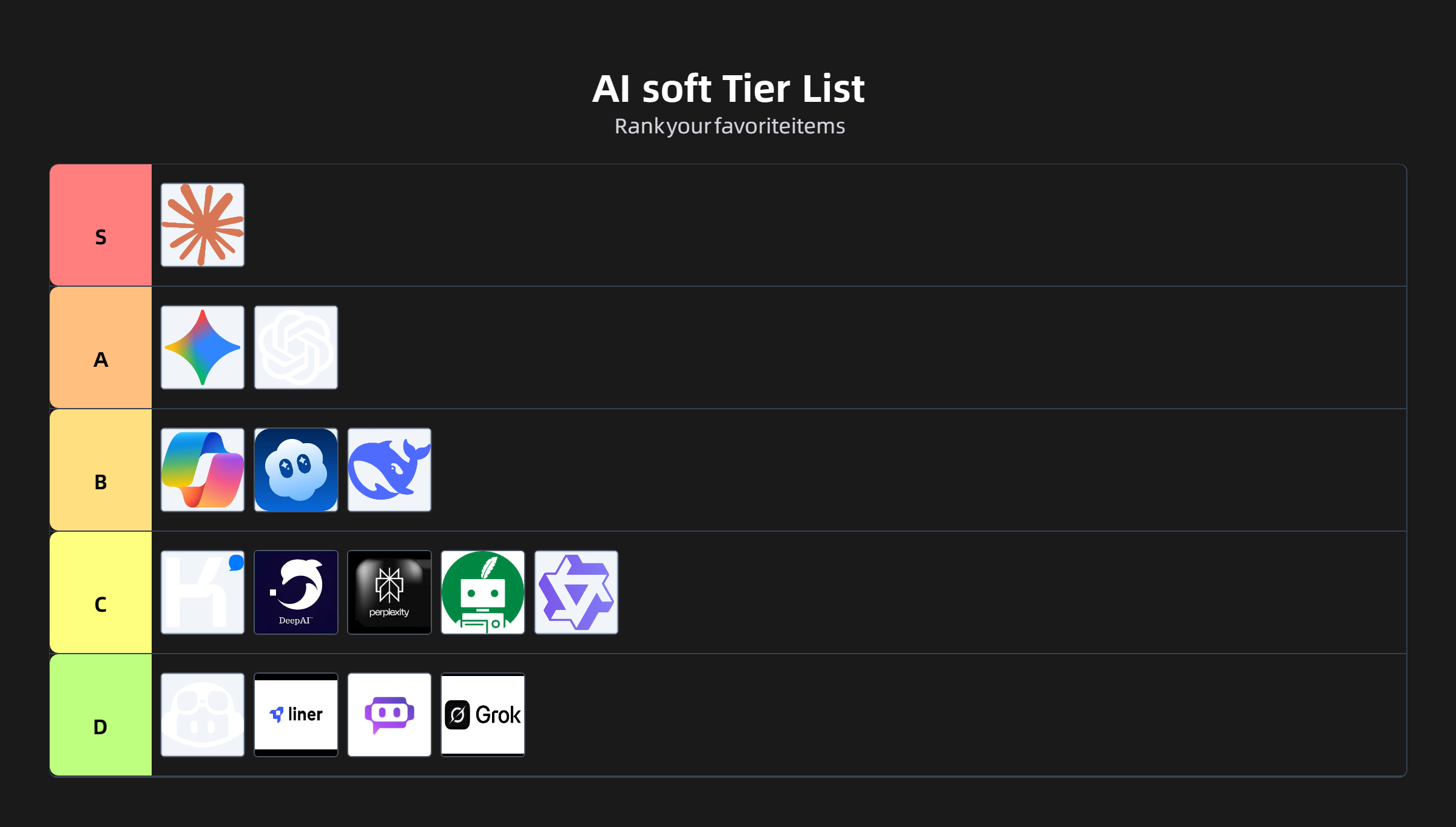
If you're building your own ranking, see how internal linking helps readers find related tools — the same logic applies to comparing AI products: don't just rank based on launch-day headlines, rank based on the tasks you actually repeat every week.
The ChatGPT and Codex Merger: A Preview of the Human-AI Collaboration Trend
The most quietly important part of the GPT-5.6 rollout wasn't the benchmark scores — it was the merger. Codex is no longer a side tool you open separately; it's folded directly into the ChatGPT desktop app alongside a new "Work" agent that can read your files, your Slack, your documents, and turn all of that context into a finished spreadsheet, slide deck, or report on its own.
That's the real story behind every AI tier list 2026 conversation happening right now. We're not really ranking chatbots anymore. We're ranking coworkers. The old question — "which AI answers questions best" — is being replaced by a much bigger one: which AI can actually finish the task, end to end, while you do something else?
This is why a simple tierlist maker ranking is more useful than a 3,000-word comparison article. It forces you to rank based on outcome, not vibes:
- Does it finish the task without me babysitting every step?
- Does it hand off cleanly between chat, coding, and document work?
- Does the cost per completed task actually make sense for how I work?
The merger of chat and coding tools into one workspace tells you where this is heading. Human-AI collaboration in 2026 isn't about picking one "best" model and sticking with it forever — it's about knowing which model to hand which job, the same way you'd delegate to different people on a team. Claude tends to win when the task needs careful judgment. Codex-powered ChatGPT tends to win when the task needs speed and execution across many small steps. Gemini tends to win when the task is buried inside a mountain of documents.
Frequently Asked Questions
Is ChatGPT 5.6 actually better than Claude? Not universally. GPT-5.6 is generally faster and more token-efficient for everyday and agentic coding tasks, while several testers have pointed to Claude as having deeper raw reasoning for complex, ambiguous work. The honest answer depends entirely on the task you're ranking.
What's the point of using a tierlist maker instead of just reading reviews? Reviews describe an AI in isolation. A tier list forces a relative comparison — S-tier versus B-tier — based on your own repeated use, which is a far more honest way to decide where to actually spend your time and budget.
Does the ChatGPT-Codex merger mean coding tools are disappearing into chatbots? Not disappearing — converging. The trend across the industry is toward one workspace that can chat, code, and produce finished documents, rather than separate apps for each job.
Should I only use one AI going forward? Most people who rank all four seriously end up using two or three, splitting work by strength rather than picking a single winner.
Final Thoughts: Build Your Own AI Tier List Before You Trust Anyone Else's
Every AI comparison you read online, including this one, is shaped by whoever wrote it. The fastest way to cut through the noise around GPT-5.6, Claude, Gemini, and Codex isn't to memorize benchmark charts — it's to open a tierlist maker, run your own week of real tasks through each model, and drag them into the tiers that reflect what actually happened for you. Human-AI collaboration is only going to get more layered from here, and the people who benefit most will be the ones who ranked honestly instead of following the loudest headline.