Classic Games
Classic Arcade Games Tier List
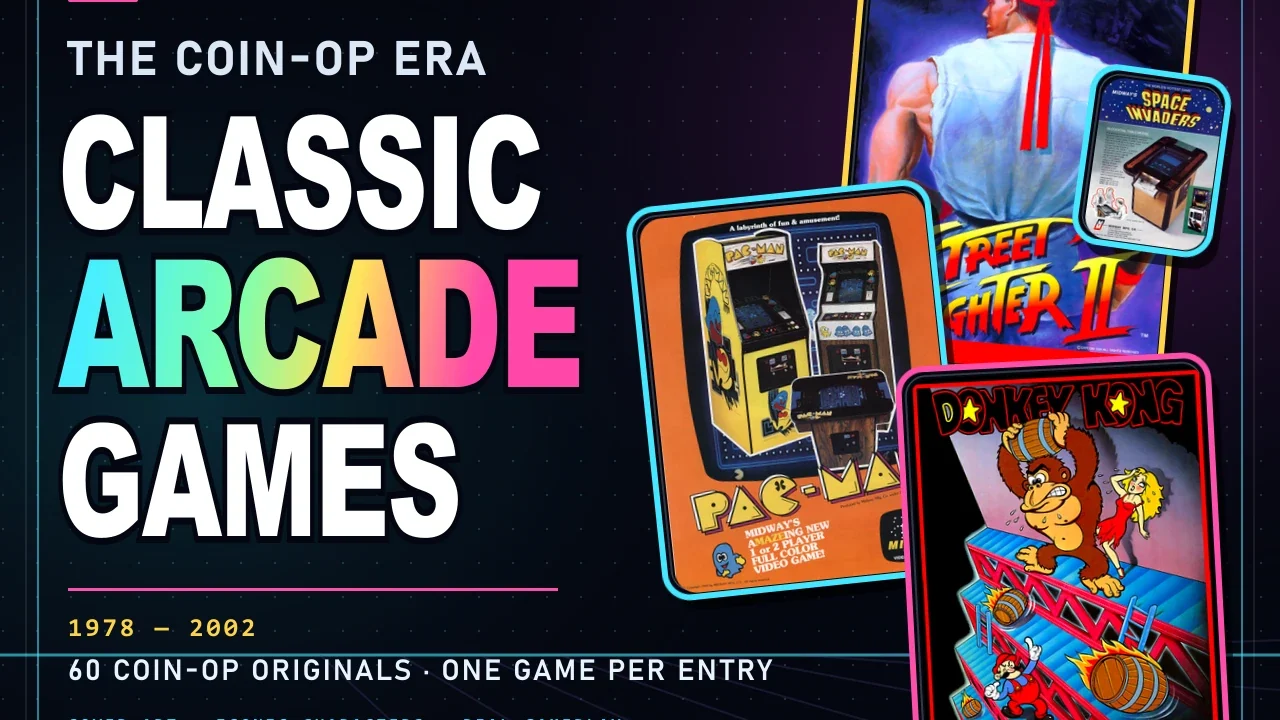
Sixty coin-op originals released between 1978 and 2002, spanning shooters, maze chases, platformers, racers, fighters, beat-'em-ups, light-gun games and rhythm cabinets. Rank each by personal favorite, arcade feel, historical influence and how well it represents its era — arcade releases only, no home ports.
Classic Arcade Games comes with preloaded items so you can begin ranking immediately, but the board is still flexible enough to reflect your own criteria.
You can also explore Classic Games templates, or create a blank tier list to keep ranking what you like.
Note: This tier list is for temporary editing. The system template may update, while images and text you add are saved in this browser and can be restored after a refresh or when you reopen the page.
Inside the template
Meet every option in Classic Arcade Games
This template gathers sixty arcade originals from the coin-op era, from Space Invaders in 1978 through Soulcalibur II in 2002. Every entry is the arcade release itself — no home conversions, no mobile games styled after arcades, and no regional variants of the same title. Sort the cabinets by how much you love them, how they felt to play, what they changed in game design, and how squarely they represent their decade. The order is yours to set.
Editorial review: 2026-11-16
-
Space Invaders
Taito released Space Invaders in 1978 as a single-screen shooting gallery in which a lone cannon slides along the bottom edge while rows of aliens march sideways and descend one step per pass. Destroying the last invader accelerates the remaining formation, a speed-up trick tied to the game's modest hardware. It helped establish the coin-op industry's high-score culture and inspired numerous later shooters.
Official source -
Asteroids
Atari shipped Asteroids in 1979, putting a vector-drawn ship in a wrapping field of drifting rocks that split into smaller, faster fragments when shot. Thrust, rotation and a hyperspace jump are the only controls, and momentum carries the ship until the player counteracts it. Its vector monitor and stark black-and-white line art became a recognizable look for late-1970s arcades.
Official source -
Galaxian
Namco's Galaxian arrived in 1979 with full-color sprite graphics and enemy squadrons that peel away from formation to dive at the player's ship, sometimes escorting a flagship. Clearing an escort pair during a dive yields bonus points, rewarding timing over mere survival. Its use of color and moving starfield set it apart from the monochrome fixed-formation shooters that preceded it.
Official source -
Pac-Man
Namco released Pac-Man in 1980, designed by Toru Iwatani as a maze game built around eating rather than shooting. Four ghosts chase the player through a dot-filled maze, each with its own targeting behavior, while power pellets briefly reverse the pursuit. Its character-driven design and intermissions helped broaden arcade audiences beyond the shooting-game crowd.
Official source -
Missile Command
Atari released Missile Command in 1980, a Dave Theurer design in which three anti-ballistic missile batteries defend six cities from falling warheads. Players move a crosshair with a trackball and tap one of three fire buttons, each tied to a limited magazine, so choosing which battery to drain becomes the central tension. Trackball aiming and the grim premise distinguish it from the shooters beside it.
Official source -
Centipede
Centipede arrived from Atari in 1981, designed by Ed Logg with Dona Bailey, then among the few women working as an arcade game designer. A trackball drives the bug-zapper through a mushroom field, and hitting the centipede splits it into faster, erratic segments that plunge toward the player. Mushrooms can be shot away for mobility or kept as cover, a choice that recurs each wave.
Official source -
Defender
Williams released Defender in 1981, the Eugene Jarvis and Larry DeMar design that puts the player in a side-scrolling ship above a planetary surface. A radar scanner at the top of the screen tracks threats outside the visible area, while thrust, reverse and fire sit on separate controls. Landers abduct humanoids, and losing them all ends the game early, an uncommon fail state.
Official source -
Donkey Kong
Nintendo's Donkey Kong reached arcades in 1981, designed by Shigeru Miyamoto for the company's early coin-op push. Jumpman, later Mario, climbs girders and ladders toward the ape, using a single jump button to clear barrels and fireballs while a timer forces pace. Four stage types rotate their hazards, and an opening animation of Kong hauling Pauline up the structure frames the rescue.
Official source -
Frogger
Konami's 1981 coin-op, distributed in North America by Sega/Gremlin, has the player hop a frog lane by lane across a highway of trucks and cars, then a river of logs and diving turtles. Every hop runs against a timer, so a hesitant jump is as fatal as a careless one. Filling all five bays at the top completes the round and pays a bonus.
Official source -
Galaga
Namco's 1981 fixed shooter builds on Galaxian's dive-bombing flights: aliens wheel into a grid, peel off in swooping attacks, then slide back into formation. A tractor beam can capture the player's ship, and destroying the captor later releases it to fly alongside as a paired fighter with doubled fire. Bonus challenging stages turn the usual formations into fast patterned flybys, rewarding clean shooting.
Official source -
Q*bert
Gottlieb's 1982 release places an orange, snout-nosed creature on an isometric pyramid of cubes that change colour each time he lands on them; clear them all to advance. Coily the snake, bouncing balls and spring-launched foes interfere, and stepping off the edge ends the round. The cabinet used a four-way joystick mounted diagonally to match the tilted playfield.
Official source -
Dig Dug
In Namco's 1982 Dig Dug the player tunnels down through colour-coded soil strata, then inflates the underground monsters Pooka and Fygar with a pump until they burst. Fygar breathes fire along a horizontal line, and loosened rocks can be dropped to crush pursuers. Because the tunnels are self-dug, escape routes close as quickly as they open.
Official source -
Joust
Williams released Joust in 1982 as a two-player-focused arcade game built on a then-new flight mechanic: tapping the button flaps the mount upward, and height decides every collision. Players lance buzzards, pterodactyls and rival knights across floating platforms above a lava pit. It was among the earliest arcade titles to offer simultaneous cooperative play, letting two riders fight together or against each other.
Official source -
Robotron: 2084
Robotron: 2084 arrived from Williams in 1982 with a twin-stick layout: one joystick moves the human, the second fires in any direction independently. Waves of robots, tanks and spheres converge from all sides, and the player must clear them while rescuing the last human family. Its dual-joystick control scheme became a reference point for later twin-stick shooters.
Official source -
Pole Position
Namco's Pole Position, licensed in North America by Atari, reached arcades in 1982 and put the player in a sit-down cabinet with a steering wheel and pedals. The goal is to qualify for pole position, then place well in a race against rival cars on a track that scrolls with pseudo-3D scaling. It was an early racing game to use real circuit branding, based on the Fuji Grand Prix course.
Official source -
BurgerTime
Data East published BurgerTime in 1982, casting chef Peter Pepper on a lattice of platforms where he walks across giant burger ingredients to drop them, layer by layer, onto a plate below. Hot dogs, fried eggs and pickles chase him while pepper spray buys a moment. Its premise of collapsing the level itself rather than clearing enemies set it apart from other maze-chase games of the period.
Official source -
Tron
Tron arrived in 1982 from Bally Midway, built alongside Disney's film rather than adapted after its release. Players rotate between four sub-games — I/O Tower, MCP Cone, Light Cycles and Battle Tanks — chosen from a central Grid screen that tracks progress through each. The light-cycle phase, which leaves a solid trail behind every bike, is its clearest arcade signature.
Official source -
Dragon's Lair
Cinematronics released Dragon's Lair in 1983, with animation by Don Bluth's studio delivered from a laserdisc rather than generated as sprites. Play consists of brief, timed input prompts during full-motion scenes; a wrong or late press costs one of the player's lives. The laserdisc let the cabinet show cartoon footage far beyond what sprite hardware of the period could draw.
Official source -
Mario Bros.
Nintendo's Mario Bros. reached arcades in 1983 as a single-screen platform game for one or two players. Mario and Luigi clear pipes and floors by bumping enemies from below, then kicking the stunned creatures away, while a POW block offers limited screen-clearing help. It introduced Luigi as a second-player character, and its flip-from-below rule echoed in Nintendo's later platform design.
Official source -
Star Wars
Atari's Star Wars appeared in 1983 and ran on a color vector monitor, drawing wireframe TIE fighters and a trench in glowing lines. A flight yoke controller handled aiming, and a speech chip delivered lines such as Obi-Wan's "Use the Force." The three-part structure moves from space combat to a surface tower assault and finally the Death Star trench run.
Official source -
Spy Hunter
Bally Midway sent Spy Hunter to arcades in 1983, casting the player as a weaponized sports car fleeing down a vertically scrolling highway. Enemy cars, helicopters and motorcycles give chase while the player fires machine guns and releases oil slicks, and driving into the weapons van swaps bodies and adds armament. Its licensed Peter Gunn theme and sit-in cockpit cabinet are recurring hallmarks.
Official source -
Paperboy
Atari Games released Paperboy in 1984, an isometric ride down a suburban street where the aim is landing newspapers in subscriber mailboxes while dodging dogs, lawnmowers, breakers and cars. Too many missed deliveries end the route, while hitting reward houses earns bonuses. The upright cabinet steered with a handlebar controller whose twist grip set the bike's speed.
Official source -
Punch-Out!!
Nintendo's arcade Punch-Out!! arrived in 1984 as a boxing game seen from behind the player's fighter, drawn as a large transparent outline at the bottom of the screen. Each opponent telegraphs punches that must be read and countered before the knockdown count runs out. The cabinet stacked two monitors vertically, giving the ring and scoring their own display space.
Official source -
Marble Madness
Mark Cerny designed Marble Madness, released by Atari Games in 1984 as the debut title on its System 1 hardware. Players roll a marble across isometric obstacle courses against a countdown, steering with a trackball whose spin converts into momentum. Sloped ramps, acid pools and a rival black marble populate the six courses, and a second player can roll alongside.
Official source -
Gauntlet
Gauntlet arrived in arcades in 1985 from Atari Games, seating up to four players in a top-down dungeon crawl of monsters, keys and treasure. Health ticks down continuously instead of only dropping when hit, so survival depends on feeding the cabinet coins, and a synthesized voice announces each character's state. Its shared screen and draining health bar shaped later four-player arcade dungeon games.
Official source -
Ghosts 'n Goblins
Capcom developed and released Ghosts 'n Goblins in 1985, a side-scrolling action game in which knight Arthur hurls lances through graveyards and demon-filled forests. A hit strips his armor and leaves him in boxer shorts; a second hit ends the run, making the armor a visible life gauge. Reaching the true ending demands a second, harder lap.
Official source -
Gradius
Konami's 1985 horizontal shooter Gradius replaced instant power-ups with a meter: every capsule collected slides a cursor across Speed Up, Missile, Double, Laser and Option, and the player confirms the pick. Selecting Option adds an orbiting satellite that copies the Vic Viper's fire, and several stack up. That spend-it-yourself upgrade scheme became the series' trademark.
Official source -
Space Harrier
Sega's 1985 rail shooter Space Harrier sends a jetpack-equipped hero sprinting toward the horizon across checkerboard ground, blasting dragons and geometric bosses stage after stage. It runs on Sega's Super Scaler sprite-zoom hardware, generating speed and depth by scaling sprites rapidly. A deluxe cabinet physically tilted and rotated with joystick input to echo the flight.
Official source -
Bubble Bobble
Taito released Bubble Bobble in 1986 as a single-screen platform puzzler. Players guide the dragons Bub and Bob, blowing bubbles that trap enemies and then bursting them to clear each of 100 stages, with power-ups altering bubble range and speed. Its cabinet linked two players in cooperation rather than head-to-head play, and the hidden true ending required both.
Official source -
Out Run
Sega's Out Run arrived in 1986, designed by Yu Suzuki on the company's Super Scaler pseudo-3D hardware. Drivers race a red sports car through five stages, choosing among branching routes at each checkpoint while a timer counts down. The deluxe sit-down cabinet tilted and swayed with the road, and a radio-style selector let players pick among three music tracks during play.
Official source -
Double Dragon
Technos Japan released Double Dragon in 1987, with Taito handling North American distribution. Two players punch, kick and throw their way through street gangs to rescue Marian, picking up baseball bats, whips and barrels left by fallen foes. Simultaneous two-player cooperation was unusual for the time, and the arcade version let partners strike each other by mistake.
Official source -
Rampage
Bally Midway's Rampage landed in 1986 as a three-player cabinet in which George the gorilla, Lizzie the lizard and Ralph the werewolf demolish city blocks. Punching buildings crumbles them floor by floor while helicopters, tanks and soldiers retaliate, and eating people or food restores health. The wide control panel let all three monsters play at once.
Official source -
Contra
Konami's 1987 arcade Contra is a side-scrolling run-and-gun in which soldiers advance through jungle and base stages, firing in eight directions while jumping and lying prone. Floating pods upgrade the default rifle into spread, laser or fire rounds. The cabinet supported two players at once, making coordinated covering fire part of the design.
Official source -
After Burner II
Sega released After Burner II in 1987, a pseudo-3D jet combat shooter rendered with the studio's sprite-scaling hardware. Behind-the-cockpit views have players bank, roll and fire homing missiles at waves of fighters, while a throttle lever controls speed for the first time in the series. Deluxe cabinets tilted and pitched in time with the aircraft's movement.
Official source -
R-Type
Irem published R-Type in 1987, a horizontally scrolling shooter built around the Force, an orb that docks to the front or rear of the R-9 ship and absorbs and fires on its own. Holding the button charges a beam, and stage layouts reward memorized positioning. Giger-influenced biomechanical enemies and a giant battleship stage define its look.
Official source -
Operation Wolf
Taito's Operation Wolf arrived in 1987 as a rail shooter played with a mounted, Uzi-styled light gun. Players sweep crosshairs across hostage-filled jungle and airfield scenes, managing a limited magazine, collecting ammunition drops and throwing grenades at tanks and helicopters. The cabinet's heavy gun controller and on-screen ammo counter made reload discipline part of the challenge.
Official source -
Altered Beast
Released by Sega in 1988, Altered Beast is a side-scrolling brawler built around a single escalating promise: gathering three Spirit Balls dropped by two-headed wolves lets the hero morph into a werewolf, dragon, tiger or bear, each with its own attacks. The transformation interrupts play for a full-screen display. Two players fight centurion-style monsters across a graveyard, cave and temple, with the arcade build running on Sega's System 16 board.
Official source -
Teenage Mutant Ninja Turtles
Konami's 1989 Teenage Mutant Ninja Turtles turned the 1987 cartoon into a four-player simultaneous beat-'em-up, with each Turtle on his own colour-coded joystick. Two buttons cover attack and jump, and pizza slices restore health. Stages follow the sewer, subway and Technodrome settings of the show, ending in fights against Rocksteady, Bebop and Krang. Its cabinet carried four sets of controls so all four Turtles could fight on screen at once.
Official source -
Final Fight
Capcom released Final Fight in 1989 on its new CPS-1 hardware, sending mayor Mike Haggar, Cody and Guy through Metro City's streets against the Mad Gear gang. Punches chain into grabs and throws, and weapons and food hidden in barrels and crates reward poking at the scenery. It began development as a follow-up to Street Fighter, and its large character sprites and two-player co-op shaped the brawlers that followed.
Official source -
Golden Axe
Sega's 1989 Golden Axe casts three fighters — Ax Battler, Tyris Flare and Gilius Thunderhead — against Death Adder, each with a different magic spell charged by collecting potions. Mounted enemies can be knocked off and then ridden, and the dwarf's lightning, the amazon's fire and the barbarian's earth magic clear the screen differently. Two-player co-op shares the same stages, and the arcade version ran on Sega's System 16 hardware.
Official source -
Track & Field
Konami released Track & Field in 1983, tasking players with clearing six Olympic-style events on a single credit. Running events hinge on rapidly alternating two buttons to build speed, while the action button sets takeoff angle or throw trajectory. That alternating-button sprint input became a widely copied arcade control scheme, and qualifying standards carried forward from one event to the next.
Official source -
Street Fighter II: The World Warrior
Capcom's 1991 Street Fighter II: The World Warrior pits two fighters one-on-one, with eight selectable characters whose fireball and anti-air moves come from joystick-and-button command inputs. Its six-button panel separates light, medium and heavy punches and kicks, and consecutive hits that players chained together developed into the combo play associated with competitive arcade fighting.
Official source -
The Simpsons
Konami's 1991 The Simpsons sends Homer, Marge, Bart and Lisa through a side-scrolling Springfield to rescue Maggie. Two buttons cover attack and jump, and pressing them together rolls the character forward as a tackle. Up to four players share a single cabinet, and characters can lift and throw each other as well as found objects, a cooperative touch uncommon in the beat-'em-ups of that period.
Official source -
Mortal Kombat
Midway's 1992 Mortal Kombat built its fighters from digitized live actors and gave the five-button cabinet a dedicated block button. After a knockout, a timed input sequence triggers a Fatality finishing move, a mechanic made notorious by the game's blood-spattered presentation. Those scenes were raised during United States congressional hearings on video game violence in 1993.
Official source -
Virtua Racing
Sega AM2's 1992 racer used flat-shaded polygons for its cars and tracks on Sega's Model 1 board, an early showcase for fully polygonal arcade racing. Players pick Formula One-style cars and chase checkpoint times across three courses, choosing automatic or manual gears. The deluxe cabinet added a hydraulic motion seat, and up to eight linked units could race at once.
Official source -
Samurai Shodown
SNK released this weapon-based fighter in 1993 on the Neo Geo MVS hardware. Duels turn on spacing and single heavy strikes rather than long combos, with a rage meter that powers a counterattack once filled. The camera pulls back and zooms in as fighters separate or close distance, an effect that gives its sword clashes unusual weight.
Official source -
Virtua Fighter
Yu Suzuki's 1993 Sega AM2 project presented fighters as flat-shaded polygonal models on Model 1 hardware, an approach new to the genre. Combat uses three buttons — punch, kick and guard — plus ring-outs that punish bad positioning. Character moves were captured from martial artists, and the sparse arena stages removed the scrolling backgrounds that 2D fighters relied on.
Official source -
Daytona USA
Sega AM2's 1994 stock-car racer ran on Model 2 hardware and offered three fictional ovals, including the beginner-friendly Three Seven Speedway. Drifting through corners while working the gearbox is the core skill, and the deluxe cabinet seated the player inside a roll cage with a four-speed shifter. Up to eight cabinets could be linked for simultaneous races.
Official source -
Time Crisis
Time Crisis debuted in arcades in 1995, developed and published by Namco on its System 22 hardware. Players aim a light gun at enemy soldiers while a foot pedal controls cover: pressing it pops the player out to fire, and releasing it ducks back to reload. A countdown timer forces constant movement between cover points, making the pedal mechanic the game's signature among light-gun shooters.
Official source -
Metal Slug
Metal Slug arrived in arcades in 1996 on SNK's Neo Geo MVS hardware, developed by Nazca Corporation, a studio formed by former Irem staff, and published by SNK. It is a side-scrolling run-and-gun in which soldiers shoot through enemy armies, rescue prisoners for bonus points and can commandeer the small tank that gives the game its name. Its large, hand-animated sprites and comic touches are a defining feature.
Official source -
The King of Fighters '97
Released by SNK in 1997 on Neo Geo MVS hardware, The King of Fighters '97 closes out the Orochi storyline through three-on-three team battles. Before each match players choose either the Advanced or Extra gauge system, one building power through hits and the other through charging, then fight in order until a whole team falls. That pre-fight choice reshapes offensive tempo and comeback options.
Official source -
DoDonPachi
DoDonPachi reached arcades in 1997, developed by Cave and published by Atlus as the follow-up to DonPachi. Pilots pick one of two ships and switch between a wide shot and a concentrated laser, while bombs double as screen-sweeping beams. Scoring hinges on the chain counter: keep destroying enemies without a break and the hit total climbs, setting survival against scoring.
Official source -
Dance Dance Revolution
Konami's rhythm game appeared in Japanese arcades in 1998, housed in a cabinet whose floor is a stage of four pressure-sensitive arrow panels. Directional prompts scroll up the screen and must be stepped on in time; too many misses end the song. The platform itself, not a joystick or light gun, is the input device.
Official source -
Marvel vs. Capcom: Clash of Super Heroes
Capcom's crossover fighter landed in 1998 on CPS II hardware, pitting Marvel heroes against Capcom characters in two-on-two tag battles. Each player additionally selects an assist partner who drops in for a single attack, and both fighters can be committed at once for a Duo Team hyper combo. Switching partners mid-combo is central rather than optional.
Official source -
The House of the Dead 2
The House of the Dead 2 reached arcades in 1998, published by Sega and built for its Naomi hardware. Players aim light guns at zombies along rail-shooter routes, rescuing civilians while route choices shift with their actions. Set in Venice, it continues the horror theme of the 1996 original, and its cabinet supports two players side by side.
Official source -
Crazy Taxi
Crazy Taxi arrived in arcades in 1999 from Sega, developed in-house by the company. Players pick up fares in an open city and race the clock to deliver them, earning tips through near misses, jumps and the Crazy Dash boost. Real brand storefronts served as drop-off points, and a licensed rock soundtrack from The Offspring and Bad Religion accompanied the driving.
Official source -
Silent Scope
Konami released Silent Scope in arcades in 1999, building the cabinet around a replica sniper rifle mounted on a stand. Players aim at the main screen, then raise the eyepiece to a small built-in display showing a magnified view, picking off enemies before a countdown expires. The scope-zoom display, rather than a conventional point-and-shoot light gun setup, set it apart from other coin-op shooters of the period.
Official source -
Marvel vs. Capcom 2: New Age of Heroes
Capcom released this three-on-three tag fighter to arcades in 2000 on Sega's NAOMI board, following earlier two-character Marvel crossovers. Each player drafts a team and picks an assist partner whose single strike can be called mid-combo, while a match ends only when all three fighters on one side fall. The roster gathered 56 characters from Marvel comics and Capcom series.
Official source -
Tekken 3
Namco released Tekken 3 in arcades in 1997 on its System 12 hardware, with Jin Kazama leading a revised cast. Each of the four buttons drives one limb, and the entry added a sidestep that lets fighters slip around linear attacks rather than block them. Rounds stay short and knockdown-heavy, which suits the cabinet's head-to-head format.
Official source -
Soulcalibur II
Weapon-based 3D duels defined Soulcalibur II, which Namco brought to arcades in 2002, developed by Project Soul and running on System 246 hardware derived from PlayStation 2 architecture. Its 8-Way Run lets fighters circle opponents freely in three dimensions, while Guard Impact rewards timed deflections over passive blocking. Ring-outs remain a valid finish, so positioning near the arena edge matters as much as damage.
Official source
Customize this board without losing the structure that makes it useful
Classic Arcade Games comes with preloaded items so you can begin ranking immediately, but the board is still flexible enough to reflect your own criteria.
Related rankings and guides