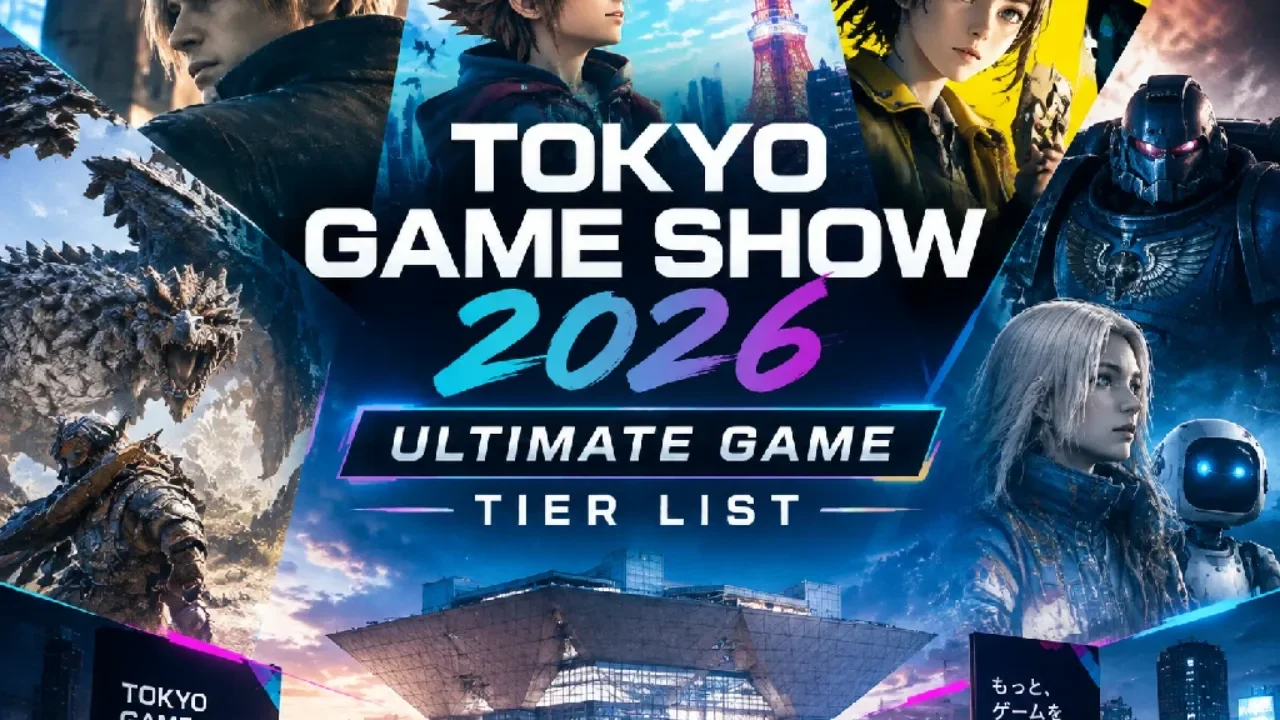
Use this guide to rank the games featured in this Tokyo Game Show 2026 collection. Consider which titles have the strongest concepts, most exciting worlds, best returning characters, or greatest potential to define their genre. The list includes established franchises, announced projects, rumored or stylized entries, and bold new directions, so feel free to judge them by anticipation rather than confirmed details alone.
-
1
Attack on Titan Season 3
Rank this as an anime season rather than a playable game. Season 3 shifts sharply from external Titan warfare to political conflict inside the Walls, then builds toward the Scouts’ return to Shiganshina. Its strongest ranking factors are the Royal Government arc, Historia’s central role, Levi’s personal history, and the major revelations delivered during the climactic second half.
Official source
-
2
Castlevania: Belmont's Curse
This is a 2D action-exploration Castlevania game centered on Rose Belmont in 1499 Paris. Rank it by the appeal of its freeform traversal, whip-focused combat, boss-derived Arcana abilities, and equipment customization across seven weapon categories. It favors players who value gothic atmosphere and exploration-driven progression over purely linear platforming or roguelike repetition.
Official source
-
3
Dragon Quest Monsters: The Withered World
Rank this monster-raising RPG around the depth of its collection and synthesis loop. Bianca and Nera travel through the Witherwood kingdom while befriending monsters, exploring fantastical regions, and seeking a cure for their fathers’ illness. The key comparison is whether its scouting, breeding, team-building, and turn-based battles feel more compelling than its story premise alone.
Official source
-
4
Dragon's Dogma: Dark Arisen
Rank this as an expanded open-world action RPG whose identity comes from physical, improvisational combat. Players create an Arisen, fight alongside AI-controlled Pawns, and face large enemies through climbing, magic, and coordinated attacks. Dark Arisen also includes the Bitterblack Isle expansion, making exploration, difficult encounters, additional equipment, and replayable challenge important factors in its placement.
Official source
-
5
Final Fantasy Resonance
This entry represents the Final Fantasy title centered on the word “Resonance,” making it distinct from the batch’s numbered Final Fantasy VII continuation. Rank it higher for its standalone-sounding identity, thematic emphasis on connection or harmony, and separation from direct sequel labeling. It fits best among anticipated fantasy RPG projects with an original subtitle.
-
6
Final Fantasy VII Revelation
This entry is the batch’s explicitly numbered Final Fantasy VII title, with “Revelation” giving it a conclusive and high-stakes subtitle. Rank it according to sequel importance, narrative-finality appeal, and direct connection to the Final Fantasy VII identity. It should stand apart from Final Fantasy Resonance as the more clearly serialized and continuity-focused choice.
-
7
Kingdom Hearts IV
This entry is the only numbered Kingdom Hearts title in the batch, so its strongest ranking distinction is franchise continuity rather than subtitle style. Place it higher for the significance of a mainline Roman-numeral installment, recognizable series identity, and direct contrast with the more experimental-sounding or project-based names elsewhere in the list.
-
8
Lollipop Chainsaw New Project
This entry is identified as a new project rather than a numbered sequel or subtitle-led continuation. Rank it for revival potential, recognizable franchise branding, and the uncertainty implied by project terminology. Compared with the Final Fantasy and Kingdom Hearts entries, it has the clearest emphasis on returning to an established property through a newly framed release.
-
9
Mega Man: Dual Override
Rank this entry by how convincingly it combines Mega Man’s recognizable action-platforming identity with the tension implied by “Dual Override.” Compare it against other mechanically focused titles by emphasizing weapon variety, boss encounters, movement precision, and whether the dual-system concept creates meaningful strategic choices rather than serving as simple cosmetic flavor.
-
10
Monster Hunter Outlanders
Rank this entry around the balance between Monster Hunter’s hunting identity and the frontier atmosphere suggested by “Outlanders.” Compare its appeal through creature-tracking potential, preparation depth, cooperative momentum, environmental exploration, and the clarity of its outsider-themed presentation. Give higher placement to entries that make the hunt feel purposeful while keeping the equipment and encounter loop readable.
-
11
Monster Hunter Wilds: Ascendance
Rank this entry by the scale and ambition implied by “Wilds: Ascendance,” while separating genuine gameplay impact from subtitle-driven expectations. Compare the strength of its wilderness presentation, monster variety, traversal flow, combat readability, gear progression, and multiplayer appeal. A top-tier placement should reflect an experience that feels like a substantial step upward rather than a minor variation on familiar hunting routines.
-
12
OD
Rank OD by the strength of its mystery, atmosphere, and ability to sustain interest with limited information. Compare it with more openly defined games by focusing on emotional impact, visual identity, narrative curiosity, and the promise of a distinctive player experience. Place it higher when the ambiguity feels intentional and compelling, while avoiding assumptions about features or release details not established by the title.
-
13
Onimusha: Way of the Sword
Onimusha: Way of the Sword is a swordplay action game set in Kyoto at the beginning of the Edo period. Malice has transformed the city, filling it with grotesque Genma. Players control a samurai equipped with the Oni Gauntlet, making this a darker, combat-focused revival of Capcom’s long-running Onimusha series.
Official source
-
14
Persona 4 Revival
Persona 4 Revival revisits the rural town of Inaba, where a chain of mysterious murders is connected to rumors about the Midnight Channel. Like the original Persona 4, the adventure combines school life, relationship-building, Persona fusion, dungeon exploration, and turn-based battles against Shadows while pursuing the truth.
Official source
-
15
Physint
Physint is a new action-espionage project from Kojima Productions made in partnership with Sony Interactive Entertainment. It marks Hideo Kojima’s return to the espionage genre after his earlier work on Metal Gear. Officially announced as a new intellectual property, the project is designed to blend advanced game technology with film-industry talent.
Official source
-
16
Pragmata
Pragmata is a single-player science-fiction action adventure set in the near future on a lunar research station. Hugh, a human astronaut, and Diana, an android called a Pragmata, must work together to escape. Its defining mechanic combines firearm combat with hacking, allowing Diana to expose enemy weaknesses and open routes through the station.
Official source
-
17
Romancing SaGa 3: Destinies United
Romancing SaGa 3: Destinies United is a full 3D remake of the 1995 JRPG, developed by Square Enix and xeen Inc. It preserves the original’s choice-driven adventure while adding Casual, Normal, and Classic difficulty options. Kenji Ito supervised newly arranged music, and players can switch between original and arranged tracks during the journey.
Official source
-
18
Silent Hill: Townfall
Silent Hill: Townfall is a first-person psychological horror game centered on Simon Ordell, who returns to the fog-shrouded St. Amelia Island. Its setting emphasizes abandoned-looking streets, coastlines, fragmented clues, and disturbing ties to the town’s former residents. Compared with traditional third-person Silent Hill entries, its first-person viewpoint gives exploration and unease a more intimate focus.
Official source
-
19
Sonic Racing: CrossWorlds
Sonic Racing: CrossWorlds is a dimension-hopping racing game built around Travel Rings that send competitors into changing worlds mid-event. Races span land, sea, air, and space, while vehicle customization, gadgets, and power-up items add strategic variety. It supports solo and team play, with offline local modes and online competition for up to 12 players.
Official source
-
20
Stranger Than Heaven
Stranger Than Heaven is RGG Studio’s action-adventure built around an epic story spanning 50 years, five distinct eras, and multiple cities. Its combat system is designed for flexibility, while show-business elements let players take on the role of a performer. The project stands apart from conventional Like a Dragon settings by emphasizing changing historical periods and a long-form personal saga.
Official source
-
21
Total War: WARHAMMER 40,000
Rank this item by how compelling its imagined blend of large-scale strategy and Warhammer 40,000 atmosphere feels. Compare it with character-driven action games, fantasy role-playing titles, and established strategy franchises in the template. Consider faction identity, battlefield scale, customization potential, and whether the concept sounds distinctive enough to stand apart from more familiar Warhammer adaptations.
-
22
Wo Long 2: Wings of Ember
Rank this item by the strength of its imagined sequel identity and martial-fantasy appeal. Compare it with other action role-playing games in the template by considering combat intensity, mythic atmosphere, visual direction, and how clearly the subtitle suggests a new adventure. Favor concepts that feel like a meaningful evolution rather than a minor continuation of an existing formula.