Movies
Best Movie Villains Tier List
Compare movie villains across films and franchises through characterization, distinctive screen presence, and the memories they leave behind. Rank your personal favorites or the most iconic characters, rather than judging combat strength or the popularity of their actors.
Best Movie Villains comes with preloaded items so you can begin ranking immediately, but the board is still flexible enough to reflect your own criteria.
You can also explore Movies templates, or create a blank tier list to keep ranking what you like.
Note: This tier list is for temporary editing. The system template may update, while images and text you add are saved in this browser and can be restored after a refresh or when you reopen the page.
Inside the template
Meet every option in Best Movie Villains
Decide whether your tiers reflect personal favorites or the villains you consider most iconic, then apply that choice consistently. Consider motivations, dialogue, visual design, narrative impact, and how vividly each character stays with you after the credits. Judge their film portrayals rather than an actor's celebrity or a hypothetical fight. For characters with multiple screen versions, choose a reference portrayal before placing them.
Editorial review: 2026-11-18
-
Dr. Hannibal Lecter
In The Silence of the Lambs, imprisoned psychiatrist and cannibal Hannibal Lecter turns interviews with FBI trainee Clarice Starling into intimate psychological contests. His cultivated manners make the threat more unsettling, not less. Rank him for the contrast between civility and brutality, his command of conversations from behind a barrier, and the uneasy fascination created by a killer who also supplies crucial insights.
Official source -
Norman Bates
Psycho introduces Norman Bates as a shy motel proprietor whose awkward hospitality gradually becomes inseparable from dread. His relationship with his mother, the looming house above the motel, and the film's revelations transform seemingly ordinary encounters into something sinister. Rank him for deceptive vulnerability, the tension between sympathy and suspicion, and how completely the ending changes your understanding of his earlier behavior.
Official source -
Darth Vader
Darth Vader gives the Galactic Empire a terrifying human silhouette: black armor, mechanical breathing, and a presence that makes subordinates visibly uneasy. The former Jedi Anakin Skywalker is also a fallen father whose connection to Luke complicates his role as an enforcer. Rank him for instantly recognizable design, controlled menace, and the tragic conflict beneath the mask rather than lightsaber prowess.
Official source -
The Wicked Witch of the West
In The Wizard of Oz, the Wicked Witch of the West pursues Dorothy and the ruby slippers, turning a colorful journey into a recurring nightmare. Her green face, pointed hat, flying monkeys, and eventual defeat by water give her unusually vivid visual anchors. Rank this incarnation for fairy-tale menace, memorable entrances, and the contrast she creates with Dorothy's hopeful companions.
Official source -
Nurse Ratched
In One Flew Over the Cuckoo's Nest (1975), Nurse Ratched controls a psychiatric ward through rigid routines, public humiliation, and a calm insistence on obedience. Her struggle with McMurphy makes ordinary institutional authority feel threatening. Rank her for the chilling contrast between her composed manner and the damage she inflicts, rather than for spectacular violence.
Official source -
Mr. Potter
In It's a Wonderful Life (1946), Mr. Potter uses financial power to challenge George Bailey's community-minded building and loan business. His decision to keep money mistakenly placed in his hands turns a business rivalry into a personal catastrophe. Rank him for how effectively his greed embodies the opposite of the film's generosity and mutual support.
Official source -
Alex Forrest
In Fatal Attraction (1987), editor Alex Forrest refuses to let her affair with married lawyer Dan Gallagher remain a brief encounter. Her escalating intrusion into his family life, including the notorious rabbit scene, turns intimacy into domestic suspense. Rank her for the tension between emotional vulnerability and threatening behavior, and for how strongly those scenes linger.
Official source -
Phyllis Dietrichson
In Double Indemnity (1944), Phyllis Dietrichson draws insurance salesman Walter Neff into an affair and a scheme to murder her husband for an insurance payout. Flirtation becomes conspiracy, while their apparent partnership steadily exposes distrust. Rank her for the precision of her manipulation and the way seductive dialogue makes a murderous bargain feel dangerously persuasive.
Official source -
The Evil Queen
In Disney’s Snow White and the Seven Dwarfs, the Queen turns jealousy into a murderous obsession, consulting her Magic Mirror and using a poisoned apple against Snow White. Her regal appearance and old-woman disguise offer two distinct faces of menace. Rank her for fairy-tale imagery, vanity-driven characterization, and the unsettling transformation of beauty into cruelty.
Official source -
HAL 9000
The Discovery’s onboard computer in 2001: A Space Odyssey makes a calm voice and watchful red lens feel threatening. HAL’s lethal actions turn the crew’s dependence on their own ship into a trap, while his shutdown introduces an unexpectedly vulnerable register. Rank him for restrained menace, the betrayal of technological trust, and the ambiguity of his apparent humanity.
Official source -
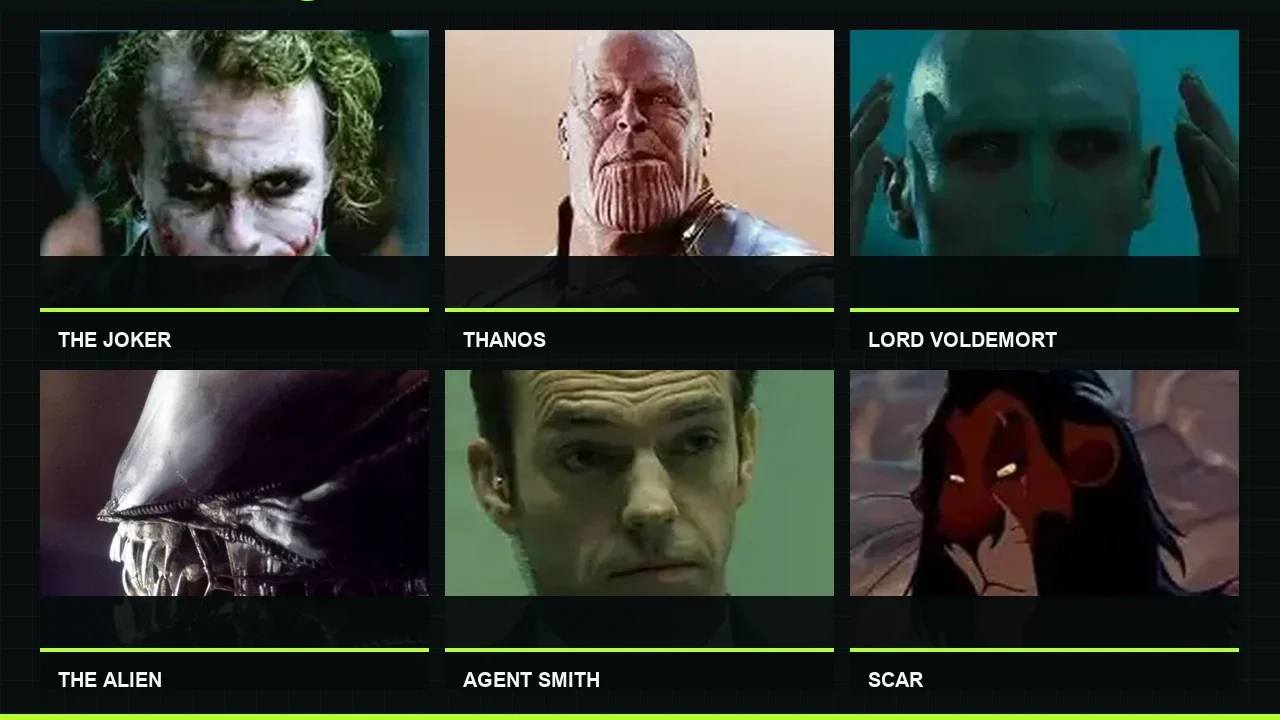
The Alien
The creature stalking the Nostromo in Alien has no persuasive speech or personal grievance: its presence makes survival itself the story. Its emergence from Kane and subsequent attacks turn enclosed working spaces into places of dread. Rank this original screen incarnation for its disturbing body horror, elusive presence, and the tension created by an enemy the crew barely understands.
Official source -
Annie Wilkes
In Misery, Annie rescues novelist Paul Sheldon after a car crash, then makes his recovery a captivity governed by her devotion to his books. Her outrage over a fictional character’s death turns admiration into coercion. Rank her for the frightening shifts between solicitous care and punishment, and for making a secluded bedroom feel like an entire prison.
Official source -
The Terminator
In The Terminator (1984), this human-looking machine travels back in time to kill Sarah Connor. Its sparse speech, relentless pursuit, and gradually exposed metal skeleton make the character frightening through persistence rather than elaborate motivation. Rank this original antagonist for the tension of its unstoppable approach and its striking fusion of slasher menace with science-fiction imagery.
Official source -
Gordon Gekko
Gordon Gekko in Wall Street tempts young broker Bud Fox with wealth, access, and the promise of belonging among financial elites. His villainy operates through persuasion and corporate espionage rather than physical intimidation. Consider how effectively his polished authority makes corruption attractive: the character's ranking appeal lies in the uneasy overlap between an aspirational mentor and a predatory manipulator.
Official source -
Jack Torrance
The Shining (1980) turns writer and winter caretaker Jack Torrance into a threat to his own wife and son inside the isolated Overlook Hotel. His resentment and history of violence give the supernatural setting an intimate, domestic horror. Rank him for the disturbing collapse of a father's protective role, the escalating hostility, and the unforgettable axe-wielding pursuit.
Official source -
Count Dracula
Bela Lugosi's Count Dracula in Dracula (1931) brings an aristocratic vampire from Transylvania to London, where he seeks victims by night. His formal bearing and controlled menace offer a different kind of villainy from frantic killers or roaring monsters. Rank this incarnation for the unsettling contrast between cultivated manners and predatory intent, and for the atmosphere his presence creates.
Official source -
Cruella De Vil
In Disney’s One Hundred and One Dalmatians, Cruella turns a desire for a spotted fur coat into a threat against defenseless puppies. Her split black-and-white hair and extravagant fashion make vanity instantly recognizable as villainy. Rank her for the contrast between theatrical comedy and genuine cruelty, rather than treating her later origin-story incarnation as the same characterization.
Official source -
Freddy Krueger
Freddy Krueger makes sleep itself dangerous in A Nightmare on Elm Street, pursuing teenagers through dreams where ordinary safety disappears. His burned face, battered hat, and bladed glove give that premise a distinctive visual identity. Consider whether his nightmare imagery and invasion of an unavoidable human routine leave a stronger impression than villains whose threats remain in the waking world.
Official source -
Hans Gruber
In Die Hard, Hans Gruber disguises an elaborate robbery as a terrorist siege of Nakatomi Plaza. His controlled manners and calculated deceptions contrast with John McClane’s improvisational survival. The encounter in which he poses as a frightened hostage crystallizes his appeal: intelligence expressed through performance. Rank him for composure, manipulation, and the tension created when his polished plans begin unraveling.
Official source -
Auric Goldfinger
Auric Goldfinger turns an obsession with gold into a scheme to contaminate the reserves at Fort Knox, increasing the value of his own holdings. In Goldfinger, his wealthy respectability conceals ruthless calculation. The laser-table confrontation distills his menace into leisurely confidence. Consider how effectively greed, extravagant planning, and unhurried cruelty combine into a memorable opponent for James Bond.
Official source -
The Joker
Batman's opposite number turns crime into a challenge to the very idea of order. In The Dark Knight, the Joker pushes Gotham into chaos and blurs the boundary between heroism and vigilantism. Rank him for the unsettling contrast between clown imagery and cruelty, his unpredictability, and how effectively he tests the hero's principles.
Official source -
Thanos
Thanos gives the Avengers' cosmic conflict a single, imposing face. His pursuit of the Infinity Stones culminates in a finger snap that erases half of all life in the universe. For this ranking, weigh the dramatic impact of a villain actually achieving his objective and how strongly that moment defines your memory of the films.
Official source -
Lord Voldemort
Born Tom Riddle, Voldemort pursues immortality through Horcruxes and commands the Death Eaters. His failed attempt to kill Harry as an infant makes their conflict deeply personal. Rank him for the tension between his terrifying reputation and his fear of death, and for how effectively that obsession sustains the Harry Potter films' central threat.
Official source -
Agent Smith
In The Matrix, Agent Smith is a black-suited program serving the machines by eliminating threats to their simulated world. That makes him more than a pursuer: he gives an oppressive system a recognizable human face. Rank him for the contrast between bureaucratic appearance and lethal enforcement, and for how effectively his confrontations with Neo embody the struggle against control.
Official source -
Anton Chigurh
In No Country for Old Men, Anton Chigurh pursues stolen money with a chilling lack of ordinary human sympathy. His coin toss turns a seemingly casual encounter into a confrontation with arbitrary death. Rank him for the dread generated by his restraint and inscrutable rules, rather than for elaborate speeches or a sympathetic backstory.
Official source -
Hans Landa
Hans Landa, the Nazi colonel in Inglourious Basterds, makes courteous conversation feel like a trap. The opening farmhouse interrogation establishes his ability to stretch uncertainty until politeness becomes terrifying. For ranking, consider how effectively his cultivated manner conceals persecution and cruelty: his defining threat is the intelligence behind the smile, not battlefield prowess.
Official source -
Scar
Scar turns family resentment into royal catastrophe in Disney’s animated The Lion King. He kills his brother Mufasa, manipulates Simba into exile, and takes the throne. His theatrical ambition in “Be Prepared” contrasts with the intimate cruelty of betraying his own family. Rank him for that combination of musical showmanship, calculated deception, and lasting emotional impact.
Official source -
Jafar
In Disney’s animated Aladdin, Jafar hides a bid for power behind his position as the Sultan’s grand vizier. His cobra-headed staff, scheming parrot Iago, and pursuit of the magic lamp give him a distinctive villainous identity. Rank him for the progression from calculating palace adviser to flamboyant magical tyrant, and for how clearly ambition drives his menace.
Official source -
Ursula
Ursula turns Ariel’s wish to become human into a trap in Disney’s animated The Little Mermaid, taking her voice while plotting to seize Triton’s realm. Her appeal as a villain lies in manipulative persuasion rather than simple aggression. Rank her for the unsettling contrast between an apparently helpful bargain and the predatory ambition behind it.
Official source -
Maleficent
In Disney’s animated Sleeping Beauty, Maleficent curses Princess Aurora and ultimately confronts Prince Phillip as a towering, fire-breathing dragon. Her villainous presence moves from calculated magical cruelty to a spectacular physical threat. Rank this portrayal for its fairy-tale menace and memorable escalation, keeping the animated antagonist distinct from the sympathetic reinterpretation in the later live-action film.
Official source
Customize this board without losing the structure that makes it useful
Best Movie Villains comes with preloaded items so you can begin ranking immediately, but the board is still flexible enough to reflect your own criteria.
Related rankings and guides