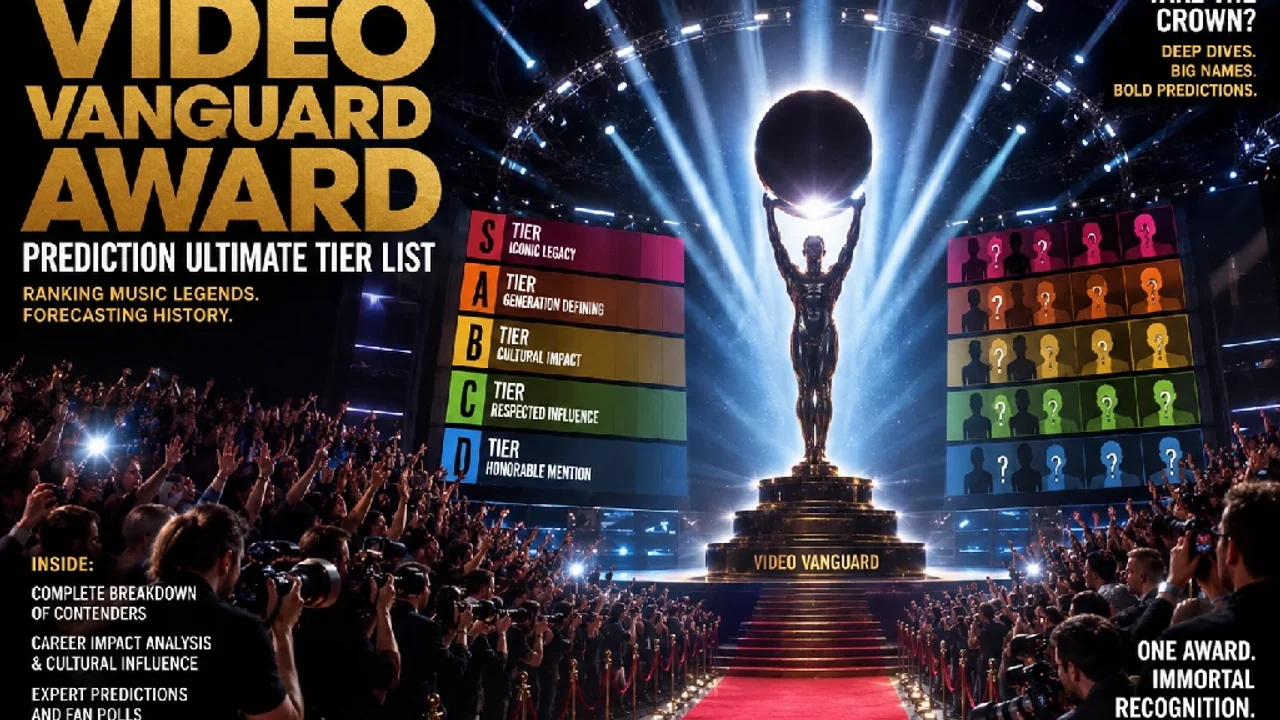
This fan-made 2026 MTV VMAs Video Vanguard Award prediction tier list compares 30 artists through the work most relevant to the honor: landmark music videos, visual innovation, choreography, direction, cultural reach, and influence across a sustained career. Several entries are previous Vanguard recipients, so rank the full image set as a debate about visual legacy and ceremony fit rather than treating it as an official eligibility list.
-
1
Taylor Swift
Taylor Swift turns each album era into a distinct visual world, from the sharp social satire of "Blank Space" and the ensemble spectacle of "Bad Blood" to the self-directed storytelling of "Anti-Hero." Her case rests on narrative control, repeat VMA success, and an unusually consistent link between songwriting and image.
Official source
-
2
Rihanna
Rihanna already received the Video Vanguard Award in 2016, so she works better here as a benchmark than a fresh candidate. "Umbrella," "We Found Love," and "Bitch Better Have My Money" show her range from iconic pop styling to raw location work and cinematic revenge narrative.
Official source
-
3
Beyoncé
Beyoncé received the Video Vanguard Award in 2014 and has continued to expand the album-length music film. The visual albums "Beyoncé," "Lemonade," and "Black Is King" combine choreography, fashion, regional history, and cinematic authorship, making her an essential standard for ambition and thematic unity.
Official source
-
4
Bruno Mars
Bruno Mars builds videos around performance precision, retro references, and effortless comic timing. "Uptown Funk," "24K Magic," and "That’s What I Like" turn choreography, wardrobe, and camera movement into extensions of the groove; his shorter catalogue competes through polish, charisma, and unusually high replay value.
Official source
-
5
Lady Gaga
Lady Gaga made the music video a stage for fashion, provocation, and dense pop mythology. "Bad Romance," "Telephone," "Born This Way," and "Rain on Me" move from horror glamour to serialized storytelling and large-scale choreography, while her unforgettable VMA performances strengthen a career built for this honor.
Official source
-
6
Britney Spears
Britney Spears helped define MTV-era pop through choreography, instantly readable concepts, and fearless image changes. "...Baby One More Time," "Oops!... I Did It Again," "Toxic," and "Womanizer" remain visual shorthand for different stages of mainstream pop, giving her a deep legacy beyond any single viral moment.
Official source
-
7
Christina Aguilera
Christina Aguilera used videos to make each reinvention unmistakable. The teen-pop framing of "Genie in a Bottle," the confrontational club imagery of "Dirrty," and the vulnerable portraiture of "Beautiful" show how styling and performance could support radically different messages without losing her vocal identity.
Official source
-
8
Justin Timberlake
Justin Timberlake received the Video Vanguard Award in 2013, making him another past honoree in this pool. "Cry Me a River," "Rock Your Body," "Suit & Tie," and "Mirrors" balance choreography, sleek production design, and longer-form narrative, with his solo breakthrough closely tied to MTV imagery.
Official source
-
9
Eminem
Eminem turned rap videos into a flexible mix of parody, character acting, and serious narrative. "My Name Is" and "Without Me" weaponize celebrity satire, while "Stan" and "Love the Way You Lie" use dramatic storytelling; that range gives his catalogue unusual cultural reach across multiple MTV eras.
Official source
-
10
Nicki Minaj
Nicki Minaj received the Video Vanguard Award in 2022 after building a catalogue defined by exaggerated color, character personas, and meme-ready imagery. "Super Bass," "Anaconda," "Chun-Li," and "Super Freaky Girl" show how her fashion, comic timing, and elastic performance style command the frame.
Official source
-
11
Ariana Grande
Ariana Grande pairs polished pop glamour with playful visual mechanics. "Problem" established her modern star image, "No Tears Left to Cry" rotated gravity and architecture, "God Is a Woman" stacked art-historical references, and "Positions" used a White House fantasy to make a concise statement about authority.
Official source
-
12
The Weeknd
The Weeknd treats videos as chapters in sustained character arcs rather than isolated promotions. The violence and transformation connecting "Heartless," "Blinding Lights," "In Your Eyes," and "Save Your Tears" gave the After Hours era a coherent nightmare, building on earlier cinematic work such as "The Hills" and "Starboy."
Official source
-
13
Miley Cyrus
Miley Cyrus has repeatedly used video to announce a new phase of her public identity. "We Can’t Stop" and "Wrecking Ball" made her 2013 break impossible to ignore, while "Midnight Sky" and "Flowers" shifted toward self-directed, performance-centered confidence with cleaner visual control.
Official source
-
14
Justin Bieber
Justin Bieber’s visual history tracks the shift from YouTube discovery to global pop institution. "Baby" captures his teen-idol origin, "Sorry" succeeds through stripped-back dance and color, and "What Do You Mean?" and "Peaches" show later attempts to balance narrative, lifestyle imagery, and adult performance.
Official source
-
15
Usher
Usher’s strongest videos make athletic choreography feel like part of the song’s structure. "U Remind Me," "Yeah!," "Burn," and "OMG" span intimate R&B drama and arena-scale pop, while his precision, camera awareness, and influence on later male performers give the catalogue lasting Vanguard relevance.
Official source
-
16
Alicia Keys
Alicia Keys favors emotional clarity over visual excess. "Fallin’," "If I Ain’t Got You," "No One," and "Girl on Fire" use piano performance, New York settings, and intimate character stories to reinforce her songwriting, creating a restrained but recognizable visual identity across more than two decades.
Official source
-
17
Avril Lavigne
Avril Lavigne gave early-2000s pop-punk a clear visual language of skate culture, loose ties, street performance, and mischievous rebellion. "Complicated," "Sk8er Boi," "Girlfriend," and "What the Hell" kept that personality legible even as production grew brighter and more conventionally pop.
Official source
-
18
Shakira
Shakira received the Video Vanguard Award in 2023 after decades of globally legible movement and multilingual pop imagery. "Whenever, Wherever," "Hips Don’t Lie," "Waka Waka," and "Monotonía" connect distinctive dance, surreal details, and Latin identity with crossover scale, making her another established benchmark in this list.
Official source
-
19
Harry Styles
Harry Styles has a smaller solo video catalogue than many names here, but it is visually consistent and willing to be strange. "Sign of the Times," "Adore You," "Watermelon Sugar," and "As It Was" combine surreal situations, saturated color, and vulnerable performance without losing broad pop accessibility.
Official source
-
20
Jennifer Lopez
Jennifer Lopez received the Video Vanguard Award in 2018, recognizing a career where dance, fashion, and screen presence are inseparable. "If You Had My Love," "Waiting for Tonight," "Jenny from the Block," and "On the Floor" trace changing pop technology while keeping movement at the center.
Official source
-
21
Pink
Pink’s videos balance blunt humor, physical risk, and emotional directness. "Get the Party Started" introduced her unruly charisma, "Stupid Girls" sharpened celebrity satire, "So What" turned personal upheaval into slapstick spectacle, and "Try" translated relationship conflict into demanding contemporary choreography.
Official source
-
22
Missy Elliott
Missy Elliott received the Video Vanguard Award in 2019 after transforming rap imagery through scale, fisheye distortion, futuristic costume, and absurd humor. "The Rain (Supa Dupa Fly)," "Sock It 2 Me," "Work It," and "Lose Control" remain reference points for artists chasing invention rather than realism.
Official source
-
23
Mariah Carey
Mariah Carey’s videos chart the evolution of modern pop celebrity across decades. "Fantasy" captures joyful amusement-park freedom, "Honey" plays with spy-film glamour, "Heartbreaker" turns dual roles into comedy, and "We Belong Together" uses romantic melodrama to support one of her defining vocal performances.
Official source
-
24
Kendrick Lamar
Kendrick Lamar approaches the music video as compressed cinema, often using composition and symbolism to extend the song’s argument. "Alright," "HUMBLE.," "ELEMENT.," and "Not Like Us" move between social protest, surreal tableaux, portrait photography, and communal celebration with unusually deliberate visual authorship.
Official source
-
25
Drake
Drake’s best-known videos understand how quickly a visual gesture can become shared internet language. The colored rooms and restrained dance of "Hotline Bling," the generosity narrative of "God’s Plan," and the celebratory cameos in "Nice for What" balance meme power with accessible storytelling.
Official source
-
26
Billie Eilish
Billie Eilish built a singular visual identity through unsettling practical effects, minimal spaces, and close control of her own performance. "When the Party’s Over," "Bury a Friend," "Bad Guy," and "What Was I Made For?" turn discomfort, deadpan humor, and vulnerability into images that remain immediately recognizable.
Official source
-
27
SZA
SZA’s videos turn emotional uncertainty into surreal, cinematic spaces. "Love Galore," "The Weekend," "Good Days," and "Kill Bill" use shifting identities, dream logic, choreography, and genre references to make inner conflict visible, giving her relatively compact catalogue a strong narrative and visual signature.
Official source
-
28
Dua Lipa
Dua Lipa’s visual strength comes from disciplined choreography and tightly controlled color. "New Rules" turned group movement into a viral pop grammar, while "Don’t Start Now," "Physical," and "Levitating" refined disco references, retro-futurist sets, and confident performance into a coherent modern dance-pop identity.
Official source
-
29
Olivia Rodrigo
Olivia Rodrigo has built a persuasive visual identity quickly by filtering heartbreak through teen-film and alternative-rock references. "Drivers License," "Good 4 U," "Vampire," and "Get Him Back!" move from intimate realism to stylized chaos; her main limitation is catalogue length rather than concept or execution.
Official source
-
30
Bad Bunny
Bad Bunny uses video to connect Puerto Rican identity, gender commentary, humor, and global-scale pop imagery. "Yo Perreo Sola," "DÁKITI," "Tití Me Preguntó," and "MONACO" range from deliberate role reversal to sleek science fiction and cinematic excess, supporting a strong case for contemporary cultural impact.
Official source