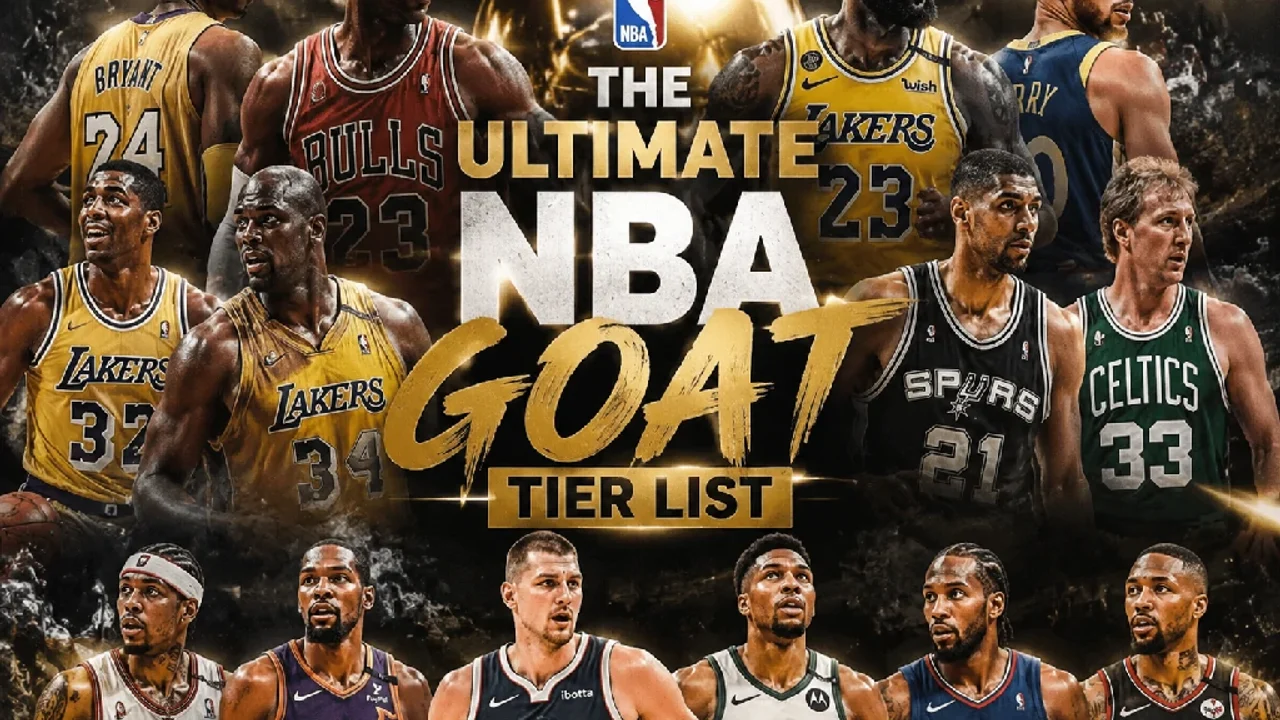
Rank 34 NBA legends and current stars including Michael Jordan, LeBron James, Stephen Curry, and Victor Wembanyama by peak dominance, two-way impact, longevity, playoff resume, cultural influence, or your own GOAT standards. A useful ranking separates first impressions from the strengths that hold up over time, so place what you genuinely know rather than reputation alone.
-
1
Michael Jordan
Michael Jordan combines six championships, five MVP awards, elite perimeter defense, and unmatched late-game scoring. His two three-peats, 1991-1993 and 1996-1998, make peak dominance and playoff translation central questions in any all-time comparison.
Official source
-
2
LeBron James
LeBron James pairs four championships and four MVP awards with extraordinary longevity, playmaking, rebounding, and scoring. His ability to carry different teams, control transition offense, and remain elite across two decades makes peak and durability inseparable.
Official source
-
3
Kobe Bryant
Kobe Bryant won five championships, two Finals MVP awards, and the 2008 regular-season MVP while building a reputation for difficult shot creation. His 81-point game, footwork, and defensive intensity reward rankings that value skill under pressure.
Official source
-
4
Stephen Curry
Stephen Curry changed modern offense through unprecedented three-point volume, off-ball movement, and pull-up range. Four championships, two MVP awards including the unanimous 2016 vote, and gravity that creates shots for teammates define his unusual offensive impact.
Official source
-
5
Magic Johnson
Magic Johnson led the Showtime Lakers with five championships, three MVP awards, and a point guard's passing vision in a 6-foot-9 frame. His transition orchestration, rebounding, and leadership make him a benchmark for total offensive control.
Official source
-
6
Shaquille O'Neal
Shaquille O'Neal produced one of basketball's most overwhelming peaks, winning four championships and three consecutive Finals MVP awards. His deep-post position, rim pressure, and physical finishing forced opponents to redesign entire playoff game plans.
Official source
-
7
Tim Duncan
Tim Duncan anchored the Spurs to five championships with two MVP awards, three Finals MVP awards, bank-shot reliability, and elite team defense. His quiet consistency across changing rosters makes him a strong test of longevity and winning value.
Official source
-
8
Larry Bird
Larry Bird won three championships and three consecutive MVP awards by combining shooting, passing, rebounding, and anticipation rather than relying on speed. His Celtics leadership and ruthless late-game reads reward rankings that value complete half-court influence.
Official source
-
9
Wilt Chamberlain
Wilt Chamberlain owns statistical extremes that remain difficult to imagine, including 100 points in one game and a 50.4-point scoring season. His two championships and later passing evolution add context beyond raw box-score dominance.
Official source
-
10
Bill Russell
Bill Russell won eleven championships in thirteen seasons and five MVP awards through anticipation, switching intelligence, rebounding, and defensive leadership. His value often appears in possessions erased before a box score can record them.
Official source
-
11
Russell Westbrook
Russell Westbrook brought relentless rim attacks, transition speed, and explosive rebounding to a guard position, highlighted by the 2017 MVP season and multiple triple-double campaigns. His ranking depends on balancing creation volume with efficiency and playoff fit.
Official source
-
12
Kevin Durant
Kevin Durant blends a near-seven-foot scoring release, three-level shot making, rim protection, and efficient isolation. Two championships and two Finals MVP awards show his playoff ceiling, while his portability across teams strengthens the versatility case.
Official source
-
13
James Harden
James Harden built an MVP-level offensive engine around the step-back three, foul-drawing craft, and high-volume pick-and-roll passing. His Houston peak produced historic scoring and creation, while playoff questions make context important in his tier.
Official source
-
14
Giannis Antetokounmpo
Giannis Antetokounmpo combines two MVP awards, a Defensive Player of the Year season, and the 2021 championship with open-court force and switchable defense. His growth from raw transition threat to primary creator defines a rare two-way arc.
Official source
-
15
Kawhi Leonard
Kawhi Leonard won championships and Finals MVP awards with both San Antonio and Toronto, pairing enormous hands with elite wing defense and precise mid-range scoring. His peak is extraordinary, but availability and workload are essential comparison criteria.
Official source
-
16
Anthony Davis
Anthony Davis offers rare center mobility, switch defense, rim protection, lob finishing, and face-up scoring, highlighted by the 2020 championship run. His tier changes sharply depending on whether peak two-way impact or availability receives more weight.
Official source
-
17
Chris Paul
Chris Paul controlled games through pace, ball security, mid-range precision, and one of the era's finest pick-and-roll decisions. His assist and steal production, leadership across several teams, and lack of a championship invite different standards.
Official source
-
18
Kyrie Irving
Kyrie Irving combines perhaps the era's deepest handle package with ambidextrous finishing and difficult shot making. The 2016 Finals comeback and his deciding three-pointer show a unique offensive ceiling, even as durability and role balance remain debated.
Official source
-
19
Damian Lillard
Damian Lillard stretches defenses from logo range, creates late-clock shots, and pairs pull-up scoring with confident playmaking. His 2019 series winner against Oklahoma City and years as Portland's offensive engine make self-created offense central to his case.
Official source
-
20
Allen Iverson
Allen Iverson turned a small frame into an MVP-caliber scoring weapon through acceleration, crossover separation, fearless rim attacks, and constant pressure. His 2001 Finals run and cultural influence broaden the comparison beyond efficiency alone.
Official source
-
21
Tracy McGrady
Tracy McGrady reached a breathtaking scoring peak with smooth pull-ups, long-stride drives, and creative passing from the wing. His 13 points in 35 seconds remains iconic, while injuries and limited playoff success complicate the legacy debate.
Official source
-
22
Vince Carter
Vince Carter combined explosive leaping, smooth perimeter scoring, and an unforgettable 2000 Slam Dunk Contest with a record-setting twenty-two-season career. His transformation from superstar scorer to veteran role player makes longevity part of the argument.
Official source
-
23
Dwyane Wade
Dwyane Wade was a downhill guard who blended shot blocking from the backcourt, creative rim finishing, and timely mid-range scoring. His 2006 Finals MVP and three championships, including the Miami Big Three era, anchor his two-way guard résumé.
Official source
-
24
Carmelo Anthony
Carmelo Anthony built a long scoring career on jab-step isolation, polished footwork, and a versatile mid-range package. His 2003 NCAA title, Olympic success, and international role add dimensions beyond the question of regular-season efficiency.
Official source
-
25
Derrick Rose
Derrick Rose became the youngest MVP in 2011 by attacking the rim with extraordinary first-step speed, body control, and fearless finishes. His later reinvention after major knee injuries makes peak-versus-longevity weighting especially meaningful.
Official source
-
26
Steve Nash
Steve Nash won consecutive MVP awards by turning the Suns into a fast, efficient offense built on early attacks, split-second passing, and elite shooting. His influence is clearest when pace, decision quality, and teammate enhancement matter as much as scoring.
Official source
-
27
Paul Pierce
Paul Pierce used strength, footwork, shot fakes, and late-clock confidence to become Boston's primary scorer before the 2008 title team formed. That championship and Finals MVP connect his isolation craft to proven team success.
Official source
-
28
Charles Barkley
Charles Barkley was an undersized power forward who generated elite rebounding, transition pressure, and unusual face-up creation. His 1993 MVP season and Phoenix Finals run show a massive individual peak, while the missing championship remains part of the debate.
Official source
-
29
Dwight Howard
Dwight Howard anchored three consecutive Defensive Player of the Year seasons with vertical rim protection, rebounding, and powerful roll finishes. His 2009 Orlando Finals team demonstrated a center-led formula, while later role changes complicate his overall ranking.
Official source
-
30
Jayson Tatum
Jayson Tatum blends wing size, self-created threes, transition finishing, and switchable defense with a growing playoff résumé. His 2024 championship run gives the modern star a team-success anchor, while continued efficiency will shape his historical tier.
Official source
-
31
Shai Gilgeous-Alexander
Shai Gilgeous-Alexander controls possessions with patient footwork, change of pace, middy precision, and relentless rim pressure. His long-stride isolation game and evolving playmaking make him a useful test of current production versus established legacy.
Official source
-
32
Victor Wembanyama
Victor Wembanyama combines extraordinary length with perimeter mobility, face-up skill, passing flashes, and shot blocking that changes opponents' geometry. His career is still developing, so projection, present impact, and durability should be separated carefully.
Official source
-
33
Anthony Edwards
Anthony Edwards attacks with explosive first steps, powerful vertical finishes, and growing pull-up shooting from the guard spot. His leadership during Minnesota's recent playoff runs and improved defense show why his ceiling is still moving upward.
Official source
-
34
Ja Morant
Ja Morant turns speed, hang time, and creative angles into spectacular rim finishing while using pick-and-roll bursts to bend defenses. His 2022 Most Improved Player season established a high offensive ceiling, with health and availability shaping the longer view.
Official source
-
35
Ben Wallace
Ben Wallace was the defensive anchor of Detroit’s championship team in 2004. The undersized center became a four-time Defensive Player of the Year through elite rebounding, shot-blocking, physical post defense, and relentless effort. Rank him especially highly for defensive impact and interior toughness, while recognizing that his offensive value was far more limited than other stars in this group.
Official source
-
36
Chauncey Billups
Chauncey Billups combined steady playmaking, clutch shot-making, and physical perimeter defense at point guard. He led Detroit to the 2004 championship and earned Finals MVP honors, thriving as a calm organizer rather than a high-volume creator. Compared with more explosive guards, his ranking should emphasize leadership, decision-making, spacing, and postseason reliability.
Official source
-
37
Chris Webber
Chris Webber was a versatile power forward whose passing, ball-handling, rebounding, and face-up scoring made him central to Sacramento’s early-2000s offense. His peak value went beyond traditional box-score production because he could initiate offense from the frontcourt. Rank him highly for all-around skill and offensive versatility, while accounting for his injury-shortened prime.
Official source
-
38
Clyde Drexler
Clyde Drexler was an athletic Hall of Fame wing who blended transition scoring, slashing, rebounding, and playmaking. Known as “Clyde the Glide,” he led Portland to two Finals appearances and later won the 1995 championship with Houston. His ranking should reflect strong two-way versatility and leadership, though his individual profile sits below the era’s very top scorer-creators.
Official source
-
39
Corliss Williamson
Corliss Williamson was a strong, efficient forward whose physical drives and mid-range scoring complemented Detroit’s defense-first identity. He won the 2004 championship with the Pistons and earned Sixth Man of the Year honors earlier in his career. Rank him as a valuable role player and interior scorer rather than alongside primary franchise superstars.
Official source
-
40
Dominique Wilkins
Dominique Wilkins was one of the league’s premier scoring forwards, celebrated for explosive athleticism, powerful finishes, and iconic Slam Dunk Contest performances. The Atlanta Hawks star won the 1986 scoring title and repeatedly carried a major offensive load. Rank him highly for scoring force and entertainment value, while weighing his defense and playmaking below his attacking strengths.
Official source
-
41
George Gervin
George Gervin was a fluid scoring wing whose signature finger roll, graceful footwork, and mid-range touch made him one of the 1970s and 1980s’ most elegant offensive players. The Spurs legend won four scoring titles and became known as the “Iceman.” Rank him for scoring artistry, efficiency, and consistency more than defensive dominance.
Official source
-
42
Hakeem Olajuwon
Hakeem Olajuwon combined extraordinary post footwork with elite rim protection, rebounding, mobility, and passing. The Rockets center won two championships, two Finals MVP awards, and the 1994 MVP, leading Houston through the mid-1990s. Rank him near the top for two-way center play: his offensive sophistication and defensive versatility separated him from most traditional big men.
Official source
-
43
James Worthy
James Worthy was a cornerstone of the Los Angeles Lakers’ 1980s dynasty, pairing explosive transition finishes with dependable playoff scoring. Nicknamed “Big Game James,” he won three NBA championships and earned 1988 Finals MVP honors. His ranking profile emphasizes postseason impact, athletic wing play, efficient finishing, and his ability to elevate his production in decisive games.
Official source
-
44
John Stockton
John Stockton defined precision point-guard play during 19 seasons with the Utah Jazz. He retired as the NBA’s career leader in assists and steals, won nine consecutive assist titles, and formed a historic partnership with Karl Malone. For ranking purposes, Stockton stands out for half-court organization, durable availability, low-error passing, pull-up shooting, and disruptive perimeter defense.
Official source
-
45
Kareem Abdul-Jabbar
Kareem Abdul-Jabbar combined longevity, interior efficiency, and defensive presence across a 20-year NBA career. The six-time champion won six MVP awards, made 15 All-NBA teams, and retired as the league’s all-time leading scorer with 38,387 points. His signature skyhook, elite rim protection, and sustained production make him a benchmark for all-time centers.
Official source
-
46
Kevin Garnett
Kevin Garnett brought rare intensity and all-around versatility to the power-forward position. A direct-to-NBA player from high school, he became the 2004 MVP, won Defensive Player of the Year in 2008, and led the Boston Celtics to the 2008 championship. Rank Garnett highly for switchable defense, rebounding, face-up scoring, communication, and emotional leadership.
Official source
-
47
Manu Ginóbili
Manu Ginóbili was an inventive left-handed guard whose creativity shaped the San Antonio Spurs’ modern attack. He won four NBA championships, earned Sixth Man of the Year in 2007-08, and complemented his NBA career with a EuroLeague title and Olympic gold medal. His ranking case centers on passing imagination, rim pressure, transition play, defensive activity, and winning impact.
Official source
-
48
Nikola Jokić
Nikola Jokić has transformed the center position through elite passing, scoring efficiency, and controlled rebounding. The Serbian star became the first player to win three MVP awards in four seasons and led Denver to its first NBA championship in 2023, earning Finals MVP. His ranking profile prioritizes offensive orchestration, touch around the basket, post creation, and triple-double versatility.
Official source
-
49
Pau Gasol
Pau Gasol was a skilled Spanish big man who combined interior scoring, passing, rebounding, and defensive positioning. He won back-to-back NBA championships with the Los Angeles Lakers in 2009 and 2010, earned Rookie of the Year in 2002, and became a six-time All-Star. His ranking value comes from reliable two-way play, high-post facilitation, and strong international résumé.
Official source
-
50
Ray Allen
Ray Allen combined textbook shooting mechanics with off-ball movement and dependable perimeter defense over an 18-year NBA career. A 10-time All-Star and two-time champion, he won titles with Boston in 2008 and Miami in 2013. His ranking profile is defined by three-point volume and accuracy, relocation movement, late-game confidence, and historic Finals shot-making.
Official source
-
51
Reggie Miller
Reggie Miller spent all 18 NBA seasons with the Indiana Pacers, becoming one of basketball’s defining clutch shooters. A five-time All-Star, he finished with 2,560 made three-pointers and built his legend through dramatic playoff performances, especially against the New York Knicks. His off-ball movement, quick release, and late-game confidence made him uniquely difficult to contain.
Official source
-
52
Tony Parker
Tony Parker was a French point guard whose speed, control, and paint scoring powered the San Antonio Spurs for nearly two decades. Selected 28th in the 2001 Draft, he became a six-time All-Star, earned four All-NBA selections, won four championships, and captured 2007 NBA Finals MVP honors. His success made him one of Europe’s most influential NBA guards.
Official source
-
53
Walt Frazier
Walt Frazier, nicknamed “Clyde,” was the stylish floor general who led the New York Knicks to both of their NBA championships. During his Knicks career, he averaged 19.3 points per game, made seven All-Star teams, and earned four All-NBA First Team selections plus seven All-Defensive First Team honors. His polished playmaking and defense defined elite two-way guard play in the 1970s.
Official source