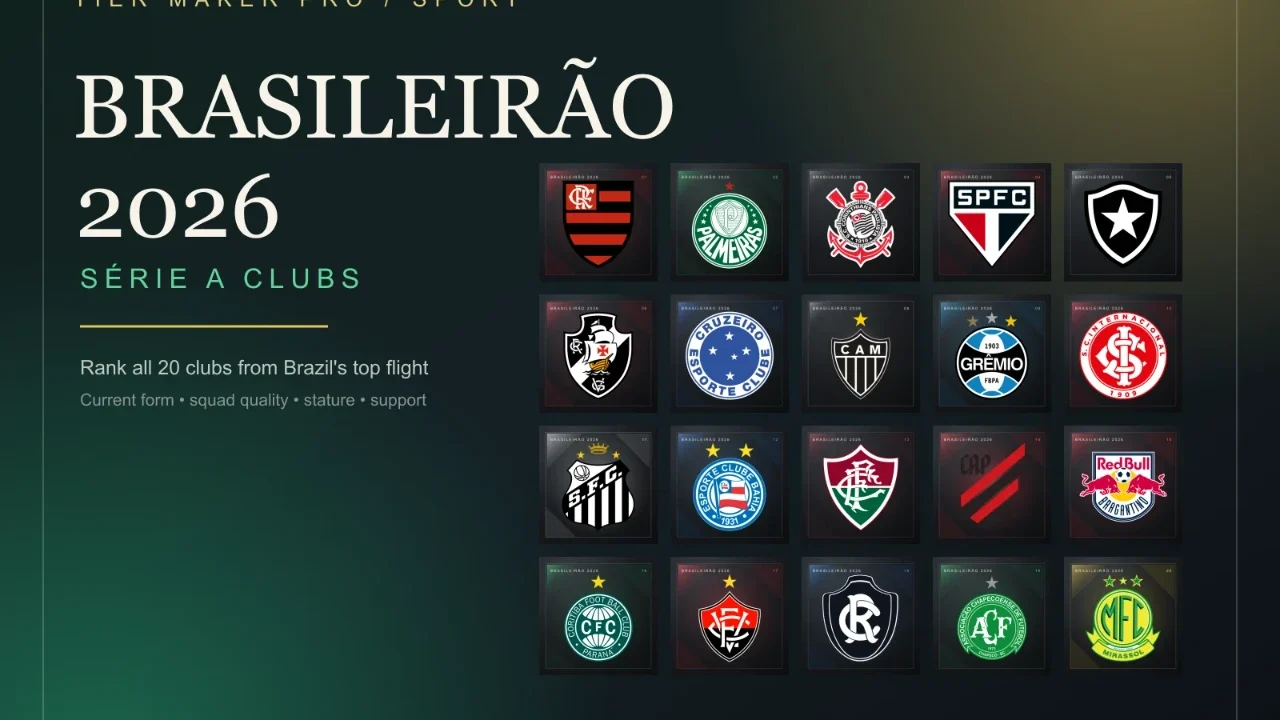
Where do Brazil’s biggest clubs belong alongside the rest of the 2026 Série A field? Place all 20 teams into tiers using the criteria that matter most to you: recent results, squad depth, historical achievements, supporter base, or prospects for the remainder of the season. Decide whether established names deserve a boost for their legacy, and whether a strong current campaign should lift a smaller club above them.
-
1
Flamengo
Based in Rio de Janeiro, Rio de Janeiro state, Flamengo wears red and black and was founded in 1895 as a rowing club. Its large fanbase and history of major honors give it exceptional stature. In 2026, strong Série A form places it among the leading sides. When ranking Flamengo, weigh that form alongside squad depth and the demands of sustaining performances across a long season.
Official source
-
2
Palmeiras
Palmeiras represents São Paulo, São Paulo state, in green and white. Founded in 1914 as Palestra Italia, it has built an extensive record of national and continental honors. Its 2026 Série A form keeps it close to the front of the field, backed by a substantial fanbase and established football infrastructure. Compare its squad depth and consistency with Flamengo’s rather than treating either club’s history as a substitute for current results.
Official source
-
3
Corinthians
The black-and-white Corinthians comes from São Paulo, São Paulo state, and plays at Neo Química Arena. Its devoted fanbase and major honors make it one of Brazilian football’s most prominent clubs. Yet its 2026 Série A form has fallen well short of its stature, making this a test of whether squad quality can translate into steadier performances. Rank the season on the field separately from the weight of the club’s history.
Official source
-
4
São Paulo
São Paulo, based in São Paulo city and state, wears red, white and black and was founded in 1930. Its three Copa Libertadores titles give the Tricolor a distinguished continental history, while MorumBIS and a large fanbase reinforce its stature. Its 2026 Série A form sits between the leading pace and the lower end. For this tier list, balance that uneven campaign against squad quality and the club’s considerable historical standing.
Official source
-
5
Botafogo
Botafogo represents Rio de Janeiro, Rio de Janeiro, in black and white, with the Lone Star on its crest. Its 2024 Brazilian league and Copa Libertadores titles give the club a recent benchmark alongside a longer history associated with Garrincha. For a 2026 tier, judge whether current Série A form and squad depth match that stature, while accounting for its established fanbase rather than treating past trophies as present-day results.
Official source
-
6
Vasco da Gama
Vasco da Gama is a black-and-white club from Rio de Janeiro, Rio de Janeiro, founded in 1898 and closely identified with São Januário. Its history and substantial supporter base make it more than a snapshot of one season. In a 2026 ranking, balance that enduring stature against actual Série A form and available squad depth; the question is how convincingly the present team reflects the expectations attached to its name.
Official source
-
7
Cruzeiro
Cruzeiro comes from Belo Horizonte, Minas Gerais, and is associated with blue and the Southern Cross stars. Founded in 1921 as Palestra Itália, it adopted the Cruzeiro name in 1942. That identity carries deep support and considerable historical weight into 2026. Rank the current side by comparing its Série A form and squad options with those established credentials, without assuming that tradition alone determines its present level.
Official source
-
8
Atlético Mineiro
Atlético Mineiro, the black-and-white Galo of Belo Horizonte, Minas Gerais, was founded in 1908 and plays at Arena MRV. Its long-standing rivalry with Cruzeiro and major honors give it a distinct place in Brazilian football, backed by a committed fanbase. For 2026, assess Série A form and the range of squad options alongside that history: a club's reach and trophies matter, but they should not substitute for the current team's evidence.
Official source
-
9
Grêmio
Grêmio represents Porto Alegre, Rio Grande do Sul, in blue, black and white. A three-time Copa Libertadores winner, the club brings major trophies and a passionate following to any ranking. Its 2026 Série A campaign has been less convincing than that history suggests, so weigh current form and squad depth against its established stature. Grêmio’s identity this year is a storied contender working to close that gap.
Official source
-
10
Internacional
Porto Alegre, Rio Grande do Sul, is also home to Internacional, the red-and-white Colorado and Grêmio’s great local rival. Founded in 1909, Inter has a substantial fanbase and a history that raises expectations beyond a difficult 2026 Série A campaign. For this tier list, separate the weight of the badge from current form: squad depth and consistency matter especially when judging the club’s immediate outlook.
Official source
-
11
Santos
Santos, from the coastal city of Santos in São Paulo state, wears black and white and carries an exceptional football legacy. Pelé’s former club won the Copa Libertadores in 1962 and 1963, a history that gives it stature well beyond one season’s results. Its 2026 Série A form calls for a more measured assessment: compare the squad’s depth and week-to-week performances with that celebrated past and enduring fan appeal.
Official source
-
12
Bahia
Salvador, Bahia, backs the blue, red and white of Bahia, a club crowned Brazilian champion in 1959 and 1988. Its strong 2026 Série A showing gives current form real weight alongside that history and its regional fanbase. Bahia’s City Football Group partnership also shapes its modern identity and squad-building outlook. When ranking it, consider whether present performances and available depth justify placing it above clubs with longer records of continental success.
Official source
-
13
Fluminense
From Rio de Janeiro, Rio de Janeiro, Fluminense wears green, white and burgundy and won the 2023 Copa Libertadores. Its established support, continental pedigree and recent strong Série A form give it a compelling 2026 profile. When ranking the Tricolor, weigh that stature against the squad’s depth and ability to sustain its league performances; history matters, but current quality should carry weight too.
Official source
-
14
Athletico Paranaense
Athletico Paranaense, the red-and-black Furacão of Curitiba, Paraná, plays at Arena da Baixada. After earning promotion from Série B in 2025, it returned to the top flight with the profile of an ambitious club rather than an unfamiliar newcomer. Its strong 2026 league form makes squad depth and consistency especially useful tests alongside its home support and broader stature when assigning a tier.
Official source
-
15
Red Bull Bragantino
Based in Bragança Paulista, São Paulo, Red Bull Bragantino retains the Massa Bruta nickname of a club founded in 1928. Its Red Bull partnership gives its 2026 identity a different shape from Brazil’s traditional giants, while its long-running top-flight presence and recent league form merit attention. Compare its squad depth and consistency with larger clubs’ historical honors and fanbases rather than judging it by brand recognition alone.
Official source
-
16
Coritiba
Coritiba, the green-and-white Coxa of Curitiba, Paraná, plays at Couto Pereira and returned to Série A after winning the 2025 Série B title. That promotion frames its 2026 identity: a club with devoted local support seeking to establish itself again in the top flight. For a tier ranking, balance its recent league form and squad depth against its established home advantage and the demands of sustained Série A competition.
Official source
-
17
Vitória
Vitória represents Salvador, Bahia, in red and black, with the Barradão central to its home identity. A five-time Copa do Nordeste winner, it brings regional stature and a committed fanbase to the 2026 Série A. Its league form makes it a more credible mid-table contender than some smaller clubs, but squad depth and consistency still matter when weighing its outlook against Brazil’s established powers.
Official source
-
18
Remo
Remo is Belém, Pará’s blue-clad Leão Azul, founded in 1905 and backed by a passionate northern fanbase. Its 2026 Série A campaign marks a return to the top flight after more than three decades, giving the club a distinctive story but less recent elite-level experience than most rivals. When ranking it, weigh that historical support against difficult league form and the demands on its squad depth.
Official source
-
19
Chapecoense
Chapecoense, the green-and-white club from Chapecó, Santa Catarina, was founded in 1973 to give the region a professional football representative. Its community roots and history give it an identity beyond its 2026 Série A results. This campaign has been difficult, so judge its resilience and local support alongside its current form; squad depth and the gap to more established top-flight clubs weigh heavily in its tier placement.
Official source
-
20
Mirassol
Mirassol represents the city of Mirassol in São Paulo state, wearing yellow and green since its return to those traditional colors in 1982. Founded in 1925, it made its Série A debut in 2025, turning a smaller-city club into a national contender. Its 2026 league form is less striking than that breakthrough, so balance its recent achievements and organized rise against a smaller fanbase and the depth demanded by another top-flight season.
Official source