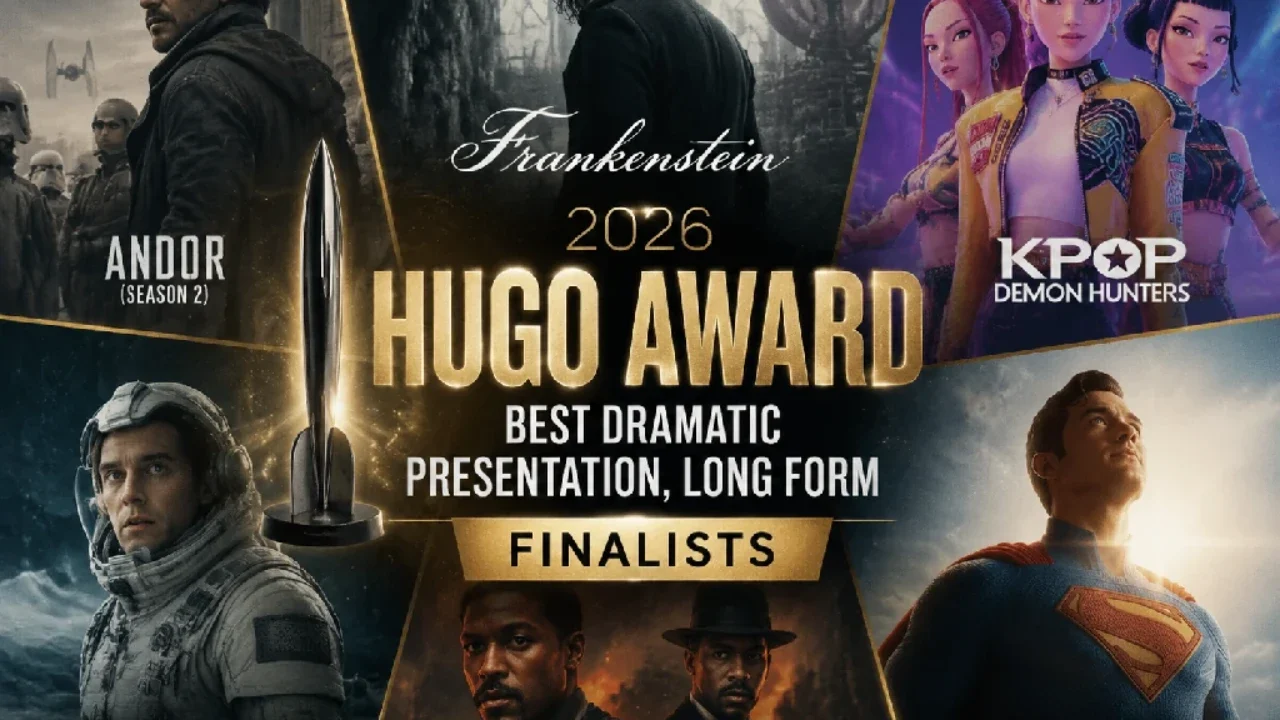
The 2026 Hugo Award for Best Dramatic Presentation, Long Form has been decided: Ryan Coogler's original period horror Sinners took the trophy at LAcon V. This retrospective ballot also includes Andor (Season 2), Guillermo del Toro's Frankenstein, KPop Demon Hunters, Bong Joon Ho's Mickey 17, and James Gunn's Superman. Weigh what each work changes or preserves, how confidently it delivers its premise, and how audiences responded before placing the winner and finalists in your own order.
-
1
Sinners
Winner of the 2026 Hugo Award for Best Dramatic Presentation, Long Form, Sinners is Ryan Coogler’s original period horror film, not an adaptation, so fidelity to a source text is not applicable. Set in 1932 Mississippi, it uses twin brothers, vampire horror, blues music, Black cultural memory, racism, and family legacy as one tightly integrated dramatic system. Audiences and critics broadly embraced its atmosphere, performances, and thematic ambition, making its win a useful benchmark for the other finalists.
Official source
-
2
Andor (Season 2)
Andor is an original Star Wars television story rather than an adaptation of a novel; its second and final season leads directly toward Rogue One. It is highly consistent with established canon while expanding the franchise through grounded espionage, organizing, surveillance, and the human cost of rebellion. Critics and viewers broadly praised its writing and political realism, though its slow-burn structure is less immediately accessible than a standalone blockbuster.
Official source
-
3
Frankenstein
Guillermo del Toro adapts Mary Shelley’s Frankenstein, keeping the creator-and-creature tragedy and Gothic moral questions while reshaping the period detail, character emphasis, and visual language for a lavish film production. Its fidelity is best described as respectful in theme but interpretive in plot and tone. Early audience conversation has highlighted the performances, creature design, and handcrafted atmosphere, with the adaptation’s deliberate stylization likely to divide viewers seeking a literal page-to-screen version.
Official source
-
4
KPop Demon Hunters
KPop Demon Hunters is an original animated musical, not an adaptation, so there is no source text to measure for fidelity. It builds its own mythology around Rumi, Mira, and Zoey, combining K-pop performance, Seoul-inspired pop culture, demon fantasy, and original songs. Viewers have responded strongly to its catchy music, expressive animation, and accessible emotional arc; rank it by the confidence of that genre fusion rather than by live-action realism.
Official source
-
5
Mickey 17
Bong Joon Ho adapts Edward Ashton’s novel Mickey7 into a darker, more visually grotesque satire about expendable worker Mickey Barnes. The film preserves the replacement-body premise and class anxiety but changes names, plot mechanics, supporting roles, and the balance between comedy and menace; fidelity is therefore moderate rather than literal. Audience reaction has often praised Robert Pattinson’s dual performance and the film’s production design, while some readers prefer the novel’s tighter internal focus.
Official source
-
6
Superman
James Gunn’s Superman is an original screen reboot built from the long-running DC Comics canon rather than a direct adaptation of one storyline. It preserves the core Superman identity, moral optimism, and familiar supporting mythology while rebalancing humor, political conflict, and a crowded ensemble for a new DC universe; its fidelity is to the character tradition, not to a single comic. Mainstream audiences have generally welcomed its warmth and accessibility, while some viewers remain divided on the busy world-building.
Official source