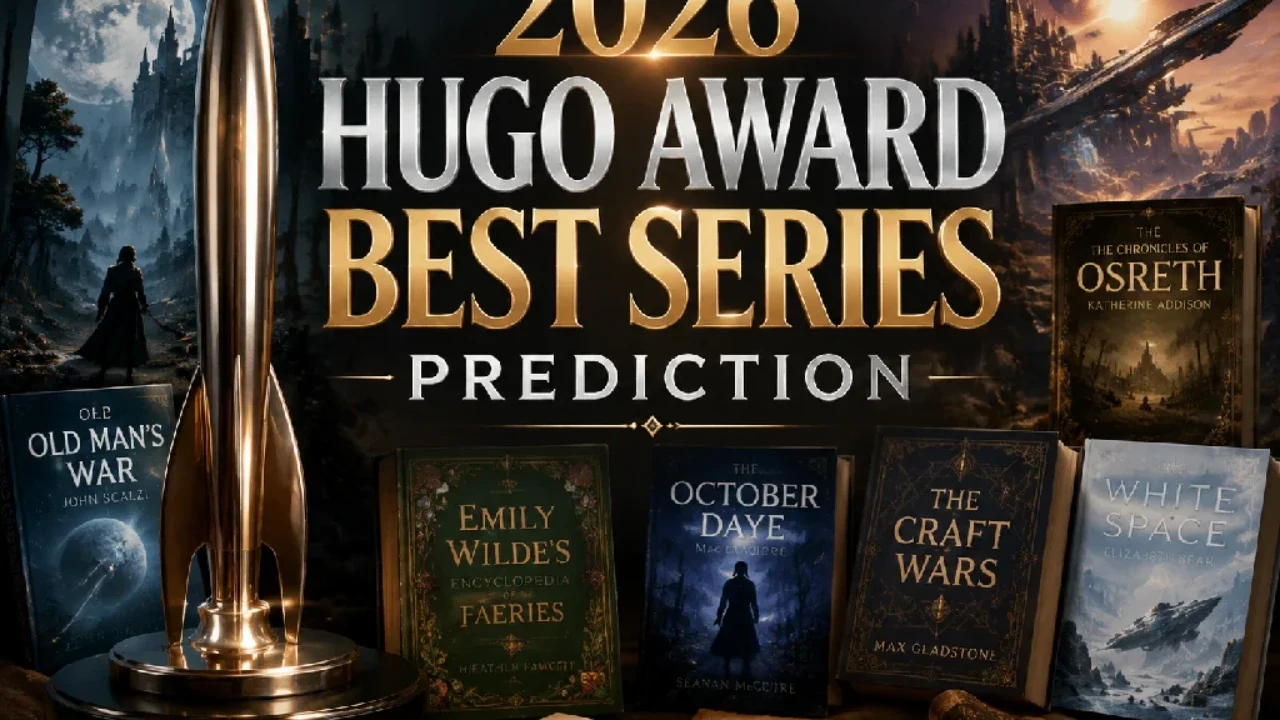
Use this book-ranking template to predict which series could stand out in the 2026 Hugo Award for Best Series conversation. Place each contender according to its strengths in sustained storytelling, imaginative scope, character arcs, thematic depth, critical momentum, and reader enthusiasm. Treat the ranking as a thoughtful forecast rather than an official ballot or result.
-
1
Emily Wilde
Heather Fawcett’s Emily Wilde series follows a brilliant, prickly scholar whose fieldwork on faeries repeatedly expands into dangerous adventures. Its appeal comes from the blend of folklore research, dry academic humor, found-family warmth, romantic tension, and carefully layered magical worldbuilding. Compared with darker epic fantasy nominees, this series offers a more intimate, whimsical, and character-driven route to faerie politics.
Official source
-
2
October Daye
Seanan McGuire’s October Daye series is a long-running urban fantasy centered on changeling knight and private investigator October “Toby” Daye. The books move between modern San Francisco and a hidden Faerie society shaped by courts, bargains, curses, and family loyalties. Its strongest ranking case is sustained continuity: recurring characters and political consequences accumulate across a broad, interconnected supernatural mystery.
Official source
-
3
Old Man's War
John Scalzi’s Old Man’s War series is military science fiction built around a striking premise: elderly humans can regain youth by joining a space-faring military. Across its novels, the series broadens from John Perry’s personal soldiering to questions of colonial policy, alien diplomacy, military command, and human identity. It suits rankings that reward accessible prose, strategic escalation, and ambitious expansion of one core idea.
Official source
-
4
The Chronicles of Osreth
Katherine Addison’s Chronicles of Osreth gathers The Goblin Emperor with The Cemeteries of Amalo trilogy in one connected fantasy world. The series contrasts imperial court politics with the quieter, morally serious investigations of Celehar, a priestly witness for the dead. Its ranking strength is tonal range: elegant worldbuilding, linguistic and ceremonial detail, compassionate attention to ordinary people, and intrigue that rarely depends on battlefield spectacle.
Official source
-
5
The Craft Wars
Max Gladstone’s Craft Wars is a tightly connected fantasy sequence set in a postindustrial world where magic operates through law, finance, contracts, and the remains of dead gods. Beginning with Tara Abernathy’s return home in Dead Country, the series escalates toward world-threatening conflict while examining power, institutions, and collective survival. It stands out for combining epic stakes with workplace satire and metaphysical systems.
Official source
-
6
White Space
Elizabeth Bear’s White Space series is sociopolitical space opera focused on interstellar travel, artificial intelligence, alien cultures, and the ethics of interdependence. Ancestral Night begins with a space salvager’s discovery that could alter the universe; later books shift attention to medical mysteries, damaged shipminds, and Baomind, a moon-sized AI. Its appeal is humane character work alongside large-scale technological and political questions.
Official source