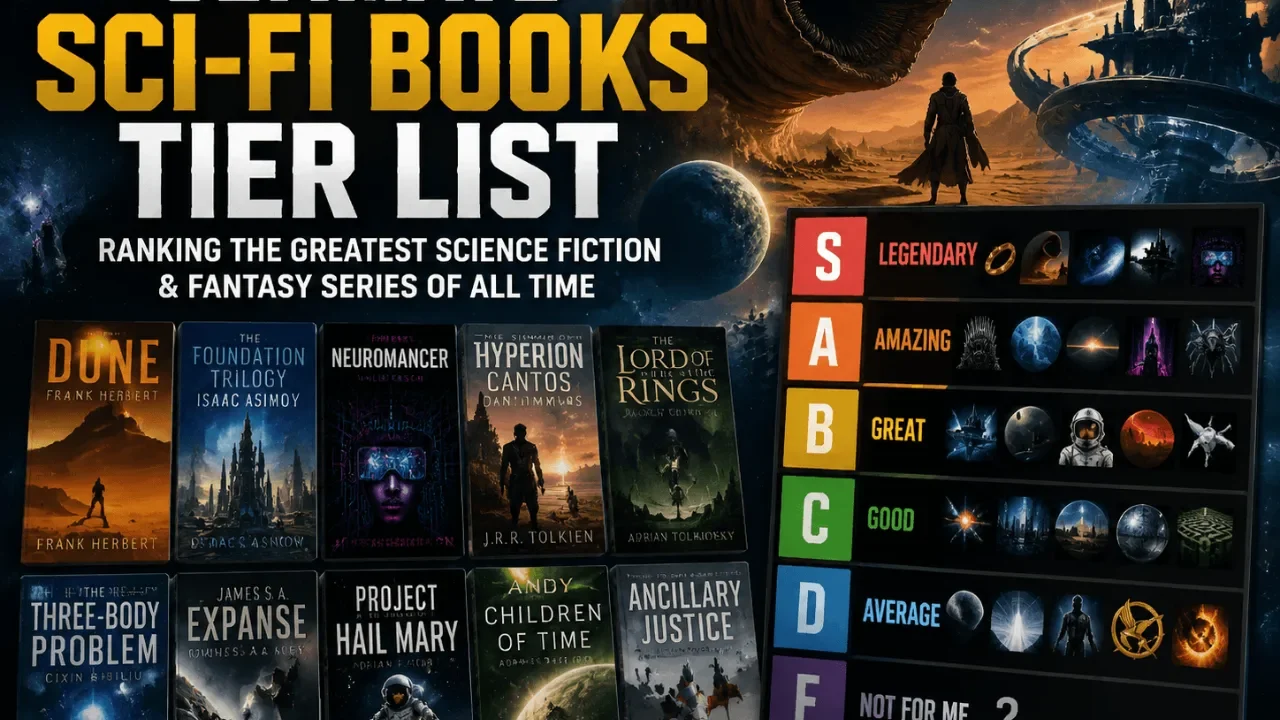
Build your ultimate science fiction books ranking by placing each novel or series into the tier that best matches your personal taste. Consider originality, setting, themes, prose, characters, emotional impact, scientific concepts, and lasting influence. The list includes acclaimed classics, modern bestsellers, crossover speculative fiction, and expansive multi-book universes.
-
1
A Song of Ice and Fire
George R. R. Martin’s epic fantasy series centers on dynastic conflict, shifting alliances, prophecy, and the supernatural threat beyond the Wall. Its sprawling ensemble includes the Starks, Lannisters, Targaryens, and many rival houses, while the five published novels move between contrasting viewpoints. Rank it for political complexity, morally ambivalent characters, historical texture, and grand-scale world-building.
Official source
-
2
Ancillary Justice
Ann Leckie’s debut combines military science fiction, space opera, and an investigation of identity. Breq is the sole surviving fragment of a starship AI, inhabiting a human body while pursuing revenge against the empire that destroyed her. Its distinctive use of pronouns and treatment of distributed consciousness make it especially valuable to rank beside more conventional galactic-war novels.
Official source
-
3
Artemis
Andy Weir’s near-future thriller follows Jasmine “Jazz” Bashara, a smuggler living in Artemis, humanity’s first city on the Moon. Unlike the isolated survival engineering of The Martian, this novel emphasizes lunar infrastructure, criminal logistics, technical improvisation, and a conspiracy threatening the colony’s control. Rank it for accessible science, a heist structure, brisk pacing, and its sharply voiced protagonist.
Official source
-
4
Blindsight
Peter Watts’s hard-SF novel sends the research vessel Theseus to investigate an unidentified signal from the outer Solar System and confront an unsettling form of first contact. Its crew includes heavily modified humans and a vampire captain, but the deeper focus is consciousness: whether intelligence, empathy, and subjective awareness are truly linked. Rank it for conceptual density, biological detail, and philosophical severity.
Official source
-
5
Children of Time
Adrian Tchaikovsky’s novel alternates between the last remnants of humanity aboard an ark ship and a civilization of uplifted spiders evolving on a terraformed planet. The opposing timelines span generations and turn first contact into a comparison between human survival instincts and radically different social intelligence. Rank it for evolutionary imagination, multi-generational scale, ecological thinking, and its unusual nonhuman perspectives.
Official source
-
6
Divergent
Veronica Roth’s dystopian debut follows Beatrice Prior, a teenager choosing among five factions that organize futuristic Chicago around traits such as honesty, selflessness, bravery, peace, and intelligence. Her hidden Divergent identity challenges the system’s demand for conformity. Rank it for immediate YA momentum, faction-based world-building, coming-of-age tension, and its emphasis on choice, loyalty, courage, and self-definition.
Official source
-
7
Dune
Frank Herbert’s landmark science-fiction novel follows Paul Atreides after his family is betrayed on Arrakis, the desert planet that produces the universe’s most valuable substance, spice melange. It combines dynastic politics, ecological transformation, mysticism, warfare, and messianic expectation. Rank it for foundational world-building, political depth, environmental themes, symbolic richness, and influence across modern science fiction.
Official source
-
8
Ender's Game
Orson Scott Card’s military science-fiction novel places Andrew “Ender” Wiggin in a battle-school program designed to prepare child geniuses for a possible alien attack. Training games, simulated battles, isolation, and manipulation blur the boundary between education and warfare. Rank it for strategic set pieces, psychological pressure, ethical ambiguity, and its contrast between Ender’s tactical brilliance and emotional vulnerability.
Official source
-
9
Leviathan Wakes
James S. A. Corey's opening Expanse novel combines detective noir with political space opera. A missing-person case pulls a washed-up detective and an ice-hauler captain into a conspiracy threatening a colonized solar system. Compared with more philosophical science fiction, it emphasizes momentum, factional tension, flawed heroes, and the practical consequences of humanity spreading across nearby worlds.
Official source
-
10
Neuromancer
William Gibson's landmark cyberpunk novel follows Case, a disgraced data thief hired for a dangerous heist in cyberspace. Its defining strengths are dense street-level atmosphere, artificial intelligence, corporate power, body modification, and the Matrix as a vivid digital frontier. Unlike military or exploration-focused science fiction, Neuromancer ranks highly for style, cultural influence, and its revolutionary vision of networked life.
Official source
-
11
Old Man's War
John Scalzi's military science-fiction debut begins with a provocative bargain: elderly Earth citizens can enlist, receive rejuvenated combat bodies, and fight for human colonies. John Perry's service turns that premise into fast-moving action while examining identity, aging, obedience, and the moral cost of perpetual war. It is more accessible and bantering than many classic military-SF counterparts, without abandoning serious ethical questions.
Official source
-
12
Project Hail Mary
Andy Weir's standalone novel is a science-driven survival mystery about Ryland Grace, who awakens alone aboard a spacecraft with no memory of his mission. The story rewards readers who enjoy orbital mechanics, engineering puzzles, and incremental problem-solving more than sweeping political worldbuilding. Its ranking appeal comes from pairing rigorous technical improvisation with an unusually warm first-contact relationship.
Official source
-
13
Ready Player One
Ernest Cline's debut novel places Wade Watts in a bleak 2045, where most people escape into the OASIS, an enormous virtual world. After its creator dies, a contest built around puzzles and decades of pop culture determines who inherits control. Compared with darker cyberpunk, it is more playful, nostalgic, game-structured, and driven by a conventional adventure quest.
Official source
-
14
Red Rising Saga
Pierce Brown's Red Rising Saga follows Darrow, a member of an oppressed mining caste who becomes the catalyst for rebellion against a rigid color-coded hierarchy. The series blends Roman-inspired social structure, military academies, insurgency, and large-scale space warfare. It stands apart from quieter dystopian fiction through its relentless escalation, operatic stakes, betrayals, and emphasis on revolutionary momentum.
Official source
-
15
Revelation Space Series
Alastair Reynolds's Revelation Space universe is hard science fiction on an immense timescale, built around relativistic travel, ancient civilizations, archaeological mysteries, and the threat of posthuman extinction. Because faster-than-light travel is absent, distance and delay shape both strategy and emotion. It is a strong choice for readers who prefer dense cosmic history and scientifically constrained space opera over near-future adventure.
Official source
-
16
Snow Crash
Neal Stephenson's Snow Crash mixes cyberpunk, satire, linguistics, virtual reality, and corporate sovereignty into a deliberately maximalist future. Hiro Protagonist works as both hacker and pizza-delivery freelancer before confronting a threat that links ancient language, computer viruses, and the Metaverse. Compared with Neuromancer's noir intensity, Snow Crash is louder, faster, more comic, and more openly interested in ideas.
Official source
-
17
The Book of the New Sun
Gene Wolfe’s five-volume science-fantasy sequence follows Severian, a disgraced torturer wandering a far-future Earth whose technology is mistaken for magic. Rank it highly for unreliable narration, dense symbolism, archaic atmosphere, and rewards that deepen on rereading. Compared with more straightforward space opera, this is deliberately demanding, literary, and built around interpretation as much as adventure.
Official source
-
18
The Broken Earth Trilogy
N. K. Jemisin’s trilogy is set on a continent repeatedly shattered by catastrophic seismic events, where earth-moving power is feared, exploited, and weaponized. Its strongest ranking case is the combination of inventive second-person narration, systemic oppression, fractured family relationships, and a world whose geology shapes every political conflict. It is more intimate and structurally daring than conventional epic fantasy.
Official source
-
19
The Expanse Series
James S. A. Corey’s series begins with humanity spread across Earth, Mars, and the asteroid belt, then expands into a large-scale conflict involving alien technology and new worlds. It earns ranking points for practical space travel, shifting political alliances, ensemble character work, and escalating scope. Compared with more abstract space opera, its tensions often grow from economics, military power, and believable logistics.
Official source
-
20
The Foundation Series
Isaac Asimov’s Foundation saga centers on psychohistory, a fictional science that models the behavior of vast populations and anticipates the collapse of a twelve-thousand-year Galactic Empire. Its defining strength is civilizational scale: ideas, institutions, and historical momentum often matter more than individual combat. Rank it above character-driven epics when you value grand strategy, scientific speculation, and long-range social consequences.
Official source
-
21
The Hitchhiker's Guide to the Galaxy
Douglas Adams’s comic science-fiction novel follows Arthur Dent after Earth is destroyed, sending him through an absurd universe of alien bureaucracy, impossible technology, and philosophical jokes. It belongs high in a ranking for wit, memorable concepts, and relentless tonal control rather than hard scientific realism. Compared with solemn cosmic epics, its appeal comes from treating existential disaster as an opportunity for satire.
Official source
-
22
The Hunger Games
Suzanne Collins’s dystopian novel places Katniss Everdeen in Panem’s televised fight to the death, using a survival plot to examine propaganda, inequality, spectacle, and moral compromise. Its ranking strength is immediacy: the political critique is embedded in tense decisions rather than delivered as exposition. Compared with broader multi-generation sagas, it offers a tighter protagonist-centered story with unusually strong media and power themes.
Official source
-
23
The Hyperion Cantos
Dan Simmons’s Hyperion Cantos combines pilgrimage narrative, military science fiction, religious imagery, time distortion, and literary allusion across a far-future interstellar civilization. The opening novel is especially distinctive because multiple travelers recount sharply different stories before the larger mystery converges. Rank it for ambition and variety, while noting that its structure and changing genres make it less uniform than a conventional space-opera series.
Official source
-
24
The Left Hand of Darkness
Ursula K. Le Guin’s novel follows envoy Genly Ai on Gethen, a world whose inhabitants are ambisexual, making gender, politics, intimacy, and cultural assumptions central to the story. Its ranking value lies in combining anthropological worldbuilding with a quiet survival journey and a demanding examination of prejudice. Compared with action-heavy space opera, it is slower, more reflective, and unusually focused on social perception.
Official source
-
25
The Lord of the Rings
J.R.R. Tolkien’s epic fantasy follows Frodo Baggins and a fellowship tasked with destroying the One Ring before Sauron can reclaim it. Its sweeping journey across Middle-earth, invented languages, layered mythology, songs, and moral focus on humility and power make it a foundational choice for readers ranking world-building and classic quest narratives.
Official source
-
26
The Martian
Andy Weir’s survival thriller strands astronaut Mark Watney alone on Mars after his crew believes him dead. Watney must stretch limited supplies, repair damaged equipment, grow food, and devise communication and rescue plans through applied science and improvisation. Rank it highly for technical problem-solving, fast pacing, dry humor, and a grounded human-versus-environment premise.
Official source
-
27
The Maze Runner
James Dashner’s young-adult dystopian novel opens with Thomas waking in an enclosed community with no memories beyond his name. Surrounded by towering walls and an ever-changing maze that has claimed previous explorers, Thomas and the Gladers must decode their environment while facing escalating danger. It suits rankings focused on suspense, survival stakes, mystery, and accessible science-fiction adventure.
Official source
-
28
The Three-Body Problem
Cixin Liu’s first novel in the Remembrance of Earth’s Past trilogy blends scientific mystery, political trauma, virtual-reality investigation, and first contact. Physicist Wang Miao becomes entangled in unexplained deaths and a strange game that models an unstable world governed by three suns. Rank it for conceptual ambition, cosmic scale, unsettling ideas about civilization, and hard-science-fiction scope.
Official source