Technology
AI Software Ranking Tier List Template
Rank popular AI software and tools by output quality, usefulness, ease of use, features, value, or workflow fit.
15 preloaded items
Technology
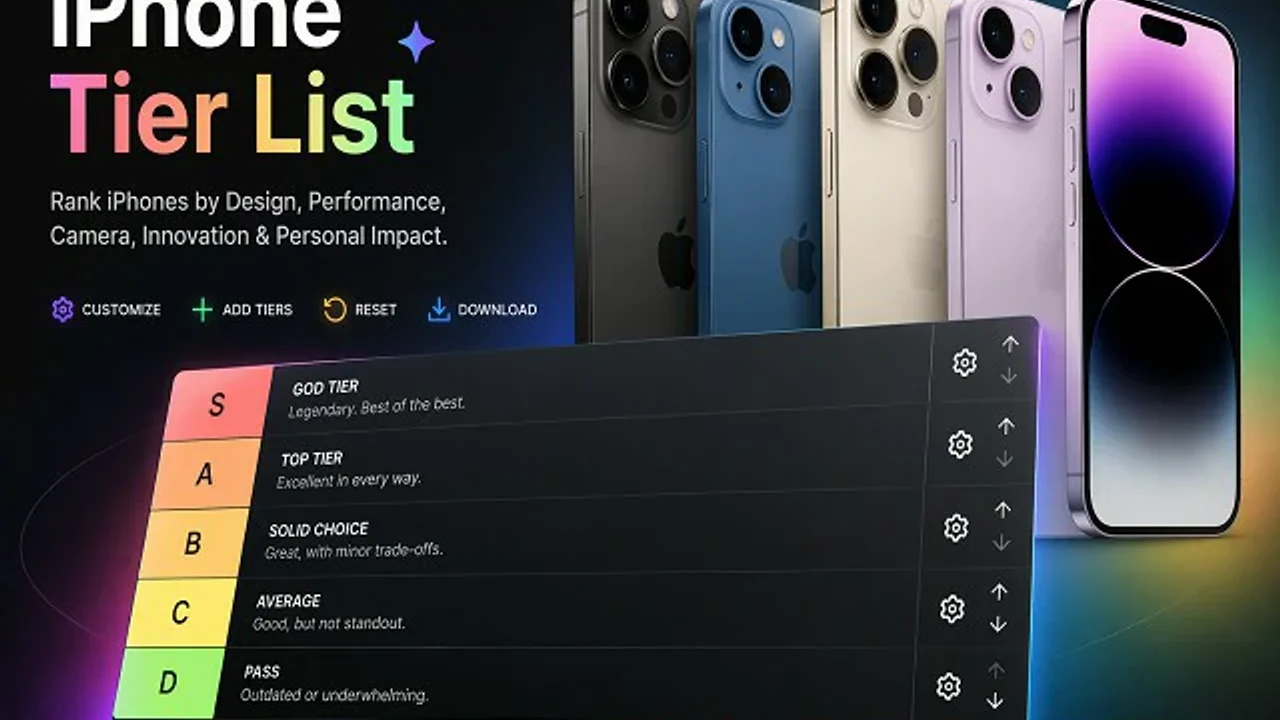
iPhone combines fast performance, long software support, a connected ecosystem, and intuitive design. Compare 34 models by cameras, battery life, and value.
Best iPhone Models comes with preloaded items so you can begin ranking immediately, but the board is still flexible enough to reflect your own criteria.
Note: This tier list is for temporary editing. The system template may update, while images and text you add are saved in this browser and can be restored after a refresh or when you reopen the page.
Inside the template
Which iPhone is the best depends on what matters most to you. Compare 34 major models from the original iPhone to iPhone 17 Pro by chip performance, cameras, battery life, software longevity, ecosystem fit, industrial design, innovation, market impact, and value. You can reward current everyday capability, historical importance, or the model that offered the strongest balance in its own era.
Editorial review: 2026-09-08
iPhone 17 Pro is Apple's 2025 professional model, combining a 6.3-inch ProMotion display with an A19 Pro chip, a heat-forged aluminum unibody, and vapor-chamber cooling for stronger sustained performance. Its three 48MP Fusion cameras cover Main, Ultra Wide, and Telephoto roles, with the new Telephoto system offering 4x optical and 8x optical-quality framing for substantially greater reach. An 18MP Center Stage front camera, ProRes RAW, Apple Log 2, and genlock support make it particularly capable for coordinated and professional video production. The regular Pro offers storage up to 1TB, while 2TB is reserved for Pro Max, so the two sizes should not be treated as identical configurations. Its higher price and weight make it excessive for casual use, but creators, mobile gamers, and users who need sustained performance or the broadest camera range gain the clearest benefit.
Official sourceiPhone 17 is Apple's standard 2025 model, pairing the A19 chip and 256GB of base storage with a 6.3-inch display that finally brings ProMotion up to 120Hz and Always-On capability to the mainstream line. Its 48MP Dual Fusion system combines Main and Ultra Wide cameras with 2x optical-quality framing and macro capture, while the 18MP Center Stage front camera offers more flexible selfies and video calls. Counterpoint Research measured base iPhone 17 sell-through nearly one-third above iPhone 16 during the first ten days in China and the US, making it the main driver of the new series' 14% gain over its predecessor. It lacks the Pro model's dedicated Telephoto camera and creator formats, but the improved display, higher starting storage, capable cameras, and strong battery life make it the most broadly balanced model in the generation.
Official sourceiPhone Air is Apple's design-led 2025 model, measuring just 5.6mm thick and weighing 165 grams while still offering a 6.5-inch ProMotion display, titanium construction, and an A19 Pro chip. Its single 48MP Fusion Main camera supplies 1x and 2x framing, while the 18MP Center Stage front camera improves selfies and flexible portrait-or-landscape video calls. Counterpoint Research found its early US sell-through slightly ahead of iPhone 16 Plus during the first ten days, but also expected the high price and narrower feature set to keep it relatively niche. It is an excellent choice for buyers who prioritize thinness, low weight, and a large smooth display, but the absence of Ultra Wide and dedicated Telephoto cameras limits photographic flexibility.
Official sourceIntroduced in 2025 as the lower-priced entry to the iPhone 16 family, iPhone 16e combines a 6.1-inch OLED display with the A18 chip, Apple Intelligence support, an Action button, USB-C, and Apple's first C1 cellular modem. Its single 48MP Fusion camera provides 1x and 2x optical-quality framing, and the efficient hardware delivers strong battery life for this size. It omits MagSafe, Camera Control, Dynamic Island, and an Ultra Wide camera, so its feature set is deliberately narrower than the standard iPhone 16. Counterpoint Research ranked it sixth worldwide in March 2025, its first full month of sales, making it a credible ecosystem entry point rather than a direct replacement for users who need multiple cameras.
Official sourceiPhone 16 Pro is Apple's 2024 professional model, expanding to a 6.3-inch ProMotion display while retaining a titanium frame and adding the A18 Pro chip and Camera Control. The camera system combines a 48MP Fusion Main camera, a 48MP Ultra Wide camera, and a 5x Telephoto lens, bringing the longer zoom to the smaller Pro for the first time. It can record 4K Dolby Vision at up to 120 fps, making slow motion, color work, and external production workflows major strengths. Counterpoint Research ranked it third among smartphones worldwide in Q1 2025; its larger, heavier, and more expensive body is the trade-off for users who want advanced video and a complete zoom range.
Official sourceiPhone 16 is Apple's 2024 mainstream model, using the A18 chip to support Apple Intelligence while adding both the Action button and Camera Control. Its 48MP Fusion Main camera offers a 2x optical-quality option, and the autofocus Ultra Wide camera adds macro and spatial capture to the standard line. Counterpoint Research ranked iPhone 16 as the world's best-selling smartphone of 2025, after it had already taken first place globally in Q1 of that year. The aluminum body, 60Hz display, and lack of a dedicated Telephoto lens keep it below the Pro model, but its performance, camera versatility, and broad market acceptance make it one of the most balanced recent iPhones.
Official sourceiPhone 15 Pro launched in 2023 with a lighter titanium frame, the A17 Pro chip, an Action button, and a 6.1-inch ProMotion display. USB-C supports USB 3 transfer speeds up to 10Gb/s, making large ProRAW and ProRes files far easier to move than on earlier Lightning-equipped Pro models. Its 48MP Main, Ultra Wide, 3x Telephoto, and LiDAR system supports advanced capture formats, while the A17 Pro also adds hardware-accelerated ray tracing for demanding games. The regular 15 Pro does not receive the 5x lens found on 15 Pro Max, but it is the better fit for users who want creator-oriented performance and fast data transfer in a smaller flagship.
Official sourceReleased in 2023, iPhone 15 brings the Dynamic Island, USB-C, and a 48MP Main camera to Apple's mainstream 6.1-inch model. The A16 Bionic chip remains fast, while the Main camera adds a useful 2x optical-quality option and automatic depth capture for more flexible portraits. Counterpoint Research ranked it as the world's best-selling smartphone of 2024, ahead of every other individual model. Its display remains limited to 60Hz, USB-C transfers run at USB 2 speeds, and there is no dedicated Telephoto camera, but the lighter aluminum build and well-rounded feature set make it an easy everyday recommendation.
Official sourceiPhone 14 Pro is Apple's 2022 professional model, introducing the Dynamic Island and Always-On display alongside adaptive ProMotion up to 120Hz. The A16 Bionic chip powers a new 48MP Main camera, with Ultra Wide, 3x Telephoto, LiDAR, Apple ProRAW, and ProRes completing the imaging system. Emergency SOS via satellite and Crash Detection add practical safety features beyond the camera and display upgrades. Its stainless steel body is heavy and Lightning limits file-transfer convenience, but the display design and 48MP sensor make it a more consequential generation than the standard iPhone 14.
Official sourceIntroduced in 2022, iPhone 14 refines the mainstream formula with a 6.1-inch OLED display, the five-core-GPU version of A15 Bionic, and an aluminum frame. A brighter Main camera, autofocus on the front camera, Photonic Engine processing, Crash Detection, and Emergency SOS via satellite are its most meaningful additions. Counterpoint Research ranked iPhone 14 as the world's best-selling smartphone of 2023. Its similarities to iPhone 13 are substantial, and it still lacks ProMotion, Dynamic Island, and a Telephoto camera, so its strongest case is reliability and safety rather than a major leap in design or performance.
Official sourceThe third-generation iPhone SE arrived in 2022 with the A15 Bionic chip and 5G, but retained the 4.7-inch LCD, Home button, and Touch ID layout of its predecessor. Its single 12MP camera benefits from Smart HDR 4, Photographic Styles, and Deep Fusion, while IP67 protection and Qi wireless charging remain useful everyday features. Counterpoint Research ranked it tenth among smartphones worldwide for 2022, giving the compact Touch ID format a place in that year's global top ten. The dated screen proportions, modest battery, and lack of Night mode, MagSafe, and an Ultra Wide camera make the design feel constrained, but it remains a focused choice for users who value familiar controls and long software support.
Official sourceiPhone 13 Pro launched in 2021 with the A15 Bionic chip, a stainless steel frame, and the first iPhone display to support adaptive ProMotion refresh rates up to 120Hz. Its triple-camera system adds macro photography, a 3x Telephoto camera, improved low-light capture, LiDAR, Apple ProRAW, and ProRes video. Strong battery life and storage options reaching 1TB make it suitable for sustained shooting and demanding apps. The steel body is noticeably heavy and the phone still uses Lightning, but its compact size, smooth display, and versatile cameras make it one of the most complete pre-USB-C Pro models.
Official sourceIntroduced in 2021, iPhone 13 combines the A15 Bionic chip with a brighter 6.1-inch OLED display, 128GB of base storage, and noticeably better battery life than iPhone 12. Its dual cameras add sensor-shift stabilization, Photographic Styles, and Cinematic mode, while the smaller notch leaves slightly more usable screen space. Counterpoint Research ranked it as the world's best-selling smartphone of 2022, reflecting the broad appeal of its balanced hardware and pricing. A 60Hz display and no dedicated Telephoto camera separate it from the Pro model, but it remains one of the strongest all-round choices for performance, endurance, and value.
Official sourceiPhone 12 mini arrived in 2020 as Apple's smallest full-screen 5G iPhone, pairing a 5.4-inch Super Retina XDR OLED display with the A14 Bionic chip in a 133-gram body. Its flat-edged aluminum design introduced Ceramic Shield and MagSafe, while the dual Wide and Ultra Wide cameras support Night mode and Dolby Vision video. Performance and camera quality are close to the standard iPhone 12, so the smaller size does not require a slower processor or a reduced camera set. Battery endurance is its main weakness, but for buyers who value pocketability and true one-handed use, it remains one of Apple's most distinctive compact phones.
Official sourceiPhone 12 Pro is a 2020 flagship built around the A14 Bionic chip, a 6.1-inch Super Retina XDR OLED display, a stainless steel frame, 5G, and MagSafe. Its Wide, Ultra Wide, and 2x Telephoto cameras are joined by LiDAR, which improves low-light autofocus and enables Night mode portraits. Apple ProRAW, Dolby Vision recording, and storage up to 512GB give photographers and video creators more control than the standard iPhone 12. The heavy steel build, 60Hz display, and relatively short 2x zoom limit its modern appeal, but it remains an important bridge between the classic Pro design and Apple's later computational-photography workflow.
Official sourceReleased in 2020, the second-generation iPhone SE places the A13 Bionic chip from the iPhone 11 family inside the familiar 4.7-inch iPhone 8 design. It retains a Home button and Touch ID while adding Portrait mode, 4K video, IP67 water resistance, and wireless charging around a single 12MP rear camera. The small LCD, modest battery, and absence of Night mode, Ultra Wide, and 5G are the main compromises. It suits buyers who prefer one-handed use, fingerprint authentication, and a lower entry price, but its older chassis offers less screen and camera flexibility than contemporary full-screen iPhones.
Official sourceiPhone 11 Pro launched in 2019 as the first iPhone to carry the Pro name, combining the A13 Bionic chip with a compact 5.8-inch Super Retina XDR OLED display and stainless steel frame. It was also the first iPhone generation to use a triple-camera system, adding an Ultra Wide and 2x Telephoto camera around the main Wide camera. Improved battery life, Night mode, and 4K60 recording across all three rear cameras made it a substantial photography upgrade. Its 64GB starting capacity, Lightning port, and lack of 5G have aged, but it remains notable for fitting a complete flagship camera system into a genuinely compact body.
Official sourceIntroduced in 2019 as the mainstream successor to iPhone XR, iPhone 11 pairs the A13 Bionic chip with a 6.1-inch Liquid Retina LCD. Its dual 12MP Wide and Ultra Wide cameras expand framing options, while Night mode and 4K video at up to 60 fps make it much more capable after dark and with moving subjects. The aluminum frame and LCD are less premium than iPhone 11 Pro, and the phone lacks both a dedicated Telephoto camera and 5G. Dependable battery life, an approachable size, and a straightforward camera system make it a strong everyday-value choice, although newer models offer sharper displays and faster connectivity.
Official sourceReleased in 2018, iPhone XR brought the all-screen design and Face ID experience to a lower starting price than the premium iPhone XS models. It used a larger 6.1-inch Liquid Retina LCD rather than OLED, paired with the A12 Bionic chip, wireless charging, and Dual SIM support. A single 12-megapixel rear camera still offered Portrait mode through computational photography, while six vivid finishes gave the phone a distinct identity. The LCD, aluminum frame, and lack of a telephoto camera were clear tradeoffs, but its large display, modern processor, and colorful design made it a well-balanced mainstream option.
Official sourceIntroduced in 2018, iPhone XS directly refined the iPhone X formula with the same compact 5.8-inch OLED display, Face ID, stainless-steel frame, and dual-camera layout. The A12 Bionic chip improved performance and efficiency, while Smart HDR and adjustable Portrait depth expanded the camera's computational capabilities. Faster Face ID and Dual SIM support also made the experience more flexible in daily use. Compared with iPhone XR, it offered OLED contrast, a dedicated telephoto camera, and more premium materials, but its value rests on polish and compact flagship quality rather than another dramatic design change.
Official sourceIntroduced in 2017 for the iPhone's tenth anniversary, iPhone X replaced the Home button with a 5.8-inch edge-to-edge OLED Super Retina display. Its TrueDepth camera system introduced Face ID, while gesture navigation, Animoji, wireless charging, and the A11 Bionic neural engine reshaped the everyday experience. Dual rear cameras with optical image stabilization and a glass-and-stainless-steel body reinforced its flagship positioning. Losing Touch ID required users to learn a new navigation and authentication model, but the all-screen layout and Face ID established the design direction followed by later flagship iPhones.
Official sourceReleased in 2017, iPhone 8 preserved the classic 4.7-inch screen, Home button, and Touch ID while replacing the aluminum rear panel with glass. The new construction enabled Qi wireless charging, and the A11 Bionic chip provided stronger performance and enhanced augmented-reality capabilities. Its Retina HD display added True Tone, automatically adapting color temperature to surrounding light. Arriving alongside iPhone X, it offered a familiar alternative to gesture navigation and Face ID, making it the most polished evolution of the traditional iPhone design rather than the year's most radical model.
Official sourceIntroduced in 2016, iPhone 7 modernized the familiar 4.7-inch design with water and dust resistance, stereo speakers, a wide-color Retina HD display, and a pressure-sensitive solid-state Home button. Its A10 Fusion chip improved performance, while the 12-megapixel camera gained optical image stabilization and a brighter f/1.8 aperture. It was also the first iPhone to remove the 3.5-millimeter headphone jack, pushing listening toward Lightning and wireless accessories. The durability, audio, and camera improvements were meaningful, but the connector change makes this one of the lineup's more consequential and divisive transitions.
Official sourceReleased in 2016, the first-generation iPhone SE combined the compact 4-inch enclosure of iPhone 5s with much newer hardware from the iPhone 6s era. Its A9 chip and 12-megapixel camera supported Live Photos and 4K video, while Touch ID and Apple Pay preserved important modern conveniences. It deliberately favored a smaller display and familiar design over the larger 4.7-inch direction of the main lineup. For users who value one-handed use and pocketability, it offered unusually strong performance in a small body and established the enduring SE formula of newer internals in an older design.
Official sourceIntroduced in 2015, iPhone 6s refined the familiar 4.7-inch iPhone 6 design with stronger 7000-series aluminum and a faster A9 chip. Its rear camera increased to 12 megapixels and added 4K video, while Live Photos captured movement and sound around a still image. The new 3D Touch display responded to different pressure levels, creating shortcuts and preview interactions across iOS. It was not a visual redesign, but its stronger construction, camera leap, and ambitious interaction system make it a substantial upgrade within the classic Home-button format.
Official sourceReleased in 2014, iPhone 6 marked Apple's move from compact 4-inch phones to a larger 4.7-inch Retina HD display. Its rounded aluminum body housed the A8 chip, an 8-megapixel camera, Touch ID, and support for Apple Pay. The larger screen offered substantially more room for apps, photos, and video while remaining smaller than the 5.5-inch Plus model. Users who value maximum pocketability may prefer the earlier form factor, but iPhone 6 is historically important for making a larger display the mainstream iPhone format.
Official sourceReleased in 2013 as the premium counterpart to iPhone 5c, iPhone 5s placed major new technology inside the compact iPhone 5 design. Its A7 made it the first smartphone with a 64-bit desktop-class architecture, while the M7 motion coprocessor handled data from the device's sensors. Touch ID introduced fingerprint-based unlocking and authorization, and the improved 8-megapixel iSight camera added a True Tone flash. Its 4-inch screen is small by later standards, but its advances in processing architecture, security, and compact flagship design make it one of the most consequential S-generation models.
Official sourceIntroduced in 2013, iPhone 5c repackaged the core performance of iPhone 5 in a colorful polycarbonate enclosure reinforced by an internal steel frame. It retained the 4-inch Retina display and A6 chip while adding a FaceTime HD camera, iOS 7, and support for as many as 13 LTE bands. Its vivid finishes gave the lineup a more playful identity and clearly separated it from the premium iPhone 5s. The tradeoff was older silicon and a less luxurious exterior, so it ranks best for color, personality, and Apple's product-line strategy rather than peak performance.
Official sourceReleased in 2012, iPhone 5 introduced a taller 4-inch Retina display without increasing the phone's width, preserving comfortable one-handed use while showing more content. Its 7.6-millimeter anodized aluminum body was thinner and lighter, while the A6 chip and LTE support delivered major gains in speed and connectivity. It also introduced the smaller Lightning connector, beginning a new accessory standard for the iPhone lineup. The required connector transition was a practical tradeoff, but its light construction, wider network support, and carefully enlarged display made it an influential portability-focused redesign.
Official sourceIntroduced in 2011, iPhone 4s retained the glass-and-steel form of iPhone 4 but substantially upgraded its internal hardware. The dual-core A5 chip improved performance, while the redesigned camera delivered better optics and 1080p HD video recording. It was also the first iPhone with Siri, and its launch alongside iOS 5 and iCloud made voice assistance and cloud synchronization central parts of Apple's ecosystem. The unchanged exterior makes it less visually transformative than iPhone 4, but Siri, iCloud, and its camera improvements give it considerable historical importance.
Official sourceReleased in 2010, iPhone 4 introduced a sharply different glass-and-stainless-steel enclosure and Apple's high-resolution Retina display. Its A4 chip, 5-megapixel camera with LED flash, 720p HD video recording, FaceTime camera, and three-axis gyroscope represented a broad hardware advance. iOS 4 added multitasking, folders, and other features that made the software feel more mature. The compact display and aging internals limit it today, but its industrial design, screen clarity, and camera upgrades make it one of the clearest generational leaps in iPhone history.
Official sourceIntroduced in 2009, iPhone 3GS emphasized speed and capability while keeping the familiar exterior of iPhone 3G. Apple described it as up to twice as fast as its predecessor, and it added a 3-megapixel autofocus camera, video recording, voice control, and longer battery life. iPhone OS 3.0 also brought practical features such as Cut, Copy, Paste, MMS, and Spotlight Search. It lacks the visual novelty of a full redesign, but it is a strong example of an S-generation delivering a noticeably faster and more complete everyday experience.
Official sourceReleased in 2008, iPhone 3G retained the original model's 3.5-inch touch-first design while adding faster 3G cellular networking, built-in GPS, and iPhone 2.0 software. Its most important change was access to the new App Store, which allowed users to download native third-party applications wirelessly. A substantially lower starting price and expanded connectivity made the iPhone concept accessible to a broader audience. The upgrade focused more on networking and the software ecosystem than on exterior design, making it a pivotal platform milestone rather than a dramatic hardware reinvention.
Official sourceIntroduced in January 2007 and released in the United States on June 29, the original iPhone combined a mobile phone, a widescreen iPod, and an internet communicator in one device. Its 3.5-inch multi-touch display replaced a conventional physical keyboard with direct touch controls, while Wi-Fi, EDGE, Bluetooth 2.0, and visual voicemail shaped the early experience. The hardware is extremely limited by later standards, especially its EDGE-only cellular connection, but its interface and product concept established the foundation for every subsequent iPhone. It belongs near the top when ranking historical influence and design significance, even though it is no longer competitive on practical capability.
Official sourceBest iPhone Models comes with preloaded items so you can begin ranking immediately, but the board is still flexible enough to reflect your own criteria.
Technology
Rank popular AI software and tools by output quality, usefulness, ease of use, features, value, or workflow fit.
15 preloaded items
Technology
Rank air conditioner brands by cooling performance, efficiency, reliability, noise, service, value, or personal experience.
14 preloaded items
Technology
Rank car brands by design, performance, reliability, technology, comfort, value, or your personal ownership experience.
52 preloaded items
Technology
Rank electric vehicle brands by range, charging, software, performance, design, reliability, value, or ownership appeal.
15 preloaded items